Evan Gough
Evan Gough is a science-loving guy with no formal education who loves Earth, forests, hiking, and heavy music. He's guided by Carl Sagan's quote: "Understanding is a kind of ecstasy."
Recent Articles
-
-
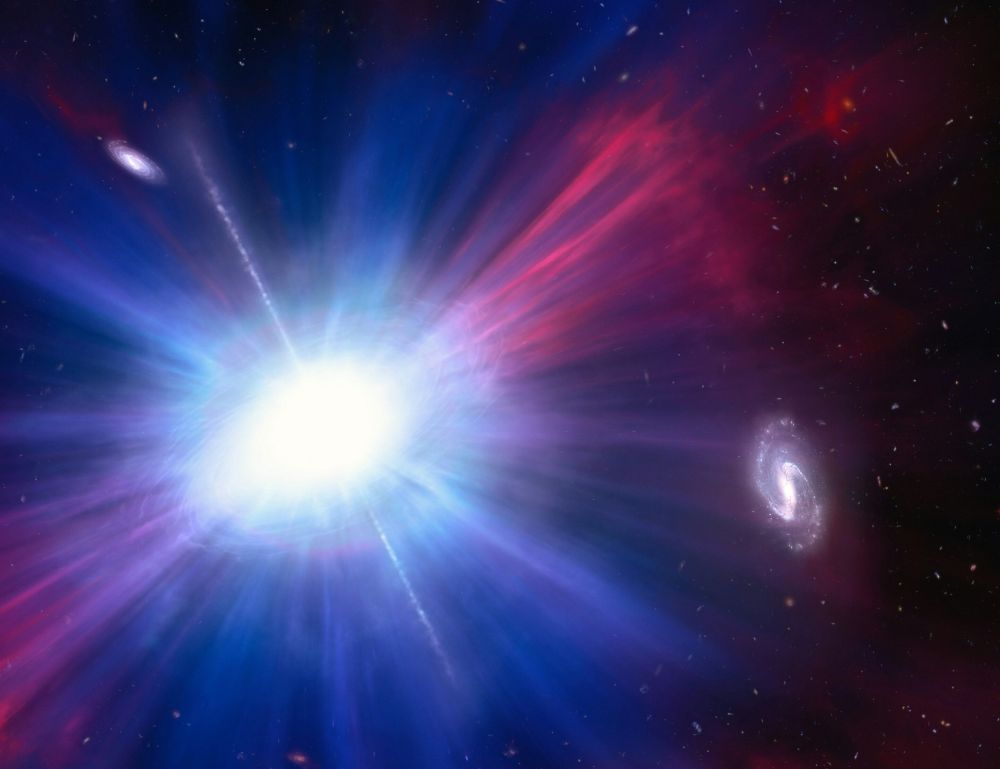
Luminous Fast Blue Optical Transients Are Likely Large Black Holes Shredding Their Massive Companions
December 18, 2025In 2024, astronomers discovered the brightest Luminous Fast Blue Optical Transient (LFBOT) ever observed. LFBOTs are extremely bright flashes of blue light that shine for brief periods before fading away. New analysis of this record-breaking burst, which includes observations from the International Gemini Observatory, funded in part by the U.S. National Science Foundation, challenges all prior understanding of these rare explosive events.
-
The JWST Found A Jekyll-and-Hyde Galaxy In The Early Universe
December 18, 2025In a glimpse of the early universe, astronomers have observed a galaxy as it appeared just 800 million years after the Big Bang – a cosmic Jekyll and Hyde that looks like any other galaxy when viewed in visible and even ultraviolet light but transforms into a cosmic beast when observed at infrared wavelengths. This object, dubbed Virgil, is forcing astronomers to reconsider their understanding of how supermassive black holes grew in the infant universe.
-
Comet 3I/ATLAS Has A Green Glow In New Color Images From Gemini North
December 17, 2025Gemini North captured new images of Comet 3I/ATLAS after it reemerged from behind the Sun on its path out of the Solar System. The data were collected during a Shadow the Scientists session — a unique outreach initiative that invites students around the world to join researchers as they observe the Universe on the world’s most advanced telescopes.
-
The First Alien Civilization We Encounter Will Be Extremely Loud
December 16, 2025When we gaze up at the night sky, we assume that what we're seeing is a representative population of similar stars at similar distances. But it's not. The stars we see are a mixture of massive and small, distant and near. In fact, we can't even see our closest neighbour, Proxima Centauri. We see these stars because they have large observational signals, and that illustrates one of the problems in astronomy.
-
The Nancy Grace Roman Space Telescope Will Teach Us A Lot More About Cosmic Voids
December 16, 2025The Large-Scale Structure of the Universe features massive filaments where galaxy clusters and superclusters reside. In between these filaments are cosmic voids, vast regions that are nearly empty. The Nancy Grace Roman will map and study 80,000 of these voids to place constraints on Dark Energy drives the expansion of the Universe.
-
It Didn't Take Long For Earth's Ancient Oceans To Become Oxygenated
December 15, 2025For roughly two billion years of Earth’s early history, the atmosphere contained no oxygen, the essential ingredient required for complex life. Oxygen began building up in the atmosphere during the period known as the Great Oxidation Event (GOE), but it had to enter the oceans first. When and how it first entered the oceans has remained uncertain.
-
Thank The JWST For Confirming The First Runaway Supermassive Black Hole
December 12, 2025Astronomers have been observing the Cosmic Owl for years, wondering if what they were seeing was a long-predicted runaway black hole. Now, 50 years after scientists first predicted the phenomenon, the JWST has provided the clinching evidence.
-
A New Five-Year Survey Of The Magellanic Clouds Will Answer Some Questions About Our Neighbours
December 11, 2025The Leibniz Institute for Astrophysics Potsdam (AIP) is forming a new research group that will focus solely on the Large and Small Magellanic Clouds. The pair of irregular dwarf galaxies are satellites of the Milky Way, and are natural, nearby laboratories for studying how galaxies form and evolve. The research group will make heavy use of the spectroscopic 4MOST survey from the VISTA telescope.
-
The Solution To Finding An Atmosphere On TRAPPIST-1 e
December 11, 2025arXiv:2512.07695v1 Announce Type: new Abstract: One of the forefront goals in the field of exoplanets is the detection of an atmosphere on a temperate terrestrial exoplanet, and among the best suited systems to do so is TRAPPIST-1. However, JWST transit observations of the TRAPPIST-1 planets show significant contamination from stellar surface features that we are unable to confidently model. Here, we present the motivation and first observations of our JWST multi-cycle program of TRAPPIST-1 e...
-
A Supermassive Black Hole That Behaves Like The Sun
December 10, 2025An international team of astronomers observed a sudden outburst of matter near the supermassive black hole NGC 3783 at speeds reaching up to 20% of the speed of light. During a ten-day observation, mainly with the XRISM space telescope, the researchers witnessed its formation and acceleration. Scientists often find that these outbursts are powered by strong radiation, but this time the most likely cause is a sudden change in the magnetic field, similar to bursts on the Sun that cause solar flares.
-
The JWST Just Identified A Supernova From Only 730 Million Years After The Big Bang
December 10, 2025The NASA/ESA/CSA James Webb Space Telescope has confirmed the source of a super-bright flash of light known as a gamma-ray burst, generated by an exploding massive star when the Universe was only 730 million years old. For the first time for such a remote event, the telescope provided a detection of the supernova’s host galaxy. Webb’s quick-turnaround observations verified data taken by telescopes around the world that had been following the gamma-ray burst since its onset, which occurred in mid-March.
-
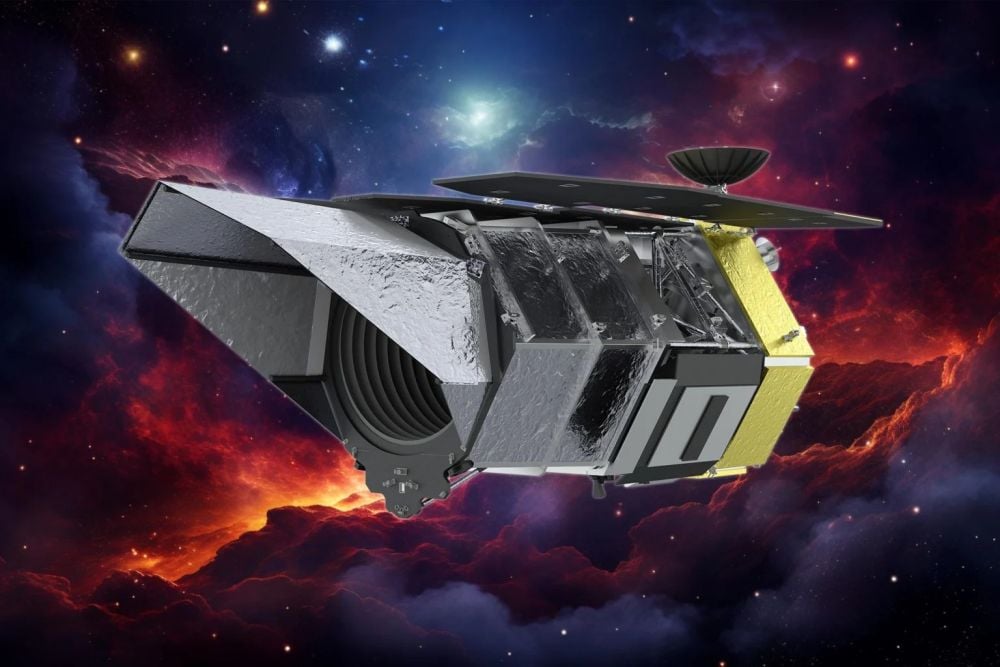
The Nancy Grace Roman Telescope Is Complete!
December 09, 2025Construction is complete on the Nancy Grace Roman Space Telescope, and its ahead of schedule. After extensive testing, the new flagship telescope should be ready to launch in Fall, 2026.
-
The Longest GRB Ever Detected Is An Intriguing Puzzle
December 09, 2025In July 2025, telescopes detected a gamma-ray burst (GRB) that lasted seven hours. Most GRBs last only milliseconds, or a few minutes. Only a handful have lasted longer than that, and July's GRB was the longest ever detected. It hints at a new, exotic type of explosive event, and astronomers have a few candidates.
-
Direct Images Of Nova Explosions Reveal Their Complexity
December 08, 2025Astronomers have captured images of two nova explosions only days after they exploded. The detailed images show that these explosions are more complex than thought. There are multiple outflows and, in some cases, delayed ejection of material.
-
It's the JWST's Turn To Look For An Intermediate Mass Black Hole
December 08, 2025Astronomers have acquired evidence that Omega Centauri, the largest-known globular cluster in the Milky Way, hosts an intermediate mass black hole (IMBH). These elusive objects should exist, according to theory, but have been difficult to verify. The IMBH in Omega Centauri is considered a candidate black hole, and new research examined the region with the JWST for any conclusive evidence.
-
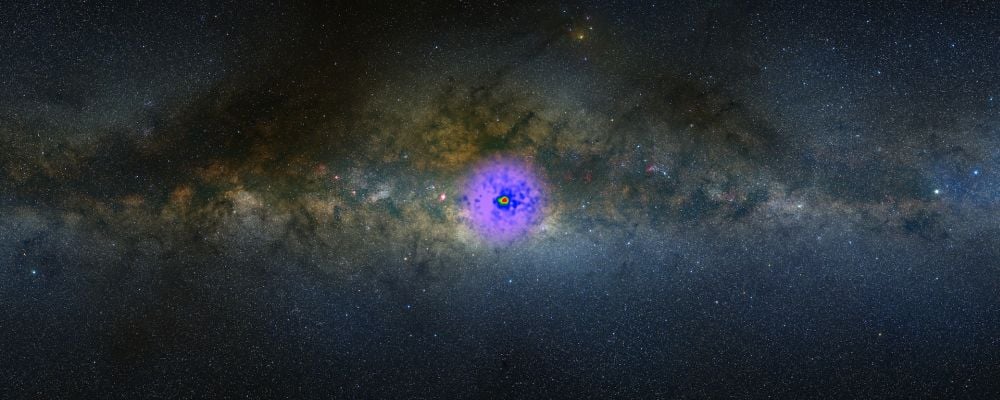
The Milky Way's Supermassive Black Hole Isn't As Destructive As Thought.
December 08, 2025New research and observations with the VLT's ERIS instrument show that some stars are following predictable orbits near Sagitarrius A-star, the Milky Way's supermassive black hole. This goes against the established idea that the black hole's enormous gravity destroys stars and gas clouds. Even a binary star system in the region seems to go about its business unaffected.
-
Dust In A Telescope's Eye Could Blind It To Earth 2.0
December 05, 2025Hot exozodiacal dust can thwart our efforts to detect exoplanets. It causes what's called coronagraphic leakage, which confuses the light signals from distant stars. The Habitable Worlds Observatory will face this obstacle, and new research sheds light on the problem.
-
SPHERE Shows Us How Our Solar System Isn't Much Different Than Others
December 05, 2025Observations with the SPHERE instrument on the European Southern Observatory's VLT revealed the presence of debris rings similar to structures in our Solar System. SPHERE found rings similar to the Kuiper Belt and the Main Asteroid Belt. Though individual asteroids and comets can't be imaged, these debris rings infer that other solar systems have architectures similar to ours.
-
An Adolescent Growth Spurt In Young Stars Helps Giant Planets Form
December 04, 2025Intermediate mass stars experience periods of rapid growth in their late stages of formation. The growing young star emits more radiation that encourages greater accretion. Rather than depleting their protoplanetary disks and preventing gas giants from forming, the opposite is true.
Universe Today