 Universe Today
A galaxy's powerful magnetic fields have a fundamental effect on light, and it's all because of dust. Tiny dust grains in interstellar space are elongated rather than spherical. In the presence of a magnetic field, these grains align themselves with the field. That means they preferentially absorb and reflect light.
They absorb some light, but allow light that's perpendicular to their long axis to pass, creating what we call polarized light. By observing this polarized light, astronomers can map a galaxy's magnetic fields.
That's how researchers mapped the magnetic fields in Arp 220, a pair of merging galaxies about 250 million light-years away. They used the Atacama Large Millimeter/submillimeter Array (ALMA) to map out a magnetic superhighway and the galactic wind that blows along that highway. Mergers like these create complex magnetic fields and winds, and they shape their surroundings with starbursts and galactic outflows. The research effort is aimed at understanding the effects the magnetic fields and the winds have on galactic evolution.
Their results are published in The Astrophysical Journal Letters and are titled "The Magnetic Fields of the Dusty Nuclei and Molecular Outflows of Arp 220." The lead author is Enrique Lopez-Rodriguez. Lopez-Rodriguez is an Associate Professor in the Department of Physics & Astronomy at the University of South Carolina.
"Galaxy mergers trigger starburst activity and galactic outflows that enrich the circumgalactic medium (CGM), profoundly impacting galaxy evolution," the researchers explain. "These phenomena are intrinsically linked to the physical conditions of the medium, which is permeated by magnetic (B) fields affecting its transport and dynamics."
They chose Arp 220 because it's a pair of interacting/merging galaxies and is also the closest ultraluminous infrared galaxy (ULIRG) to Earth. Astronomers consider it to be the prototypical ULIRG, another reason to study it. ULIRGs experience starbursts in response to mergers, which were more common in the early Universe. "We emphasize that Arp 220 serves as the nearest prototype of a ULIRG and provides a benchmark for understanding feedback processes in high-redshift systems," the authors explain.
Many galaxies, possibly even our own, went through a ULIRG phase. Arp 220 began merging about 700 million years ago, sparking a massive starburtst that resulted in at least 200 huge star clusters in its densely-packed central region.
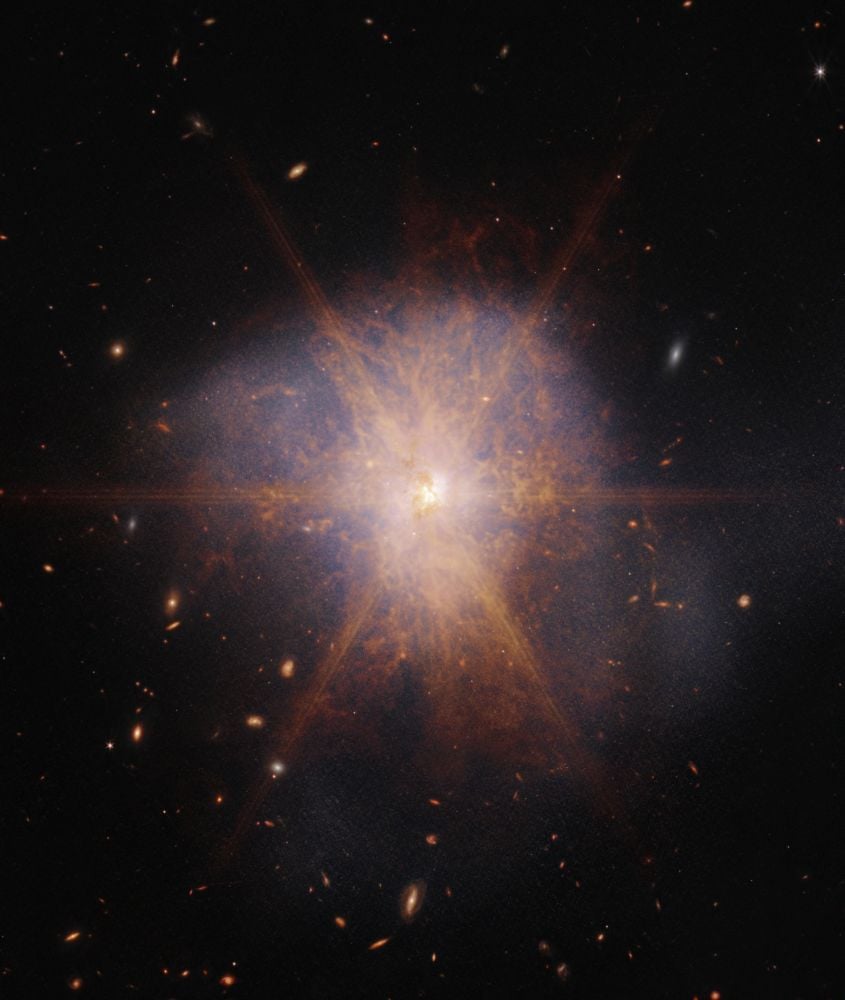 The JWST captured this image of Arp 220 in 2023. It's a ULIRG that shines with the light of more than one trillion Suns. Compare that to the Milky Way which is as bright as ten billion Suns. The individual galactic cores aren't visible in this image, but they're only about 1,200 light-years apart. Image Credit: NASA, ESA, CSA, K. Pontoppidan (STScI), A. Pagan (STScI). Licence: ESA Standard Licence/CC BY-SA 3.0 IGO
It's difficult to study the relationship between mergers and starbursts because so much of it happens behind obscuring dust. But the researchers used ALMA observations to map the magnetic fields of the galactic nuclei and the winds in 3D.
“We used ALMA to map the orientation and strength of magnetic fields in the twin galaxies,” said lead author Lopez-Rodriguez in a press release.
“This revealed previously unseen details about Arp 220’s dust-enshrouded cores and molecular outflows, including the first detection of a polarized CO(3–2) molecular line emission,” added Josep Miquel Girart. Girart is a co-author and researcher at the Institut de Ciències de l’Espaiand who led the observational work. This emission traced the galactic outflow in the external galaxy, showing that the outflowing gas itself carries a well-ordered magnetic field.
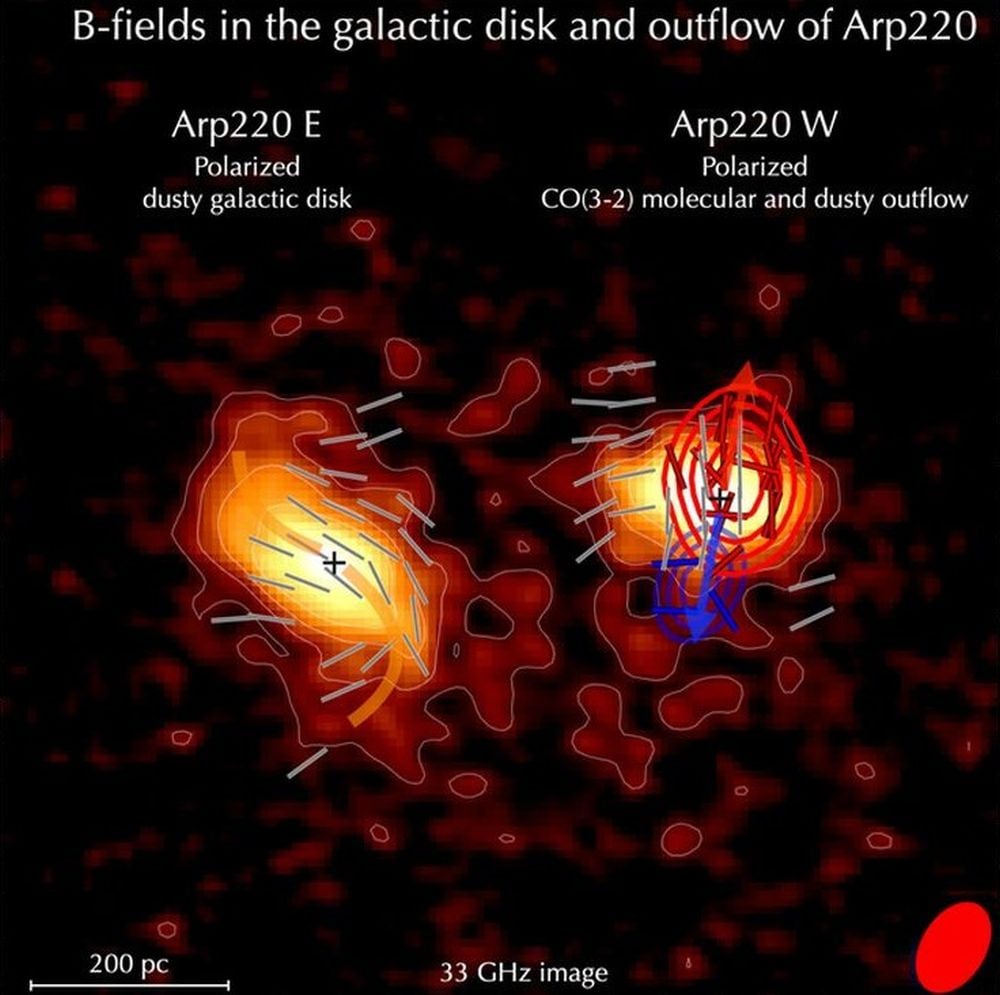
Arp 220's western nucleus, called Arp 220 W, has an almost vertical magnetic field aligned with a bipolar molecular outflow. The outflow moves rapidly, at about 500 km/second, and propels a magnetic superhighway out of the galaxy. Researchers know that mergers and starburst episodes inhibit star formation by removing gas. But this is the first time magnetic fields have been identifed as a driver of the gas-removing winds.
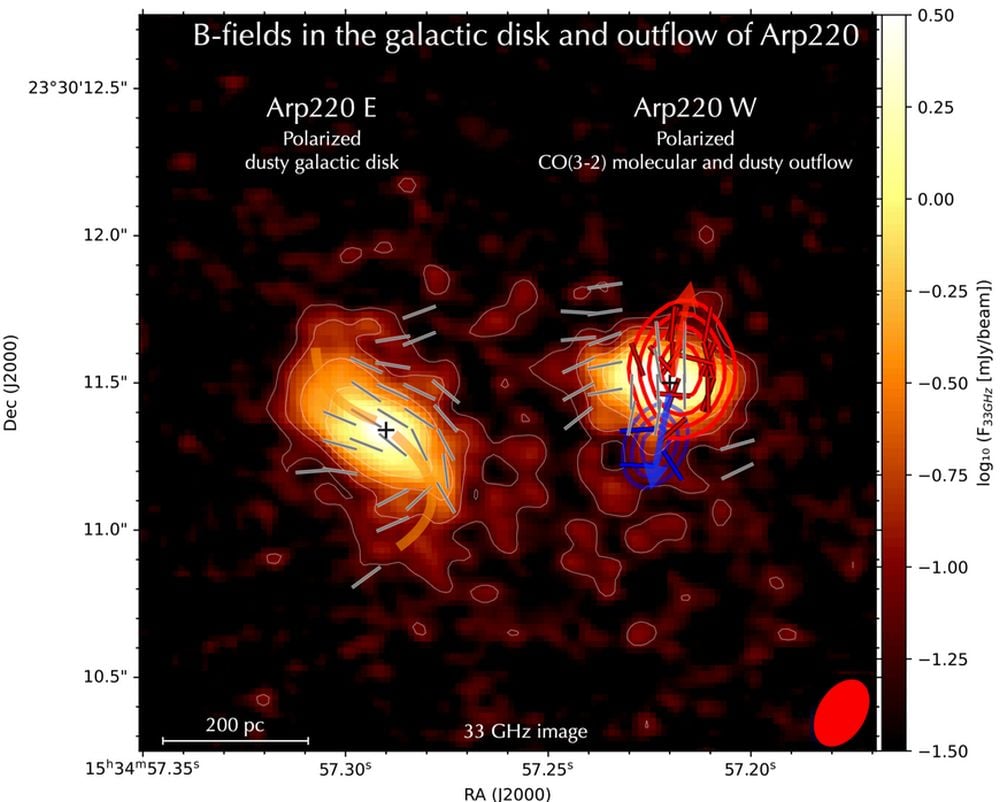 The magnetic fields of the galactic disk and dusty and molecular outflow of the merging galaxy Arp220 observed by ALMA. The magnetically aligned dust grains (grey lines) show a magnetic field parallel to the disk in Arp 220 East, while in Arp 220 West, the magnetic field is parallel to the outflow (red and blue contours) driven by the starburst activity. The CO molecular emission shows a collimated magnetic field (blue and red lines) along the fast molecular outflows of Arp 220 West. Image Credit: Lopez-Rodriguez, E. (USC; polarization data), Girart, J.M. (ICE-CSIC and IEEC; polarization data); (Barcos-Muñoz, L. (NRAO; 3GHz data)
The researchers also combined their polarization observations with measurements of gas mass, turbulence, and outflow speed. This let them estimate the strength of the magnetic fields in the blue-shifted and red-shifted outflow lobes. The observations uncovered a spiral magnetic pattern threading a compact, dust-enshrouded disk and arm in the eastern nucleus. Spiral fields are ordered, and its presence shows that spiral fields can persist despite the chaos of a merger.
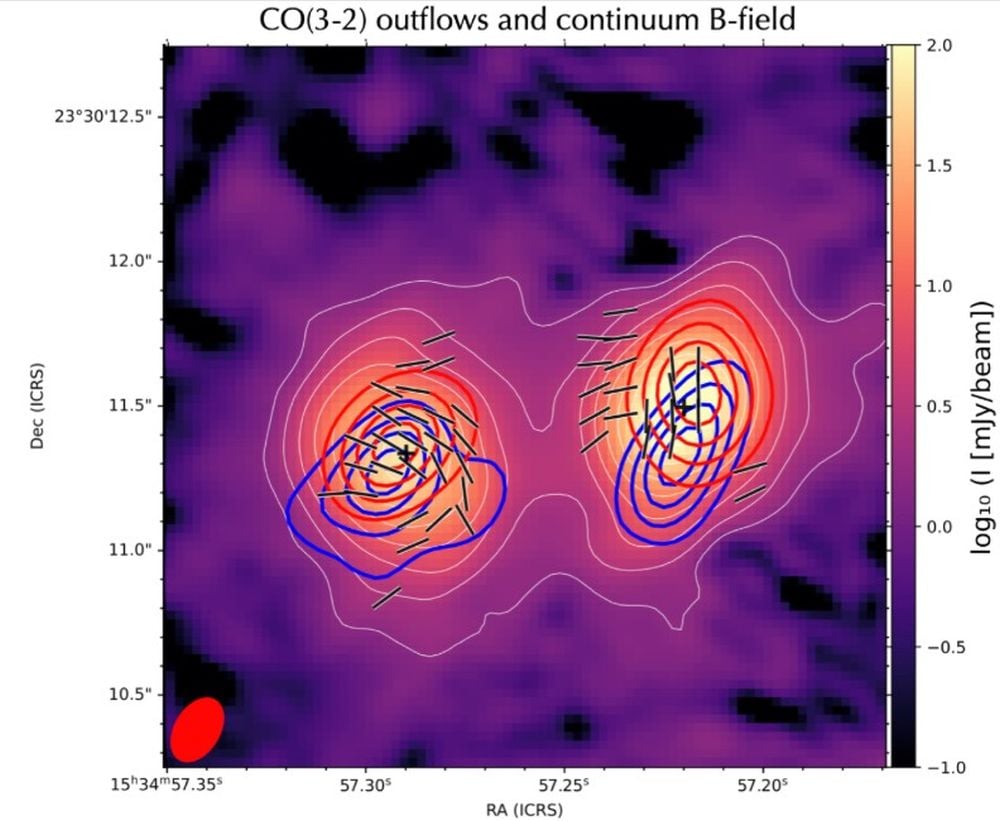 Another figure from the study. This one shows fast molecular redshifted (red contours) and blueshifted (blue contours) outflows overlaid on the total intensity and B-field orientation. Image Credit: Lopez-Rodriguez et al. 2026. ApJL
But the most interesting finding might be the bridge connecting both cores. There's a highly-polarized bridge spanning the nuclei that could be how material and magnetic flux are funnelled between the pair.
"When Arp 220 is observed as a whole, it’s one of the best places in the Universe for astronomers to study how gravity, star formation, and powerful winds work together with strong magnetic fields to reshape a galaxy and seed its surroundings with magnetized gas and dust," lead author Lopez-Rodriguez said.
The team estimated the strength of Arp 220's magnetic fields and determined that they're hundreds, even thousands, of times stronger than those in the Milky Way's disk. Overall, the results show that the compressed and amplified magnetic fields in merging galaxies can shephered material out of the galaxies into the circum-galactic medium. Since Arp 220 represents a common feature of the early Universe, the observations show that these powerful fields and winds have shaped galaxies and star-formation over vast expanses of time.
"The Arp 220 results suggest that such strong B-fields may be common in extreme starbursts, amplified by turbulence, shear, and feedback," the authors write. "This amplified B-field is likely sustained by the turbulent kinetic energy in the outflow and may be critical in directing the transport of metals and cosmic rays into the CGM."
ALMA can perform these same observations on high-redshift galaxies to see if the same magnetic fields and winds were present in the deep past. That could confirm what this research is suggesting.
"Future ALMA observations targeting similar transitions in high-z systems could reveal widespread ∼100–1000 μG B-fields in molecular outflows, confirming that magnetic fields play a fundamental role in regulating star formation and feedback across cosmic time," the authors conclude.

