 Universe Today
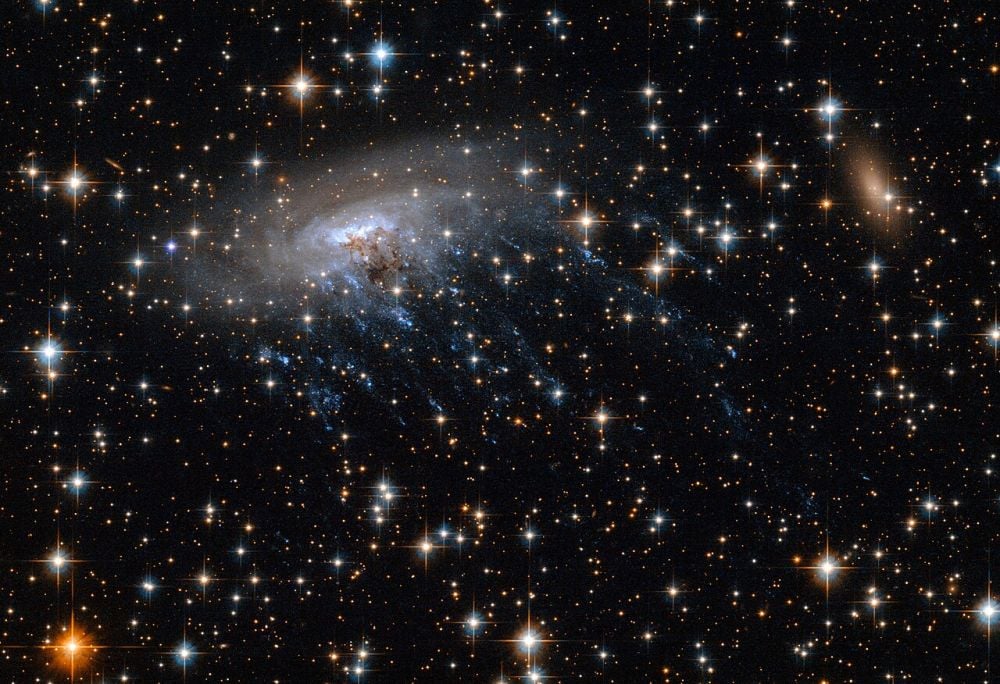
Astronomers working with JWST have found a jellyfish galaxy only about 5 billion years after the Big Bang. Jellyfish galaxies are so named because they trail streams of gas that look like jellyfish tentacles. They're created when a galaxy moves rapidly through a cluster, and the intracluster medium (ICM) strips gas from them, stretching it into long streams.
The phenomenon is called ram-pressure stripping, and while it's not unusual, astronomers didn't expect to find it so early in the Universe's history. This is yet another example of the JWST showing us the true nature of the early cosmos.
The findings are in a paper titled "JWST Reveals a Candidate Jellyfish Galaxy at z = 1.156," and it's published in The Astrophysical Journal. The lead author is Dr. Ian Roberts, Banting Postdoctoral Fellow at the Waterloo Centre for Astrophysics in the Faculty of Science.
"We report the discovery of COSMOS2020-635829 as a candidate jellyfish galaxy undergoing ram pressure stripping in a (proto)cluster at z > 1," Roberts and his co-researchers write.
It was found in the COSMOS field, a well-observed region of space where astronomers search for distant galaxies. It's away from the Milky Way's galactic plane, making it easier to observe. It' s also visible from both the north and south hemispheres, and has no bright foreground stars that can make observing difficult.
“We were looking through a large amount of data from this well-studied region in the sky with the hopes of spotting jellyfish galaxies that haven’t been studied before,” lead author Roberts said in a press release. “Early on in our search of the JWST data, we spotted a distant, undocumented jellyfish galaxy that sparked immediate interest.”
This discovery is a surprise because of the galaxy's age. It existed about 8.5 billion years ago. Scientists think that ram pressure stripping was only a feature of more mature galaxy clusters. Only galaxies in massive clusters with dense intracluster medium were thought to exhibit the phenomenon. So this discovery pushes the timeline back significantly.
"High-resolution imaging from the James Webb Space Telescope reveals a symmetric stellar disk coupled to a unilateral tail of star-forming knots to the south," the authors write. The researchers used the Gemini Telescope and its multi-object spectrograph to examine the tail and found that the knots are embedded in it. "If confirmed, this represents the highest-redshift discovery of a ram-pressure stripped ionized gas tail," the researchers explain.
"The tail sources are characterized by extremely young stellar populations (≲100 Myr), have stellar masses of ∼10superscript8 M⊙, and star formation rates of 0.1–1 M⊙ yr−1," Roberts and his co-authors write. 100 Myr is very young for a star, and their ages confirm that they formed in the tail after the gas in the tail was stripped away from the galaxy. The tail sources aren't individual stars; instead, they're comparable to a dwarf galaxy or very large star cluster. They're massive enough to potentially survive as star systems once the gas in the tail dissipates. They could even become ultra-diffuse galaxies.
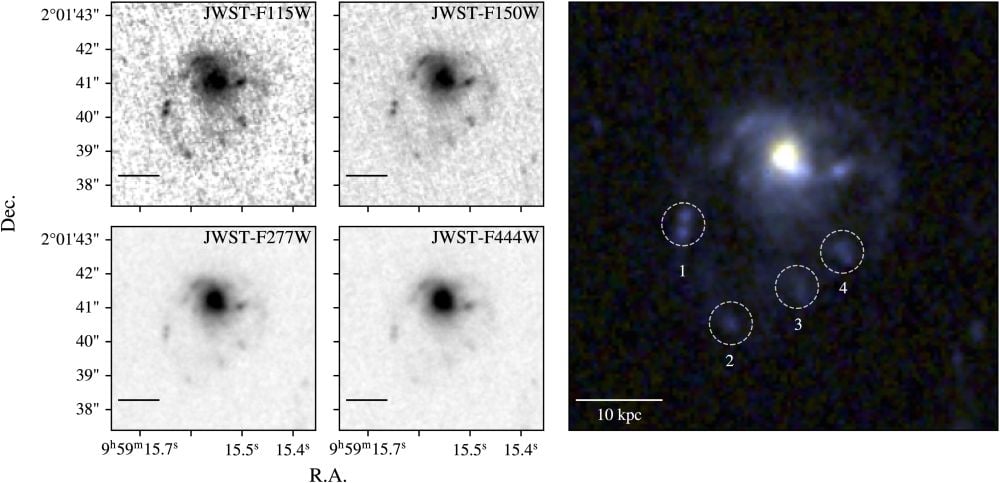 The four panels on the left are JWST images of COSMOS2020-635829 taken with different JWST filters. The panel on the right is a red–green–blue image combination from the four filtered images. The dashed circles show the star-forming clumps in the galaxy's "tail." Image Credit: Roberts et al. 2026. ApJ
The star formation rates in these clusters approached that of the entire Milky Way, even though the structures are only a tiny fraction of the Milky Way's size. The results show that ram pressure not only strips gas away, but can compress it and trigger abundant star formation.
The existence of this jellyfish galaxy at such an early stage in the Universe means that our understanding has to be updated in several ways.
“The first is that cluster environments were already harsh enough to strip galaxies, and the second is that galaxy clusters may strongly alter galaxy properties earlier than expected,” Roberts said. “Another is that all the challenges listed might have played a part in building the large population of dead galaxies we see in galaxy clusters today. This data provides us with rare insight into how galaxies were transformed in the early universe.”
Quenching on this scale wasn't expected so soon in the Universe, but finding this example could explain some other findings. Astronomers have found quenched galaxies at z ~ 2-4. These galaxies must have formed massive numbers of stars extremely rapidly, and then shut down when the Universe was only about 1 or 2 billion years old. Astronomers call these "red nuggets," and have puzzled over how they formed.
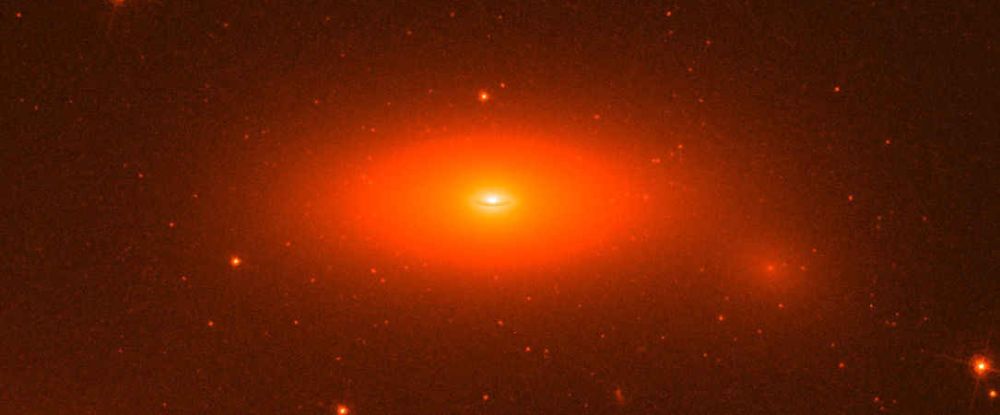 This is NGC 1277, the most well-studied red nugget galaxy. Its stars formed in a 100 million year timespan about 12 billion years ago. This research shows that ram pressure stripping could've been responsible. Its stars are all aged and reddened now. Image Credit: By ESA/Hubble, CC BY 4.0, https://commons.wikimedia.org/w/index.php?curid=46758561
The researchers stress that COSMOS2020-635829 is still only a candidate jellyfish galaxy at this point. But it's still significant. "Given the paucity of direct evidence for RPS at z > 1, COSMOS2020-635829 represents an important new addition to the broader understanding of environmental quenching at these early times," they write.
This study is also another example of how the JWST continues to be a resounding success. It was built with several objectives in mind, and one was studying the very early Universe. It has successfully peered into the cosmos' distant past and helped us re-orient our understanding of these early epochs.
Assuming that it's eventually confirmed as a jellyfish galaxy, the JWST's observations will help astrophysicists constrain the quenching mechanisms native to the very early Universe. But more observations are needed to confirm it.
"COSMOS2020-635829 is now an important laboratory in this regard and efforts moving forward will be dedicated to confirming the nature of this galaxy via multiwavelength observations of the candidate ram-pressure tail presented in this work," the researchers conclude.

