 Universe Today
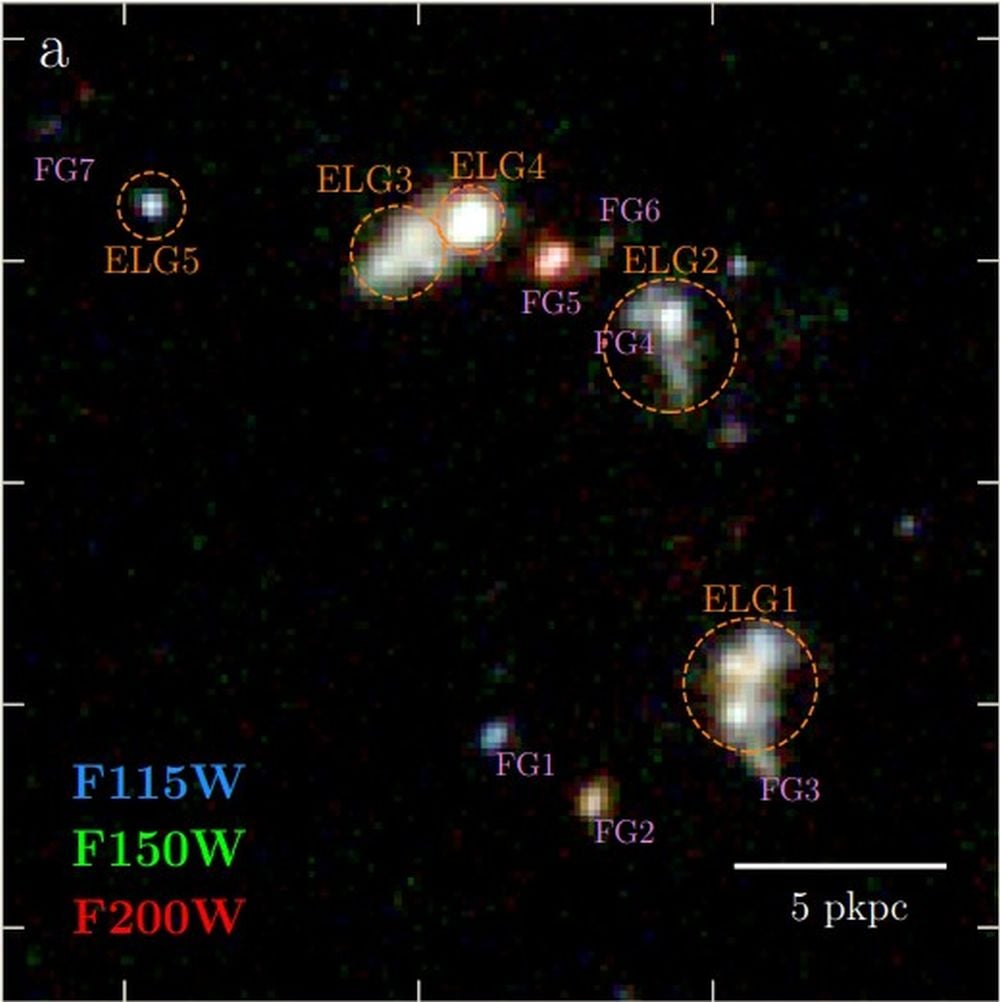
The JWST has spotted a system of five merging, interacting galaxies only about 800 million years post Big-Bang. This is sooner than astronomers thought, and is another example of the powerful space telescope forcing us to reconsider our understanding of the early Universe.
Galaxy mergers are a hot topic in astronomy because they're a fundamental aspect of the Universe we see around us. Only a long history of galaxy mergers could've created the massive galaxies like the one we live in. Prior to the eye-opening observations from the JWST, astronomers thought that these mergers were a common occurrence more than one billion years after the Big Bang. But like many things about the ancient Universe, the JWST is showing us how off-target we were.
The discovery is in new research published in Nature Astronomy titled "Extended enriched gas in a multi-galaxy merger at redshift 6.7." The lead author is Dr. Weida Hu, a post-doctoral researcher at Texas A&M University.
"Recent JWST observations have uncovered high-redshift galaxies characterized by multiple star-forming clumps, many of which appear to be undergoing mergers," the authors write. The findings clash with the understanding that galaxies in the early Universe were spread out, isolated, and much less massive.
"Such mergers, especially those of two galaxies with equivalent masses, play a critical role in driving galaxy evolution and regulating the chemical composition of their environments," the researchers explain.
They've dubbed the five-galaxy merger JWST’s Quintet (JQ).
“What makes this remarkable is that a merger involving such a large number of galaxies was not expected so early in the universe’s history, when galaxy mergers were thought to (be) simpler and usually involve only two to three galaxies,” lead author Hu said in a press release.
Despite being tens of thousands of light-years apart, JQ's galaxies are actually tightly-packed for galaxies. Their star formation rate (SFR) is also high, about 250 solar masses each year. That's an extremely high SFR for early galaxies, even though their rates are generally higher because so much pristine gas was available.
The earlier-than-expected merger isn't the only noteworthy result of this research. The JWST also found that the activity is generating ionized oxygen and spreading it into the circumgalactic medium (CGM). "We also detect a large [O iii] + Hβ gaseous halo surrounding and connecting four galaxies in JQ, suggesting the existence of metals in the surrounding medium—the inner part of its circumgalactic medium," the authors write. Hβ is also an active marker of ionization.
[O iii] is doubly-ionized oxygen, meaning powerful radiation has stripped two electrons from oxygen atoms. Astronomers compare the ratio of [O iii] to hydrogen to determine the source of the radiation. The researchers think that shocks from the mergers generated the radiation that ionized the oxygen. "It is therefore more plausible that the [O III]+Hβ halo of JQ results from oxygen-enriched gas stripped out of the galaxies through interactions and tidal forces," the researchers explain. "The stripped gases are shock-heated in galaxy collisions and dispersed to large radii, leading to large hot gaseous halos."
![These panels show the galaxies in JQ (left) and the cloud of [O iii] + Hβ. Image Credit: Hu et al. 2026 NatAstr](/article_images/J5_and_cloud_20260204_174944.jpg) These panels show the galaxies in JQ (left) and the cloud of [O iii] + Hβ. Image Credit: Hu et al. 2026 NatAstr
These panels show the galaxies in JQ (left) and the cloud of [O iii] + Hβ. Image Credit: Hu et al. 2026 NatAstr
This discovery also helps explain some of the JWST's other early-Universe galaxy discoveries. Astronomers found massive galaxies about 1 to 1.5 billion years after the Big Bang that are quiescent. They're massive, meaning lots of stars have already formed in them. But this, again, is suprising, since at this young age there hasn't been enough time for this many stars to form.
The JQ could be the precursors of these quenched galaxies. It has the mass and the rapid SFR to explain them.
"The high mass and star formation rate of JQ are consistent with the star formation history of those unexpected massive quiescent galaxies observed at redshift 4–5, offering a plausible evolutionary pathway for the formation of such galaxies," the authors explain.
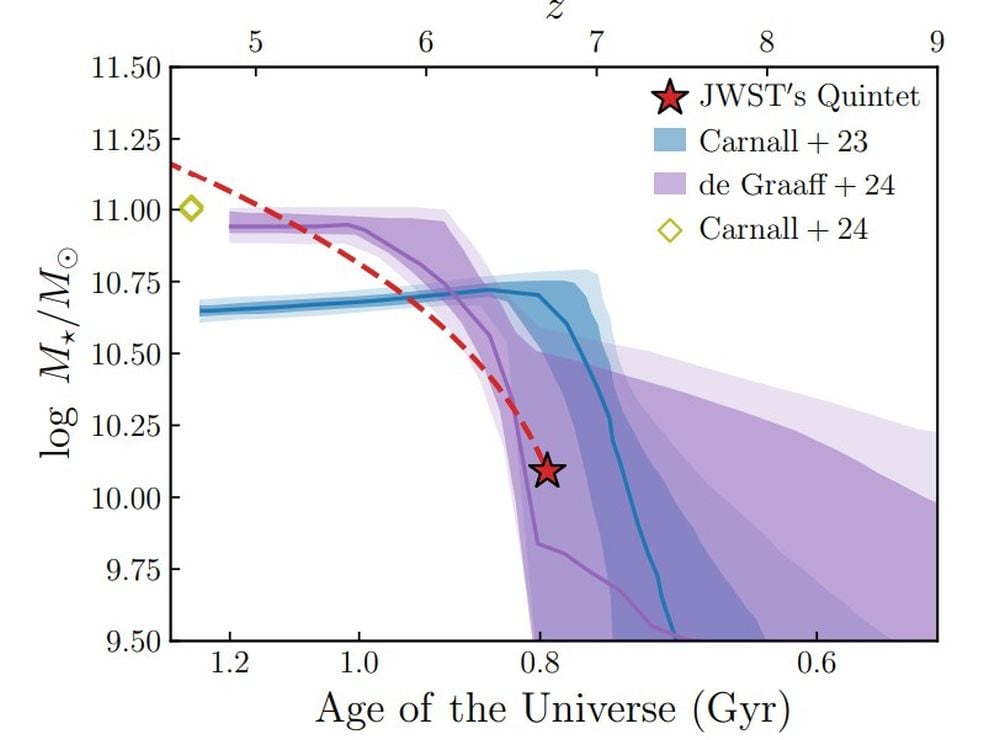 This figure from the study shows how JQ could be a precursor to the unexpected massive quiescent galaxies previously found by the JWST. The red dashed line shows the expected stellar mass growth of the JQ system. The shaded regions show the quiescent galaxies star-formation history, where the two different shades are different confidence intervals. The olive diamond is one of the confirmed massive quiescent galaxies. "The future growth of the JQ system is consistent with these tracks," the authors write. Image Credit: Hu et al. 2026 NatAstr
The JWST has delivered a steady stream of surprises and theory-defying observations, which is a critical part of the scientific endeavour. If all of our observations matched our theories, it would be a warning sign that something was wrong.
In fact, whenever a new telescope is commissioned, or a new exploratory probe or rover is sent on its mission, scientists say they're looking forward to whatever surprising findings come their way. The JWST has delivered an outsized share of surprises and is driving scientists to gather more observations and refine their theories to match them.
“By showing that a complex, merger-driven system exists so early, it tells us our theories of how galaxies assemble — and how quickly they do so — need to be updated to match reality,” said co-author Dr. Casey Papovich, a Professor of Physics and Astronomy at Texas A&M University.

