 Universe Today
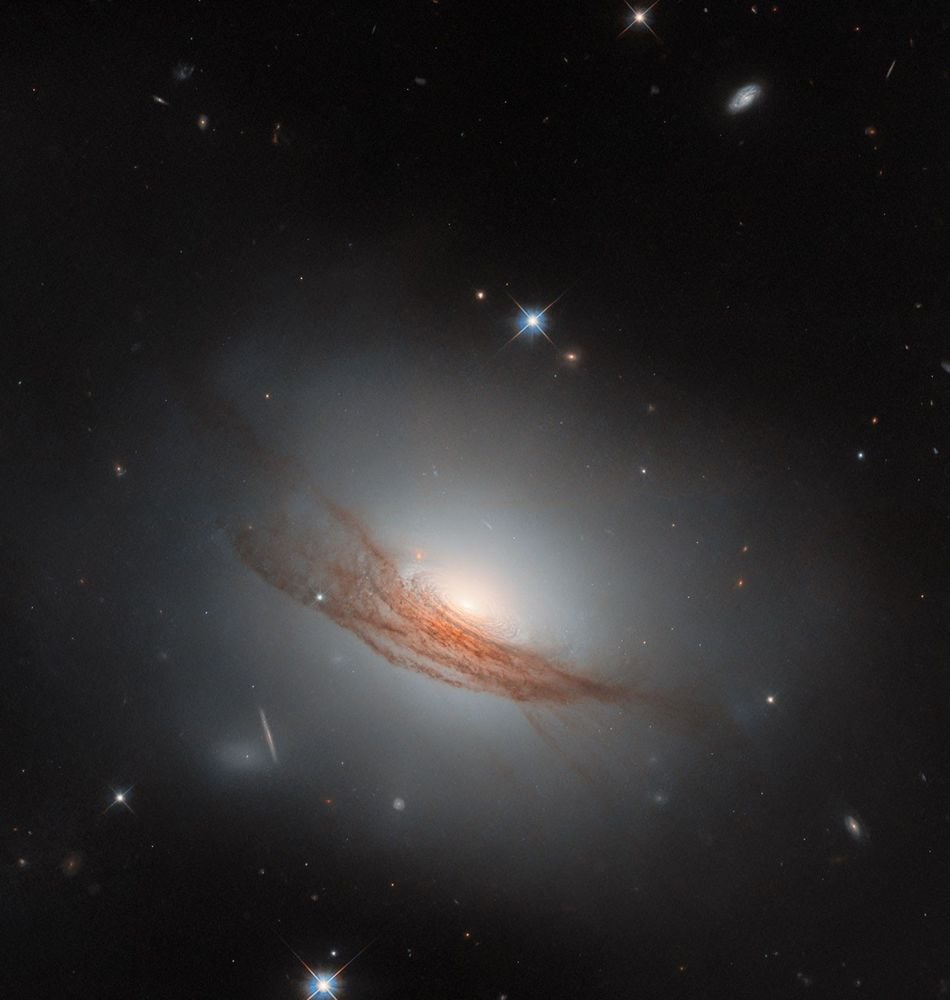
This Hubble Picture of the Month shows NGC 7722, a lenticular galaxy about 185 million light-years away. It's known for its striking appearance, where dramatic dust lanes can't quite block out the light from its central region. The dusty lanes are likely from a past merger. In fact, astronomers think all lenticular galaxies are the result of past mergers, or at least gravitational interactions with other galaxies.
The Hubble captured this image as part of a supernova survey. The Zwicky Transient Facility detected a supernova explosion here in 2022, subsequently named SN 2020SSF. That supernova isn't visible in this image, but the Hubble was observing the fading light from the supernova. It was a Type Ia supernova, which are used as standard candles in the cosmic distance ladder. Astronomers are always keen to have a better understanding of these types of supernovae.
Lenticular galaxies are intermediate between spirals like the Milky Way and elliptical galaxies like the well-known M87. They have features of both types of galaxies. Lenticulars have also used up most of their star-forming gas and are quiescent. Type Ia SNe are found in quenched lenticulars because, unlike core-collapse supernovae, they don't require the recent formation of a massive progenitor star.
But whether it hosts supernovae or not, and whether its dormant or not, NGC 7722 is an intriguing sight. It has several features that help explain lenticular galaxies, and that bring questions about their formation into focus.
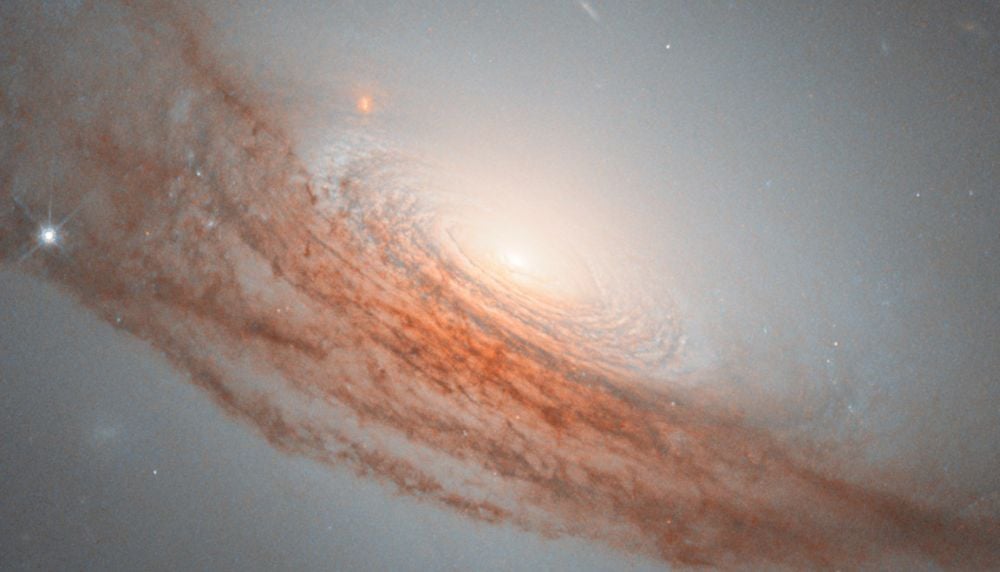 This zoomed-in look at NGC 7722 highlights the galaxy's dust lines and luminous heart. Image Credit: ESA/Hubble & NASA, R. J. Foley (UC Santa Cruz), Dark Energy Survey/DOE/FNAL/DECam/CTIO/NOIRLab/NSF/AURA; Acknowledgment: Mehmet Yüksek
The prominent dust lanes in the image are dramatic because they're illuminated by the blazing light from the galaxy's center. For years, astronomers thought that the light at the heart of many lenticulars like NGC 7722 came from active galactic nuclei. But in the last couple of decades, conflicting evidence is showing that the light could be from a population of post-AGB stars. These stars are in an evolved state where they're hot and energetic enough to ionize the surrounding gas, and could create the scene in NGC 7722.
The galaxy shows clear signs of a merger, and mergers and other gravitational interactions can do more than just twist and warp galaxies. Mergers are puzzling because they can result in accelerated star formation or quenching. If a merger is "wet" or rich in gas, star formation likely spikes. It can trigger a starburst, an intense period of time where gas clouds are colliding and collapsing, and a large number of stars in a short period of time.
But all of the gas doesn't become stars, and feedback mechanisms eventually quench the starburst. Some of the gas feeds the supermassive black hole, and feedback from that can heat the remaining gas, quenching star formation. All of the radiation from the abundant stars formed during the starburst also feed radiation back into the gas, adding to the quenching effect.
Aside from accelerating or quenching star formation, NGC 7722's ancient merger also created the dust lanes. Astronomers think these are the fingerprints from the merger. During that merger, NGC 7722 likely collided with a smaller, gas-rich galaxy. The merger tore the smaller galaxy apart, stripping away its gas and dust. This new dust was funnelled gravitationally into the rings and coiled lane features we see today. Now, they're backlit by the galaxy's bright nucleus.
This image doesn't reveal NGC 7722's star-formation state. Nor does it reveal the supernova. Instead, astronomers used the Hubble to check in on the galaxy two years after the supernova was observed. They wanted to see the SN's after-effects and observe its surroundings. SN explosions are intense and bright, and by waiting until the light had faded, the Hubble could gather more information. Type Ia SNe generate a decay chain of radioactive elements that results in stable iron. They're the primary source of iron throughout the cosmos, including the iron in our blood.
Type Ia SNe involve a binary pair, usually a white dwarf and a companion. Astronomers are also using the Hubble to search for the surviving companion star. Sometimes the SN explosion kicks the companion star out, and it becomes a hypervelocity star. Sometimes it stays in its location and the blast strips away its outer layers, up to 50% of its mass. Sometimes the companion star becomes coated with heavy elements like the iron created during the explosion, and this is how astronomers identify the companion.
Other times, the Type Ia involves a pair of white dwarfs. In those cases, the companion can be almost unrecognizable as it hurtles through space. Other times, the companion is also completely destroyed.
If that's the case, the Hubble will find nothing, but we still get to enjoy this gorgeous image.

