Universe Today
Welcome to our final installment in the Brief-ish History of SETI. Throughout this series, we explored the humble origins of the Search for Extraterrestrial Intelligence (SETI), the first modern experiment (Project Ozma), and the theoretical foundations that still guide the search. We then looked at the first attempts at Messaging Extraterrestrial Intelligence and the most likely candidate for a message (the WOW! Signal), the first interstellar messengers, and the many proposed resolutions to Fermi's big question ("Where is Everybody?").
Lastly, we looked at modern attempts to resolve the paradox and how SETI has experienced a renaissance since the turn of the century. In this, our final installment, we shall consider all the close calls, possible candidates, and instances in which extraterrestrial signals could not be ruled out. While humanity has not yet found definitive evidence of extraterrestrial civilizations (ETCs), there are many instances where the possibility cannot be dismissed.
In short, we may already have heard from extraterrestrials and simply not known it. As Konstantin Tsiolkovsky stated in his 1933 essay "The Planets are Occupied by Living Beings," where he predicted the Fermi Paradox forty years before it existed:
Our facilities are too weak to perceive these signs. Our celestial neighbors understand that at [a] certain level of knowledge people themselves will definitely prove inhabitance of [other] planets. In addition, there is no good of informing about inhabitance of planets lower animals from the Earth, along with [the] majority of humankind – because of [the] low degree of their development. What if this knowledge does harm? Time must pass until the average level of humankind’s development is sufficient for nonearthly dwellers to visit us.
WOW! Signal
As noted in our previous installment, the WOW! Signal is considered by many to be the best candidate for an extraterrestrial signal. The event occurred on August 15th, 1977, by the Ohio State Radio Observatory, which detected a narrowband radio signal that lasted for 72 seconds and appeared to be coming from the direction of the Sagittarius Constellation. The following day, volunteer astronomer Jerry Ehman examined the readout from the night before and noted a surprising change in the usual numbers, denoted as “6EQUJ5.”
So impressed was Ehman that he circled the code in red and wrote “WOW!” in the margin next to it. This led astronomers to nickname it the "WOW!" Signal, with many speculating that it might have been a signal from an extraterrestrial civilization. This was based in part on the signal being transmitted at 1,420 MHz, the same frequency as neutral hydrogen.
SETI researchers consider this frequency ideal for interstellar messaging because it propagates well through space and is universally recognized since hydrogen is the most common element in the Universe, making it a potential "meeting point" for communication. However, several follow-up surveys of the Sagittarius constellation were conducted by the Big Ear Observatory over the next 22 years, but failed to detect the signal again.
In addition, the signal lacked modulation (which is used to transmit information via radio), casting doubt on the extraterrestrial signal theory. Nevertheless, the WOW! Signal remains the strongest candidate for an alien signal, and all attempts to identify a natural cause have been inconclusive. Decades later, scientists are still searching for a natural explanation for this mysterious event.
In 2017, a study was published in which the authors claimed that the signal could have been caused by a hydrogen cloud left by a passing comet. However, these findings were dismissed by Yvette Cendes, a Ph.D. student at the Dunlap Institute at the University of Toronto, who noted several issues with the research team's paper, ranging from technical flaws to unspecified tools and target areas examined.
Beginning in 2024, scientists from the Planetary Habitability Laboratory (PHL) published a series of papers regarding observations made in 2020 at the Arecibo Observatory. In the first paper, they conclude that the WOW! signal was likely caused by stellar emissions energizing a cold hydrogen cloud, which caused it to surge in brightness suddenly.
In the second paper, they determined that the signal was stronger than previously thought, assigning a new value of 250 Jansky (10-26 watts per m2 per Hz), whereas previous estimates put it somewhere between 54 and 212 Jansky. However, these explanations cannot be proven definitively, and many noted astronomers still maintain that the WOW! Signal could have been sent by an ETC.
In a 2019 interview with John Michael Godier (video below), Dr. Jerry Ehman stated: "I'm convinced that the Wow! signal certainly has the potential of being the first signal from extraterrestrial intelligence." As Seth Shostak, the senior astronomer at the SETI Institute, characterized it:
Was that E.T., or was it not E.T.? Nobody knows. Nobody has ever found another explanation for what that might have been. It’s like you hear chains rattling in your attic, and you think, ‘My God, ghosts are real.’ But then you never hear them again, so what do you think?
The Lorimer Burst:
In 2007, West Virginia University (WVU) student David Narkevic was searching through archival data obtained by the Parkes Observatory in 2001, a task assigned to him by WVU professor Duncan Lorimer. Analysis of this data revealed a radio burst lasting 5 milliseconds originating near the Small Magellanic Cloud (SMC). This event came to be known as the "Lorimer Burst," and was the first time astronomers detected a Fast Radio Burst (FRB). Since then, thousands of FRBs have been detected by observatories or found in archival data, most of which were extragalactic in origin.
On August 30th, 2017, Breakthrough Listen announced that it had detected a series of 15 FRBs originating from a dwarf galaxy about 3 billion light-years away, and that the possibility of extraterrestrial origin could not yet be ruled out. In April 2020, the first FRB in the Milky Way was detected by the Canadian Hydrogen Intensity Mapping Experiment (CHIME) radio telescope.
To date, the exact cause of FRBs remains unknown. However, scientists generally agree that they could be powered by rapidly rotating neutron stars with powerful magnetic fields (aka magnetars). However, some maintain that repeating FRBs could be evidence of extraterrestrial transmissions.
Tabby’s Star
In 2015, citizen astronomers with the Planet Hunters project published a paper detailing their observations of KIC 8462852, an F-type main-sequence star located 1,470 light-years from Earth in the Cygnus constellation. Using data from the Kepler Space Telescope, the team found that a sudden, major dip in brightness occurred on March 5th, 2011, when the star dimmed by 15 percent. This was followed by an incident on February 28th, 2013, where the star dimmed by up to 22 percent before brightening again.
Follow-up observations noted new fluctuations that lasted from mid-May 2017 to July 2018. The star gained the nicknamed Tabby’s Star (aka. Boyajian’s Star) after team leader Tabetha S. Boyajian. It immediately became the subject of controversy as some scientists suggested that the dimming could be the result of a Dyson structure (or megastructure) passing in front of it.
Multiple attempts were made to explain these patterns using natural phenomena. Examples include transiting comets, dust clouds, a debris disk, a consumed planet, a giant planet, a planet with rings, exomoons, and many more. Similarly, multiple attempts have been made to find evidence of possible technosignatures coming from the system.
On October 26th, 2016, Breakthrough Listen observed Tabby’s Star for eight hours for signs of radio signals. Several follow-ups observations were made in the ensuing months, but no signals were detected. In December 2018, a search for optical emissions (possibly "spillover" from laser communications or propulsion) was carried out using the Automated Planet Finder (APF). While several candidates were identified, further analysis revealed they were false positives from terrestrial sources.
The mystery of Tabby's star also inspired searches for similar dimming patterns and "disappearing stars" throughout the Universe. In 2016, a team of Uppsala University astrophysicists suggested that SETI researchers should look for stars and galaxies that suddenly became undetectable, which they saw as examples of “physically impossible effects caused by highly advanced technology."
To illustrate, the team examined the positions, motions, and magnitudes of 10 million celestial objects observed as part of the Sloan Digital Sky Survey (SDSS), hoping to find objects that did not appear in their expected positions. In the end, the team found a star visible in one image but significantly dimmer in the next and advised that it be designated as a target for follow-up observations.
Similarly, researchers from the University of Nebraska-Lincoln reported in 2019 that they had identified multiple analogs for Tabby’s Star. Using data from the Northern Sky Variability Survey (NSVS) and the All-Sky Automated Survey for SuperNovae (ASAS-SN), they identified twenty-one stars that also experience infrequent small dips in brightness and a long-term decline between dips.
In June of 2020, a team of astronomers using the ESO's Very Large Telescope (VLT) noted the sudden absence of an unstable massive star in the Kinman Dwarf galaxy. In the accompanying paper, they offered a few possible explanations, including that it was partially obscured by dust or that it collapsed into a black hole without producing a supernova. The team from Uppsala University, however, suggested it might be evidence of a “disappearing star.”
ISO's & UAP
On October 19th, 2017, the Panoramic Survey Telescope and Rapid Response System-1 (Pan-STARRS-1) announced the detection of an interstellar object passing Earth. This object, designated 1I/2017 U1 (aka. ‘Oumuamua), was the first interstellar object (ISO) ever detected, and multiple follow-up observations were conducted as the object left the Solar System. To this day, 'Oumuamua inspires debate among the scientific community as to its nature and origin.
For starters, astronomers initially believed the object was an interstellar comet, but later designated it an asteroid because it showed no signs of outgassing during its closest approach to the Sun. But then, ‘Oumuamua sped up as it was leaving the Solar System, a behavior more consistent with a comet. Multiple explanations were made, including the highly controversial suggestion that it might be an interstellar probe, made in a 2018 paper by postdoctoral researcher Shmuel Baily and Harvard professor Abraham Loeb.
In their paper, Loeb and Baily argued that ‘Oumuamua’s behavior was consistent with a solar sail, similar to what was being developed by Breakthrough Starshot (of which Loeb was a member). This was based in part on 'Oumuamua's strange spectra, which indicated that ‘Oumuamua had a flattened shape and was oddly-proportioned. Second, the way it accelerated as it left the Solar System was consistent with radiation pressure.
Third, 'Oumuamua's trajectory allowed it to slingshot around the Sun and then make a close flyby of Earth, which they saw as a possible indication that it was sent to study the only habitable planet in our Solar System. Multiple attempts to explain 'Oumuamua were also made that were discredited, including the "interstellar dustbunny," comet fragment, and "hydrogen iceberg" hypothesis.
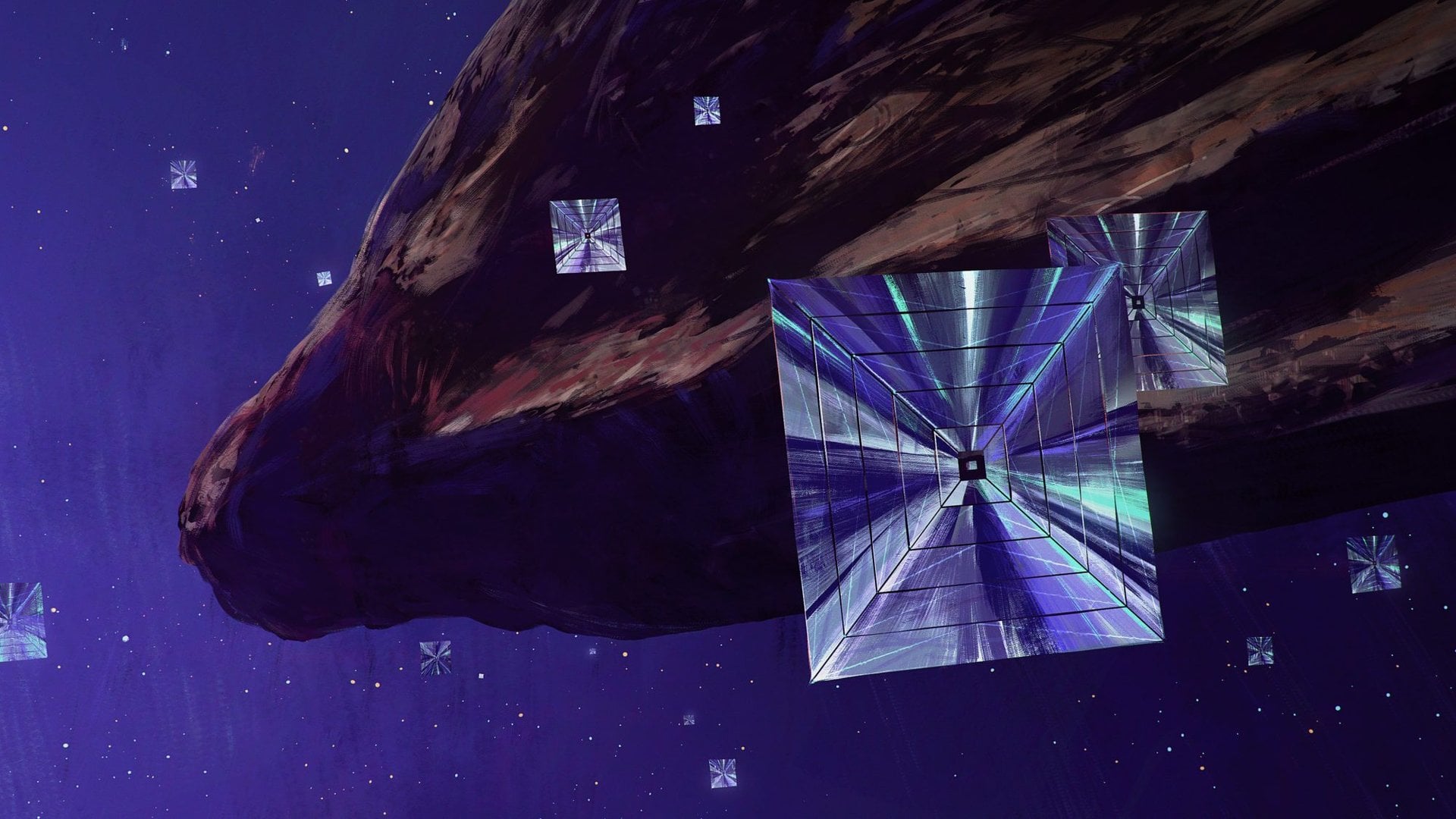 Laser sail spacecraft arriving at 'Oumuamua, the interstellar asteroid. Credit: Maciej Rebisz
To date, the best fit for the data involving natural phenomena is the nitrogen iceberg hypothesis, a new class of object created by the collision of "exo-Plutos." These objects would behave like comets but would not show obvious signs of outgassing as they approached a star. Multiple studies have also confirmed that interstellar objects are likely to enter the Solar System regularly and that many of them have remained.
This was bolstered by the arrival of another interstellar object known as C/2019 Q4 (Borisov) – clearly identified as a comet – less than two years later (in August of 2019). The theory was bolstered further with the arrival of 3I/ATLAS in 2025, which was observed extensively before and after it made its closest approach to the Sun.
Next-generation facilities like the Vera C. Rubin Observatory are expected to detect dozens of future ISOs as they enter our Solar System. The inventory it will provide on objects in the Solar System could also be used to plan missions to explore potential ISOs that have been captured. If even the tiniest percentage of these objects are artificial in origin (as Loeb has suggested), such missions would allow for the greatest discovery in human history.
Similarly, multiple proposals have been made to build spacecraft capable of rendezvousing with ISOs and returning samples to Earth, such as the ESA’s Comet Interceptor or NASA's proposed Janus probe. The Initiative for Interstellar Studies (i4is) has even recommended building a spacecraft (Project Lyra) to catch up to 'Oumuamua to study it up-close. Once again, if there's even the tiniest chance this first interstellar visitor was a probe or a piece of debris, the scientific returns would be immeasurable.
Closer to home, the study of Unidentified Aerial Phenomena (UAP) has entered the mainstream. This began on June 25th, 2021, when the U.S. government released a report from the Office of the Director of National Intelligence that summarized decades' worth of information on UAPs. Since then, the Department of Defense has conducted an ongoing series of disclosures of historical UAP files, including documents, videos, and other declassified materials.
The DoD also established the All-domain Anomaly Resolution Office (AARO) in 2022, tasked with synchronizing efforts to detect, identify, and resolve UAP. The office also conducts annual intelligence assessments of sightings and, in 2023, set up a website for reporting and learning about UAP. In September 2023, NASA responded with the released of an independent study on UAP, which included recommendations on how the agency should take on a greater role in studying such phenomena.
Most recently, the Pentagon began releasing previously classified files on UAP dating back to the Apollo missions, as part of the administration's Presidential Unsealing and Reporting System for UAP Encounters (PURSUE) program. These 161 files (more are expected to follow) consist of reports, photos, and videos related to UAP sightings from military missions dating back to the 1940s.
The files also include pictures taken by the Apollo 12 and 19 astronauts, as well as descriptions by Neil Armstrong and Buzz Aldrin of strange things they saw on the Moon's surface. There's also a transcript from the Gemini 7 mission where astronaut Frank Borman describes a "bogey" and a debris field consisting of "hundreds of little particles," which have since been identified as likely fragments of Gemini 7's booster.
Message from Next Door?
On Dec. 18th, 2020, astronomers announced that the Parkes radio telescope had picked up a radio signal between April and May of 2019 coming from Proxima Centauri (the closest star to the Solar System). This signal was designated Breakthrough Listen Candidate 1 (BLC1), since BI had been using the Parkes telescope at the time.
The signal was a very sharp narrowband emission (982 MHz) that lasted for about 30 hours and underwent a frequency shift (aka. Doppler shift), which was said to be consistent with a moving radio source (like a planet). This raised the possibility that the source could be Proxima b, the rocky planet that orbits within Proxima Centauri’s Habitable Zone (HZ). An anonymous source involved in the study of the signal claimed that this might be the strongest candidate since the “WOW! Signal.”
However, follow-up observations failed to detect the signal again, and the 30-hour window in which it was detected raised some doubts. As Franck Marchis, the Senior Planetary Astronomer with the SETI Institute, summarized:
Of the 300 million exoplanets that could be habitable in our galaxy, which is 200,000 light-years across, it would be an astonishing coincidence for two civilizations (ours and one on Proxima b or c) to be using the same technology at the same time. Although I love the idea, it seems highly improbable—which is why I suspect we will quickly find a more down-to-earth explanation for the signal’s origin.
A year later, a study by an international team led by Prof. Sofia Z. Sheikh of UC Berkeley revealed that BLC1 was likely caused by radio frequency interference (RFI). This was evident in the detection of 60 similar signals occurring simultaneously with BLC1, spanning a range of frequencies and exhibiting similar signal shifts. These signals had initially been filtered out as RFI, indicating that BLC1 was likely the same as well. The team further concluded that the way these signals mixed and interacted made it appear as if BLC1 was localized toward Proxima Centauri, though it was coming from Earth.
Alas, after sixty years of searching, the search for intelligent life in the Universe still hasn't yielded anything conclusive yet. Despite our best efforts, Fermi's question still stands. But the "paradox" Hart and Tipler derived from it need not apply. The assumption that humanity should have heard from ETCs at this point is based entirely on speculative assumptions, many of which are easily discredited, which Carla Sagan and William Newman did in their aforementioned ("Sagan's response.")
Similarly, one need not assume that there is any special reason our efforts to find intelligent life have not yet yielded anything undeniable. For starters, we haven't even begun to scratch the surface as far as SETI efforts and space exploration in general go. For all we know, there could be Von Neumann probes lurking at the edge of our Solar System, or space junk that washed up in our backyard. As famed astronomer and author Gregory L. Matloff said in a 2022 interview with Universe Today:
The Solar System is huge and mostly unexplored, and the probes could be very small. There could be probes everywhere: in craters on the Moon, or lurkers in the Asteroid Belt and Kuiper Belt. There are 100 million objects in the Kuiper Belt alone, and we have examined only two, one of which was very anomalous in its shape.
The only sensible (and gutsy) answer to that is that we must keep exploring! If there is intelligent life beyond Earth, it will most surely be asking the same questions we are: "Where is everybody?" By extension, we can safely assume that many of them are trying to address that very question, and perhaps their methods are more advanced than our own. The prospect of discovering, or even meeting, an ETC is both awe-inspiring and terrifying, but it feels like something humanity is destined for, assuming our civilization survives.
Who knows? Contact may prove essential to that.
Thank you to all the readers who followed this series! We hope it was enlightening, or at least entertaining!