Universe Today
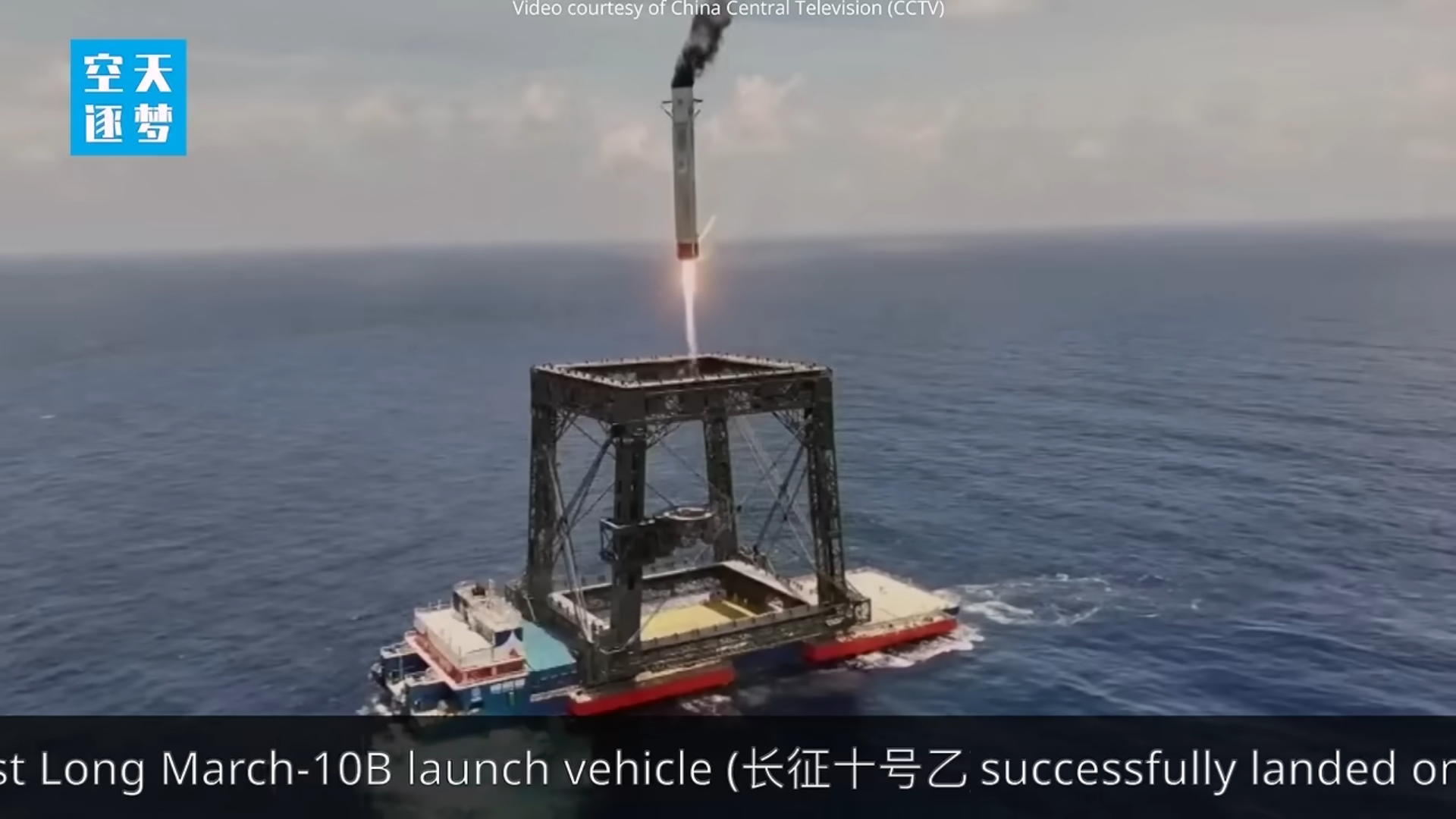
On Friday, July 10th, China achieved a major milestone in its race to become a space power comparable to NASA. During its maiden flight on Friday, mission controllers successfully landed and recovered the first stage of the Long March-10B (CZ-10B). The vehicle is partially reusable, with a retrievable first-stage booster and an expendable second stage, similar to Blue Origin's New Glenn.
In December of 2025, the China Academy of Launch Vehicle Technology (CALT), a division of the China Aerospace Science and Technology Corporation (CASC), announced that it would henceforth develop a commercial variant of its two-stage, medium-lift Long March-10 rocket, known as the Long March-10B (CZ-10B). The vehicle lifted off at 12:15 pm local time (12:15 am EST; 08:15 am PST) from the Hainan International Commercial Aerospace Launch Center on the island province of Hainan in southern China to deliver a satellite to orbit.
About six minutes after launch, the first stage was secured using a new cable recovery system aboard a specially designed vessel off the coast of Hainan. This was the first time a booster was recovered by China's net system, and the first time the country achieved a maritime rocket recovery. It also makes the Long March-10B only the fifth orbital-class rocket system to be successfully recovered after making a propulsive landing.
Measuring 70.2 meters (230 ft) tall and 5 m (ft) in diameter, the Long March-10B shares its first-stage core with the Long March-10A, carrying seven liquid oxygen (LOX) and liquid kerosene engines, while the upper stage uses a LOX and liquid methane engine. With a payload capacity of up to 16 metric tons ( U.S. tons), the CZ-10B is designed to support the deployment of commercial payloads, such as large satellite constellations.
Other reusable rocket systems, such as SpaceX's Falcon 9 and Falcon Heavy, use deployable landing legs for recovery. Rocket Lab, meanwhile. relies on a drogue and main parachute to land the spent first stages of its Electron rockets. And of course, you have the Starship's recovery system that relies on the large set of "Mechazilla" robotic arms to literally catch the Super Heavy booster as it descends to its landing pad.
China's net-capture recovery system shifts much of the process to ground-based infrastructure. As the booster descends toward the recovery platform, a rocket-mounted hook deploys and connects with tension cables, slowing it down so a system of nets can catch it. Once captured, the cable system absorbs the remaining momentum, reducing the load stress on the ship itself. Auxiliary cables then keep the booster steady amid waves and wind as an automated locking platform moves beneath it to clamp it into place for transport.
The success of this test places China on track to become a significant player in the commercial space and satellite market in the coming years. Alongside the country's buildup towards sending taikonauts to the Moon (currently planned for 2030), this milestone is one of many marking China's ascent in the space sector.
Further Reading: CGTN