Universe Today
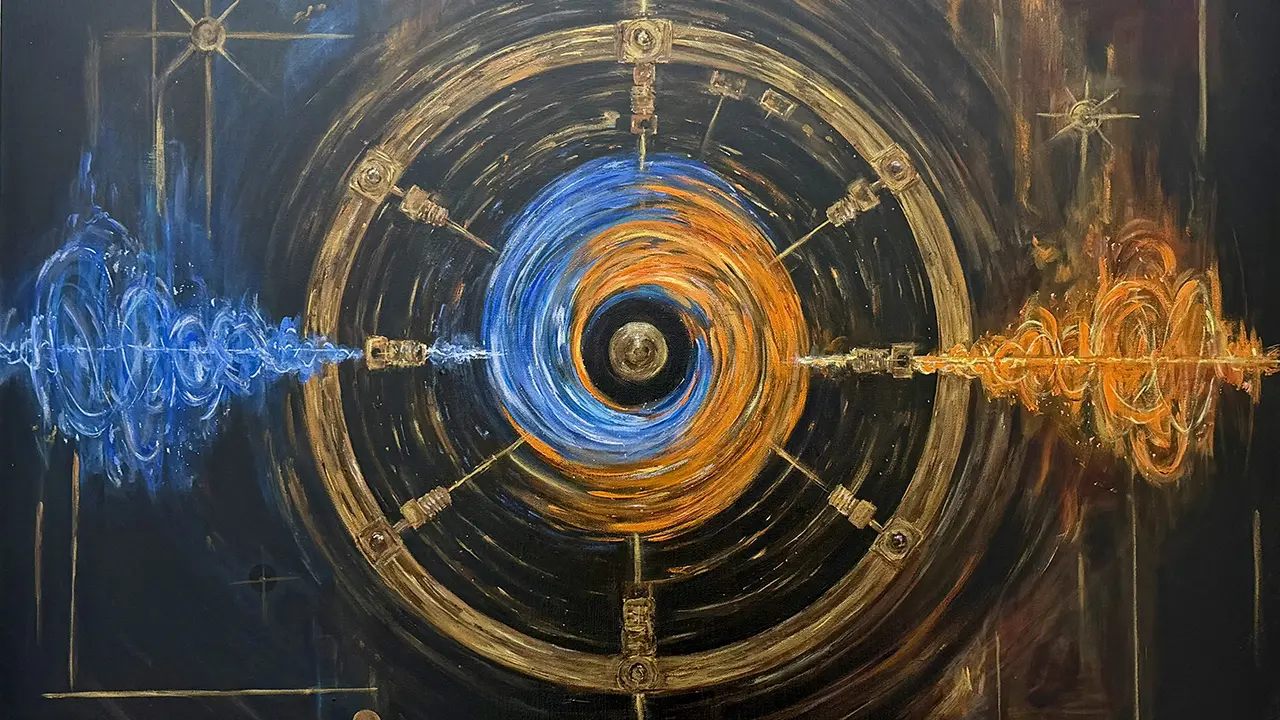
Researchers at the Advanced Science Research Center at the City University of New York Graduate Center (CUNY-ASRC) have demonstrated something English mathematician and physicist Sir Roger Penrose predicted over 50 years ago. According to Penrose, it would be possible to extract energy from a rapidly spinning (Kerr) black hole by inserting an object into the region just beyond its event horizon (the ergosphere). This object would be accelerated and ejected from the region, carrying more energy than it did when it entered/
In 1971, Soviet physicist Yakov Zeldovich came along and built on this theorem (the Penrose Process), predicting that a wave interacting with a rapidly-spinning object could not only extract energy from it, but amplify it. In a paper recently published in Nature, the team (all members of CUNY-ASRC Photonics Initiative) demonstrated a new approach for amplifying waves through interaction with rotating bodies. Using a radio-frequency device modulated to mimic spinning, they created a synthetic form of ultrafast rotation far beyond what can be achieved mechanically.
Their device and the physical principles it utilizes could allow researchers to overcome limitations that have long hindered experimental studies of ultra-fast rotational dynamics. It consists of a ring-shaped network of electronic resonators whose properties were rapidly modulated in a timed sequence to produce a traveling pattern around the ring. While the device remained still, the traveling pattern of electromagnetic waves created a form of synthetic motion that mimics an object rotating at ultra-fast speed.
“Our approach facilitates a new method of wave–matter interaction in which waves with selected rotational properties extract energy from synthetic time-engineered rotation, producing a form of broadband selective amplification,” said Andrea Alù, Distinguished and Einstein Professor of Physics at the CUNY Graduate Center and founding director of the CUNY-ASRC's Photonics Initiative.
Their experiment addresses the fundamental question raised in Zeldovich's work: can electromagnetic waves sent to a stationary device behave as though they were interacting with an object rotating at ultrafast speeds and extracting energy from it? According to lead author Hadiseh Nasari, a post-doctoral researcher with the CUNY ASRC’s Photonics Initiative, the success of the experiment shows it can be done:
This successful experiment moves ideas about extreme rotational dynamics from theory to practice and creates a versatile experimental platform for exploring a broad range of phenomena at the intersection of astrophysics, wave physics, and quantum science. The work has implications for advances in fundamental science and in communications, optics, and photonics.
Another significant takeaway from this experiment is that synthetic rotation can simulate motion faster than the speed of light, providing researchers with a powerful tool for studying extreme physics in a controlled laboratory setting. The research potential is immense, giving scientists the ability to manipulate light, process information, and investigate wave phenomena taking place in the most extreme environments in the Universe.
Looking ahead, the team hopes that their findings can be adapted for technological applications and extended to photonic and quantum studies. What's more, there are potential applications for the commercial sector, including classic and quantum optics, as well as wireless communications. As co-lead author Hady Moussa, a former PhD student with the CUNY ASRC Photonics Initiative, added:
Waves with the appropriate rotational characteristics extracted energy from the system and became amplified, reproducing the essential physics of the Penrose–Zel’dovich process. Our approach relies on engineered metamaterials that are designed to control how waves propagate.
Further Reading: CUNY-ARSC