Universe Today
Welcome back to our continuing series, A Brief-ish History of SETI. In our previous installments, we examined the foundations of the Search for Extraterrestrial Intelligence, both intellectual and technological. We also looked at the first modern SETI experiment, Project Ozma, and theories regarding what advanced extraterrestrial civilizations (ETCs) would be capable of. We also looked at the first attempt at Messaging Extraterrestrial Intelligence (METI) and what was (and still is) the most promising candidate for a signal detection.
All of these milestones and contributions have contributed to the legacy of the "Great Search." They also led to the realization of a profound concept, known as the "Cosmic Mirror." To put it simply, humanity's search for intelligent life tells us as much (if not more) about the evolution of human civilization as it does the extraterrestrial life we are searching for. Given that human civilization is the only example we have as a reference, SETI researchers are forced to speculate about the technologies an advanced species would rely on and the signals their technological activity would produce ("technosignatures").
This same principle has also informed "active SETI," or METI, where scientists have pondered what types of messages an advanced species would be able to understand. As the Arecibo Message demonstrated, math was the favored language among those who composed messages intended for ETCs. A close second were images, followed by sounds, intended to convey where we are in the galaxy and what we (and the lives we live) look and sound like. These considerations would be reflected in humanity's first attempts to send a "message in a bottle" beyond our Solar System.
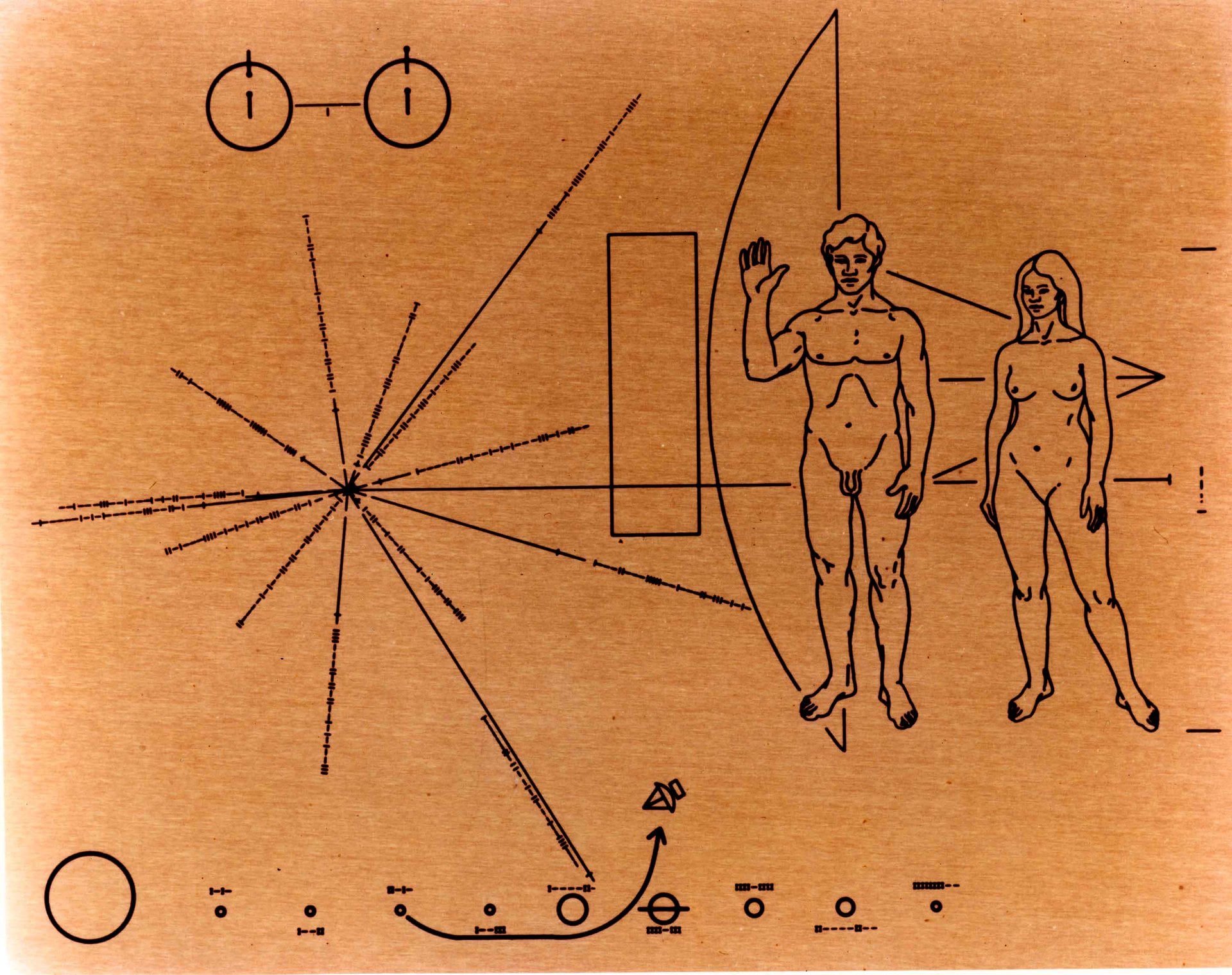 A detailed view of the visual message on the Pioneer plaques. Credit: NASA Ames
The Pioneer Plaques
The Pioneers 10 and 11 probes, launched on March 2nd, 1972, and April 5th, 1973 (respectively), were the first missions to explore the Asteroid Belt, Jupiter, and Saturn. As part of NASA's Pioneer Program, these missions were primarily focused on planetary science and improving our understanding of "space weather." Pioneer 10 and 11 were special, however, in that they would also be the first probes to achieve escape velocity from the Solar System.
As such, NASA decided to include a message from humanity with these missions in case an extraterrestrial species finds them someday. The idea was first suggested by journalist and science correspondent Eric Burgess, the chronicler of the Pioneer Program, and famed science communicator Carl Sagan. These efforts led to a pair of six-by-nine-inch (~23 cm by 15.25 cm) gold-anodized aluminum plates, known as the Pioneer Plaques. Each contained an engraved pictorial message identifying the probes’ time and place of origin and who had sent them.
From top to bottom, left to right, the message included the following details:
- The hyperfine transition of neutral hydrogen (the most common element in the Universe)
- The location of the Sun based on its distance from 15 nearby pulsars
- A depiction of the Solar System, showing the flight path of the probe from Earth
- A silhouette of the spacecraft
- Figures of a naked man and a woman, with the man raising his hand in greeting
Based on its current trajectory and velocity, Pioneer 10 will reach Aldebaran, a star roughly 65 light-years away in the Taurus constellation, in over two million years. Meanwhile, Pioneer 11 is headed for the Aquila constellation and will pass near one of its stars in about 4 million years. The Pioneer plaques were the first probes to carry an interstellar message of greeting from humanity. But they would not be the last, and would inspire an even more ambitious "message in a bottle" launched just a few years later.
The Voyager Golden Records
The twin Voyager 1 and 2 spacecraft were both launched in the summer of 1977 for the purpose of conducting close-up studies of Jupiter, Saturn, Saturn's rings, and their larger moons. However, as the mission progressed, NASA chose to take advantage of a rare alignment of the outer planets in the late 1970s and the 1980s to enable the four-planet "Grand Tour" that would include Uranus and Neptune. Since these missions would also achieve escape velocity from the Solar System, they were also equipped with messages from Earth.
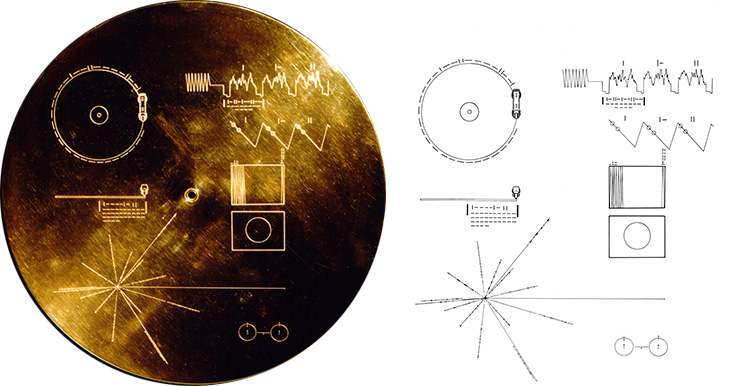 The Golden Record cover shown with its extraterrestrial instructions. Credit: NASA/JPL-Caltech
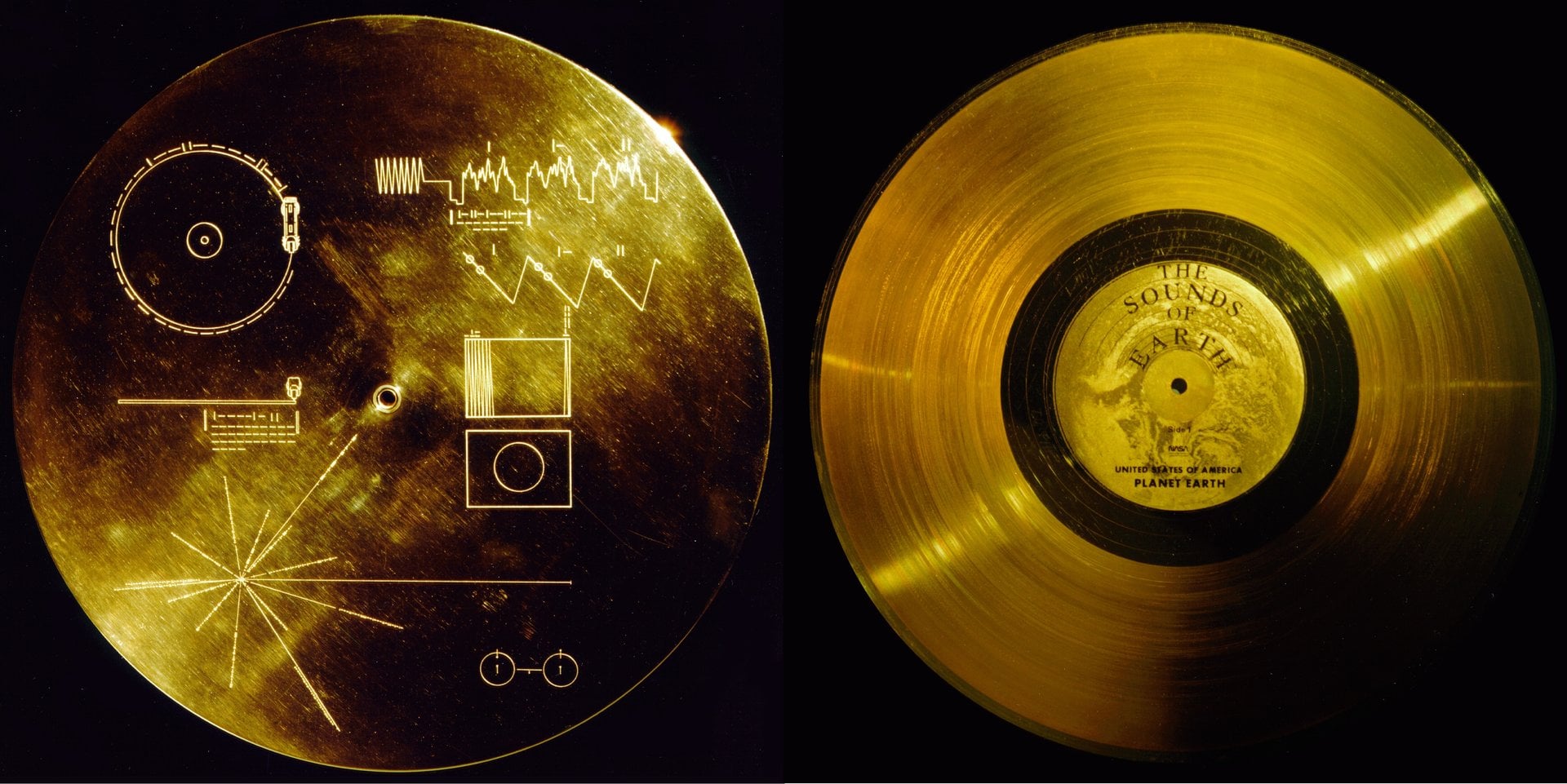
These were known as the Voyager Golden Records, a series of 12-inch (30.5 cm) gold-plated copper disks containing sounds and images selected to portray the diversity of life and culture on Earth. The outer cases were etched with pictograms (see above) showing where the probes came from (like the Pioneer Plaques) and instructions for playing the record. In the upper left portion, there's a drawing of the phonograph record and the stylus in the correct position for playing it.
Around it, in binary arithmetic, are the time for one rotation (3.6 seconds), the total duration (1 hour), and how it should be played from the outside in. The upper-right corner contains instructions for constructing pictures from the record. This includes (from top to bottom) a representation of the typical signal at the start of a picture, how the signals must be grouped as a series of 512 vertical lines per picture, and what the first image looks like (a circle) to confirm the signals are being processed correctly.
The drawing in the lower left-hand corner of the cover is the pulsar map (similar to the Pioneer Plaques) and a drawing of the hyperfine transition of neutral hydrogen. The record contains 115 encoded images that show human anatomy, our planet's geography, and mathematical/scientific concepts. It also contains sound recordings of greetings in 55 languages, whale calls, and music from various cultures and eras (including Beethoven and Chuck Berry).
The cover also features a "radioactive clock" in the form of an electroplated uranium-238 sample. Since this element has a half-life of 4.51 billion years, the recipients can calculate how long the probe has been in space. These records were also the brainchild of Carl Sagan and were intended to act as both a possible message for extraterrestrials and a time capsule, should future generations of human explorers find them first. As Sagan noted at the time:
The spacecraft will be encountered, and the record played only if there are advanced spacefaring civilizations in interstellar space, but the launching of this 'bottle' into the cosmic 'ocean' says something very hopeful about life on this planet.
On August 25th, 2012, Voyager 1 made history by becoming the first probe to enter interstellar space, and was joined by Voyager 2 on November 5th, 2018. They will be joined by the Pioneer 10 and 11 probes around 2057, though scientists may not be able to verify this since both probes are unpowered and cannot send data back to Earth. These plaques and records remain humanity's first attempt to send physical messages into space intended for extraterrestrial recipients.
Alongside the Arecibo Message, these efforts inspired a new debate among scientists about the ethics of METI. This debate is ongoing and central to the emergence of METI as a distinct field of study separate from SETI. Of particular controversy are the questions of safety - i.e., is it wise to broadcast our location to the cosmos? - and who has the authority to speak for Earth. Today, efforts to formulate a message from humanity are overseen by the non-profit organization METI International.
Tune in next time, where we'll explore more concepts that have become foundational to SETI, and which are sure to blow your mind!