Universe Today
Welcome back to our continuing series on the Brief-ish History of SETI. In our previous installments, we looked at the early history and the first experiments in the Search for Extraterrestrial Intelligence (SETI), followed by the first example of a modern SETI survey (Project Ozma) led by famed Cornell professor Frank Drake, the Drake Equation, and the enduring legacy of both. This was followed by some of the most enduring theories about what advanced civilizations might look like, including our own someday.
Next, we examined the first attempt at Messaging Extraterrestrial Intelligence (METI) and what is still considered the best candidate for an extraterrestrial signal (the Arecibo Message and the WOW! Signal), followed by the first physical message sent to interstellar space. And in our last installment, we examined two fundamental (and related) theories on why humanity has neither seen nor heard from an advanced extraterrestrial civilization (ETC), and the possible implications for humanity.
Today, we will examine some of the more practical suggestions as to why humanity has neither seen nor heard from an advanced extraterrestrial civilization (ETC), consistent with many of the arguments Sagan and Newman argued in their seminal paper (nicknamed "Sagan's Response"). We'll also examine some of the most mind-blowing and exotic explanations that take the concept of advancement in a whole different direction (and a whole different level!).
The Longevity Factor
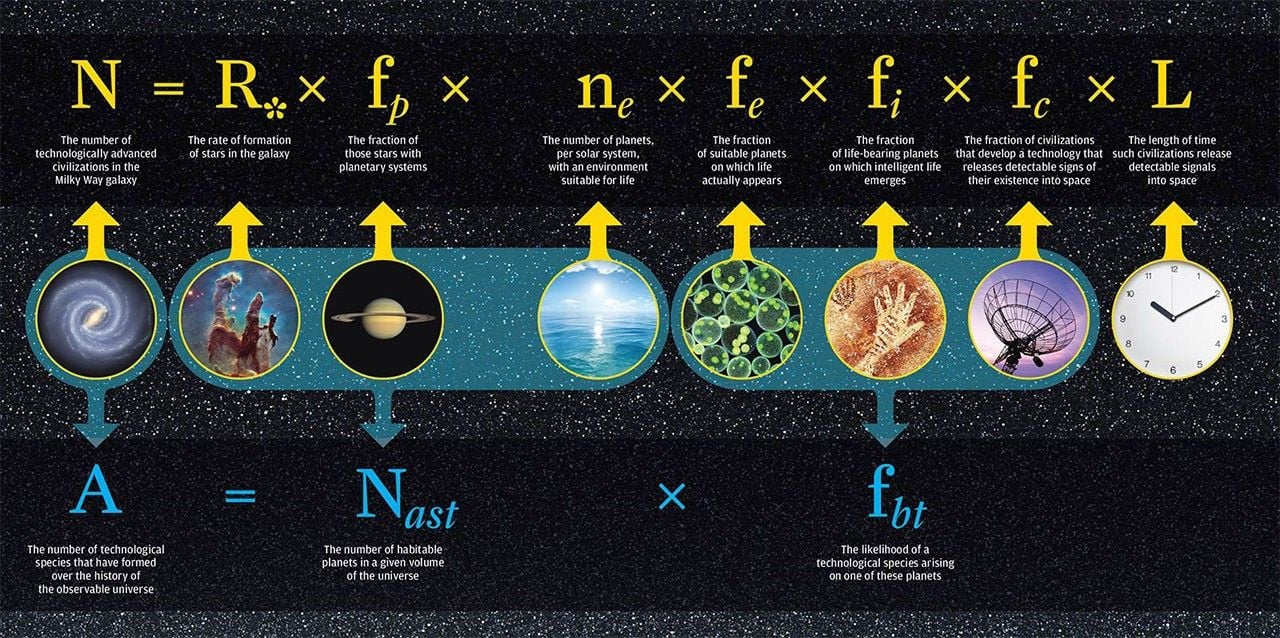
First up, there's what this author likes to call the "Brief Window Hypothesis," a proposed resolution to the Fermi Paradox that takes its cue from Frank Drake himself and from what he claimed was the most important parameter in his famous equation. This was none other than the time an extraterrestrial would have to transmit messages into space (L), otherwise known as the longevity factor. Basically, Drake posited that the lifetime of a civilization is finite, which was inspired by the very real possibility of nuclear annihilation during the Cold War.
This parameter has also inspired proposed resolutions to Fermi's Paradox. One of the earliest examples came from German astrophysicist and radio astronomer Sebastian von Hoerner, a colleague of Frank Drake's who participated in Project Ozma. In 1961, he penned a paper titled "The Search for Signals from Other Civilizations," in which he argued that the existential window of a technologically-advanced civilization might be too short relative to the time it would take to make contact with another intelligent species. As he wrote:
We should not underestimate the power of two critical factors that can terminate the life of a civilization once the technical state has been reached. Science and technology have been brought forward (not entirely, but to a high degree) by the fight for supremacy and the desire for an easy life.
Both of these driving forces tend to destroy if they are not controlled in time: the first one leads to total destruction, and the second one leads to biological or mental degeneration. In summary, we assume that a state of mind not too different from our own will have developed at many places but will have only a limited longevity.
Another issue with most proposed resolutions to Fermi's Paradox is the inherent assumption that advanced civilizations will experience exponential growth. In contrast, some researchers have presented scenarios in which ETIs were unable to sustain this growth pattern, which is why none have succeeded in becoming a galactic civilization. In 2009, Jacob D. Haqq-Misra of the Blue Marble Space Institute of Science (BMSIS) and Seth D. Baum of the Global Catastrophic Risk Institute (GCRI) argued this very point in a study titled "The Sustainability Solution to the Fermi Paradox."
Essentially, they ventured that "[t]he absence of ETI observation can be explained by the possibility that exponential or other faster-growth is not a sustainable development pattern for intelligent civilizations." Drawing on lessons from human history, Haqq-Misra and Baum showed that exponential growth has been a common feature, often to the detriment of the civilizations involved. This has led geologists to coin the term "Anthropocene," which acknowledges that humanity is currently the single greatest determining factor in Earth's evolution.
When applied to exo-civilizations, they claimed, the same tendency could explain why we don't hear from aliens:
The Fermi Paradox ultimately concerns the spatial expansion of civilizations, but spatial expansion is closely linked with expansion in population, environmental impact, and resource consumption. For example, migration is often driven by resource shortages, which in turn may result from large population and/or environmental degradation. Likewise, migration to uninhabited regions can lead to resource surpluses, which can in turn drive population growth. Finally, [a] broadly expansionist policy can cause expansion in each of space, population, environmental impact, and resource consumption.
Another example comes from a 2018 book titled Light of the Stars: Alien Worlds and the Fate of the Earth, by astrophysicist Prof. Adam Frank. This work also drew on his 2018 study, "The Anthropocene Generalized: Evolution of Exo-Civilizations and Their Planetary Feedback," which Frank conducted with an international team of colleagues. In both cases, Frank argued that the Anthropocene could offer a resolution to the Fermi Paradox by framing sustainability as a counterargument to exponential growth. Citing the Drake Equation, Frank stressed the following:
Earth is not unique. Even if, for example, Pc [the probability of a civilization arising on a habitable zone planet] were as low as 10-19, the number of technological civilizations like our own across the history of the visible Universe would still be large enough (Nc~1000) for statistically meaningful average properties of exo-civilizations to exist.
These average properties include, the average lifetime of a technological civilization. We note that represents the final factor in the Drake equation and, therefore, has a long history within the debate concerning exo-civilizations. Its importance for issues of sustainability are straightforward.
Other research has focused on the possibility that the window itself might be a function of distance, and civilizations that send out signals are unlikely to live long enough to get a response. This argument was made by Claudio Grimaldi and a team of scientists - including Dr. Frank Drake - in a 2018 study titled "Area Coverage of Expanding E.T. Signals in the Galaxy: SETI and Drake’s N." where they made two key assumptions about the Drake Equation. First, they posited that ETIs emerge in our galaxy (N) at a constant rate. Second, they'll only be able to send transmissions for a certain amount of time before they go extinct.
Long after these civilizations have died, these broadcasts will keep traveling outward at the speed of light (c). They would form an annulus (a donut-shaped wavefront) within which the radio signals would be detectable. The thickness of each annulus' walls (measured in light-years) will correspond to how many years the civilization was able to broadcast radio signals to space before going silent. Two cases emerged based on the radiation shells being (1) thinner or (2) thicker than the diameter of the Milky Way (~100,000 light-years).
This is relative to the assumed lifetimes of advanced civilizations, which could be shorter or longer than the time it takes light to cross our entire galaxy (~100,000 years). In the first case, each annulus wall would be smaller than our galaxy and only fill a fraction of it, reducing the chance of a SETI detection. But depending on how often civilizations emerge, they found, these rings might fill our galaxy with signals and even overlap. In the second case, a ring would be thicker than our galaxy, but detection would depend on how many civilizations are broadcasting.
In the end, Grimaldi, Drake, and their colleagues found that the number of signals reaching Earth would be about the same in both cases. However, assuming that civilizations live for less than ~100,000 years, they determined that "the transmissions arriving at Earth may come from distant civilizations long extinct, while civilizations still alive are sending signals yet to arrive." In other words, by the time humanity receives a message from an advanced civilization, that civilization would already be dead!
The Coming Singularity
Similarly, researchers have offered a reinterpretation of the longevity factor by citing the concept of the Technological Singularity. This concept is traced back to the famed Hungarian-American mathematician and physicist John von Neumann, who is also credited with the idea of self-replicating machines (aka. "Universal Constructors" or von Neumann probes). In 1958, his longtime colleague Stanislaw Ulam penned an essay, "John von Neumann (1903–1957)," in which he recounted a conversation the two once had concerning the changing pace of technological change:
"One conversation centered on the ever-accelerating progress of technology and changes in the mode of human life, which gives the appearance of approaching some essential singularity in the history of the race beyond which human affairs, as we know them, could not continue."
The term has been popularized by authors such as Vernor Vinge, a former professor of computer science at San Diego State University (SDSU), and by computer scientist, author, futurist, and entrepreneur Ray Kurzweil. In 1993, Vinge wrote an essay titled "The Coming Technological Singularity," in which he formalized arguments made previously in a presentation at the VISION-21 Symposium, sponsored by NASA Lewis Research Center and the Ohio Aerospace Institute. Central to both was Vinge's assertion that humanity was on the verge of a major transformation resulting from the "imminent creation by technology of entities with greater-than-human intelligence."
He further predicted that this transformation would occur between 2005 and 2030 and could be due to any of the following causes:
- Computers that are "awake" and superhumanly intelligent
- Large computer networks and their associated users
- Computer/human interfaces that allow users to be considered superhumanly intelligent
- Biological science leading to improved natural human intellect
Similar arguments were made by Jodrell Bank Center for Astrophysics Director Michael A. Garretta, who is also the Sir Bernard Lovell Chair of Astrophysics at the University of Manchester. In a 2025 paper titled "Blink and you’ll miss it - How Technological Acceleration Shrinks SETI’s Narrow Detection Window," he revisited the "communication horizon" argument made by Carl Sagan in his 1973 paper, "On the detectivity of advanced galactic civilizations."
As Garretta argued, highly advanced civilizations may undergo rapid technological acceleration to the point that they evolve "beyond recognizable or detectable phases." Such "post-biological" lifeforms may opt to live in "radio quiet" regions and choose not to communicate, focusing on optimizing their environments instead. Meanwhile, Ray Kurzweil emphasized that the history of technological progress is guided by the "law of accelerating returns," in which each new technological breakthrough accelerates the pace of development.
This trend, Kurzweil argues, will eventually reach a point of inflection where progress will no longer be measurable using our current metric.
The Trouble with Transcension
A related idea is the Transcenion Hypothesis, which was popularized by futurist John M. Smart, the CEO of Foresight University and founder of the Acceleration Studies Foundation. In his 2002 paper, titled " Answering the Fermi Paradox: Exploring the Mechanisms of Universal Transcension, " he argued that technological evolution could be the reason for the "Great Silence."
Smart extended his arguments in a 2011 essay titled "The transcension hypothesis: Sufficiently advanced civilizations invariably leave our universe, and implications for METI and SETI." Here, explained how "a universal process of evolutionary development guides all sufficiently advanced civilizations into what may be called "inner space," a computationally optimal domain of increasingly dense, productive, miniaturized, and efficient scales of space, time, energy, and matter..."
Central to this hypothesis is the idea that Evolutionary Development (aka. evo-devo) is a fundamental dynamic in our Universe where biological and technological development simultaneously contribute to an "autopoietic" (self-reproducing) system. In particular, Smart considered how transcendent ETIs would relocate to the regions surrounding black holes since they are an ideal power source (the Penrose Process) and could enable all kinds of extreme physical science.
Central to the Transcension Hypothesis and other theories that focus on "environmental optimization" over expansion is the Barrow Scale. Proposed in 1998 by cosmologist John D. Barrow, this scale is the inverse of the famous Kardashev Scale, suggesting that advanced species would choose to occupy smaller and smaller scales of space. In his 1998 study, "Impossibility: Limits of Science and the Science of Limits," Barrow observed that humans have benefited far more from extending their abilities to increasingly small scales than to larger ones, citing concepts like Moore's Law.
This led Barrow to propose a possible extension to the Kardashev Scale known as "Microdimensional Mastery," which classifies civilizations in the following way:
- Type I-minus: capable of manipulating objects over the scale of themselves - Type II-minus: capable of reading and engineering the genetic code - Type III-minus: capable of manipulating matter at the molecular level - Type IV-minus: capable of manipulating matter at the atomic level (i.e., nanotechnology) - Type V-minus: capable of manipulating matter at the subatomic level (nucleus and nucleons) - Type VI-minus: capable of manipulating the elementary particles of matter (quarks and leptons) - Type Omega-minus: capable of manipulating the basic structure of space and time
As you have probably gathered by now, the "Brief Window Hypothesis" and related ideas come down to a simple premise. Essentially, humanity has a limited amount of time to communicate with other intelligent species before they "go quiet." On the one hand, the window could be the result of distance and the good old longevity factor, where civilizations inevitably die before their "annulus" of transmissions is detected and a reply is received.
On the other hand, the window could be the result of technology and the "Law of accelerating returns." In this scenario, humanity has a limited amount of time to detect messages sent via traditional broadcasting technologies (such as radio waves). By the time a reply reached the intended recipient, they would have already advanced to a higher stage of technological development and would no longer be listening to that frequency. Similarly, a sufficiently advanced civilization may lose interest in making contact with others, preferring to live out its optimized existence in silence.
In short, civilizations either inevitably die or evolve to the point that we would lack the means to communicate with them (or maybe even recognize them). Both of these possibilities have significant implications for SETI, METI, and the prospect of humanity someday making contact with another intelligence. These theories represent another important milestone in the history of SETI, where scientists truly dug deep to answer the fundamental question, "Where is everybody?"
Tune in next time, where we'll address one of the most pressing questions facing SETI researchers today: Is it time to update the Fermi Paradox, or let it go? We'll also look at the new and exciting efforts to renew the search for intelligent life, thus proving finally that humanity is not alone in the Universe!