Universe Today
Welcome back to a Brief-ish History of SETI! In our previous installments, we examined the earliest attempts to find extraterrestrial intelligence (ETI) beyond Earth, as well as one of the most important philosophical underpinnings (Fermi's Paradox). We also looked at the first true example of the Search for Extraterrestrial Intelligence (SETI) experiment (Project Ozma) and the Drake Equation, followed by the first proposed searches for megastructures (Dyson Spheres) and classification schemes for ETIs (the Kardashev Scale).
Today, we'll examine the first attempt at "active SETI," aka. Messaging Extraterrestrial Intelligence (METI), and what remains the best candidate for a possible message of extraterrestrial origin. These are none other than the Arecibo Message, and the WOW! Signal, two pivotal moments in the history of SETI that remain unrivaled to this day. Buckle up, because some big concepts and big names (one of whom was the focus of Part II) are about to be dropped!
The Arecibo Message
In 1960, famed Cornell Professor Frank Drake spearheaded Project Ozma (the first modern SETI experiment) using the radio telescope at the National Radio Astronomy Observatory in Green Bank, West Virginia. For six hours a day, between April and July of 1960, Drake and his colleagues listened to Tau Ceti and Epsilon Eridani - two nearby Sun-like stars - for radio signals in the frequency range of cold neutral hydrogen gas in interstellar space (1420 Hz or near 21 cm). Although the project failed to detect anything beyond radio static, it paved the way for future SETI and METI efforts.
Construction on the National Astronomy and Ionosphere Center (NAIC) - aka. the Arecibo Observatory - lasted from the mid-1950s until the early 60s. Originally, this massive radio telescope was dual-purpose, designed to study Earth's ionosphere and to detect incoming ballistic missiles as they traveled through the upper atmosphere. When it became operational in 1963, Prof. Drake was the Director of the NAIC and oversaw its conversion into an astronomical observatory dedicated to radio astronomy.
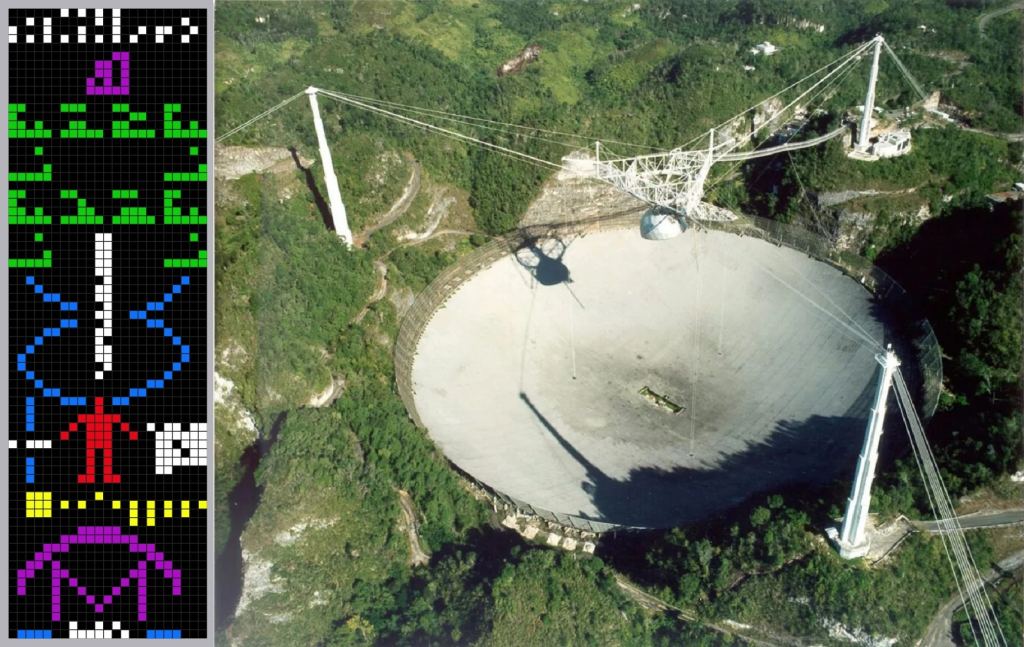
In the early 1970s, Frank Drake organized the first campaign to use Arecibo's megawatt transmitter, attached to its 305-meter (1000-foot) antenna, to send a message to space. Rather than an invitation to open communications between Earth and an ETI, the message was a technology demonstration intended to convey humanity's abilities, scientific knowledge, and our location in the galaxy. In essence, it was a way of saying "Hello there" and "This is who and where we are" to any advanced species capable of receiving it.
The message was composed by Drake with the assistance of Sagan and other prominent astronomers and consisted of a 1679-binary-digit picture (210 bytes), the product of two prime numbers, arranged in a rectangular grid of 73 lines, each with 23 characters (also prime numbers). The use of prime numbers was deliberate since it would likely make the message easier for an alien civilization to decode. The message conveyed a series of scientific, geographical, biological, and astronomical information in different colors. These included:
- A counting scheme of 1 to 10 (white)
- The atomic numbers for hydrogen, carbon, nitrogen, oxygen, and phosphorus, which make up DNA (purple)
- The chemical formula of the four purines and pyrimidine bases that make up DNA (green)
- An image of the DNA double helix and an estimate of the number of nucleotides (blue and white, respectively)
- A stick-figure of a human being (red), our average dimensions (blue/white), and the human population of Earth (white)
- A depiction of the Solar System, indicating that the message is coming from the third planet (yellow)
- A schematic of the Arecibo Observatory and its dimensions (purple/white and blue)
This signal was transmitted on November 16th, 1974, at a frequency of 2380 MHz, with an effective bandwidth of 10 Hz, and lasted for less than three minutes. The broadcast lasted less than three minutes and was equivalent to a 20-gigawatt omnidirectional broadcast, meaning that it would be detectable by any radio antenna in the galaxy similar in size to Arecibo. The destination for this message was Messier 13 (NGC 6205 or "The Great Hercules Cluster"), a globular star cluster located about 22,000 light-years from Earth.
This cluster, composed of 300,000 stars across 145 light-years, is estimated to be 11.65 billion years old, making it a good candidate for messaging an extraterrestrial civilization. More than fifty years later, the Arecibo Message is still considered one of the most important milestones in the history of SETI and METI. Like Project Ozma, it coincided with the Space Age, taking place just 2.5 years after the last Apollo mission (Apollo 17) landed on the Moon. In this sense, our exploration of space was mirrored by a similar interest in finding intelligent life elsewhere in the cosmos.
A few years later, another major event took place, making scientists and regular folk alike wonder whether someone out there was trying to message us as well!
WOW!
On August 15th, 1977, radio astronomer Jerry Ehman was reviewing printouts of observational data at the Ohio State University Radio Observatory (OSURO) in Delaware, Ohio - aka. the Big Ear Observatory. Between 1965 and 1971, the observatory conducted the Ohio Sky Survey, an astronomical survey of extragalactic radio sources. With this complete, the facility's Big Ear Telescope began searching for extraterrestrial radio signals two years later, a search that continued until 1995 (making it the longest SETI experiment in history).
While the mountains of data this search generated were generally nothing more than the background hum of the Universe, Ehman noticed something very different on this day. When searching through endless fields of numbers, he noticed the characters "6EQUJ5," which indicated a signal of particular intensity. In red pen, Ehman wrote "WOW!" next to it, and the nickname stuck. The entire signal sequence lasted 72 seconds, during which the Big Ear Telescope was able to receive it. Several follow-up observations failed to detect the signal again.
Over fifty years later, the WOW! Signal remains an unexplained one-off event, with now-debunked explanations including radio interference, comets, and space debris. However, in August 2024, the Planetary Habitability Laboratory (PHL) published a paper reporting that the Wow! Signal was likely caused by stellar emissions energizing a cold hydrogen cloud, causing it to suddenly surge in brightness.
A year later, the same team from the PHL published a paper offering updated conclusions on its possible point of origin, peak flux density (250 Janskys instead of 54 and 212), and frequency. The updated frequency, 1420.726 MHz rather than 1420.4556, suggested that the signal came from a galactic source with a substantially higher radial velocity than previously assumed, they claimed. While the updated paper also narrowed the part of the sky the signal could have emanated from, this increased the statistical certainty of its location by two-thirds.
These two events, the first METI signal and the most promising candidate, remain unparalleled in the history of SETI. In addition, they've also inspired a great deal of follow-up investigations, surveys, and discussions regarding the ethics of communicating to the cosmos. Tune in for our next installment, where we will look at some more examples of messages intended for other intelligent life forms, as well as other proposed explanations for why we haven't heard from anybody... yet!