 Universe Today
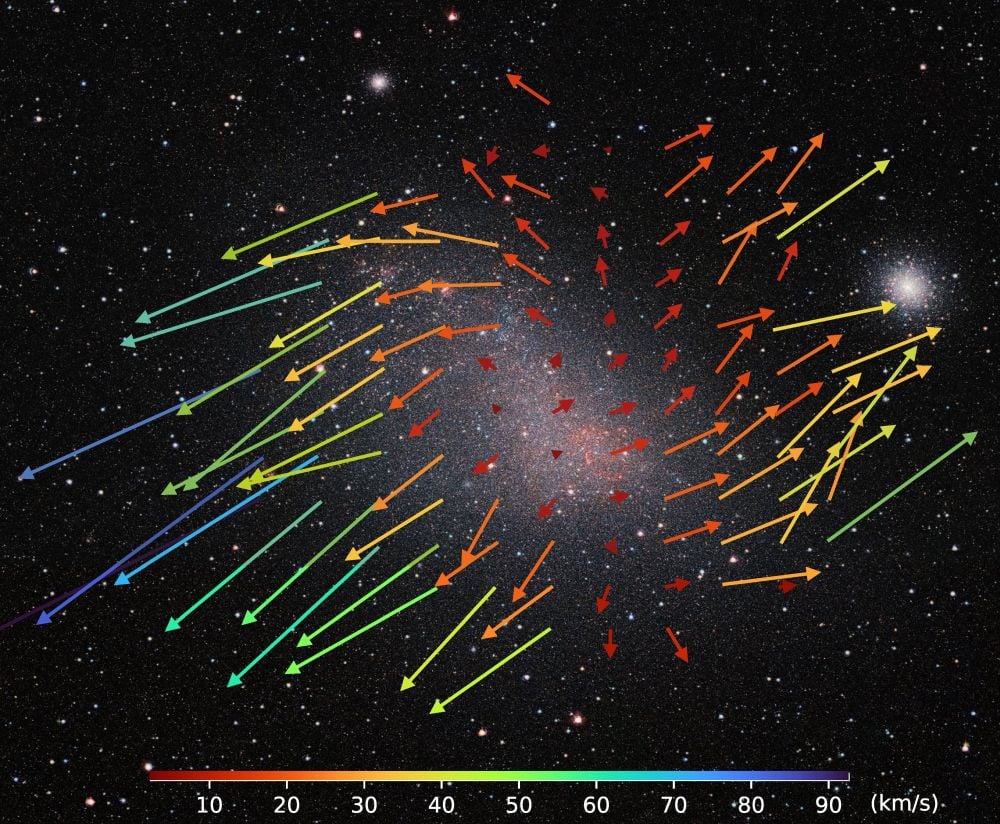
Our galactic neighbours are struggling to get along with one another. According to a new research letter to be published in Astronomy and Astrophysics, interactions between the Large and the Small Magellanic Clouds are anything but peaceful. The SMC is expanding and is out of equilibrium because of its interactions with the LMC.
The Magellanic Clouds are the Milky Way's two largest and most well-known satellite galaxies. Though research shows they're both being shaped by the much more massive Milky Way—and will eventually merge with it— the pair of irregular dwarf galaxies are also engaged in their own gravitational shenanigans. Astronomers know about a bridge of gas connecting the two clouds, and how stars are forming in it. But this research shows that there's more to their ongoing interactions.
The research letter is titled "The VMC survey. LV. The coherent expansion of the SMC," and the lead author is Sreepriya Vijayasree, a doctoral student at the Leibniz Institute for Astrophysics Potsdam. The VMC in the title stands for the VISTA Survey of the Magellanic Clouds.
VISTA is an infrared survey telescope in Chile. It's the largest telescope in the world dedicated to near-infrared (NIR) surveys. Though Earth's atmosphere blocks most infrared light, there are a few openings at specific NIR wavelengths, and VISTA makes use of them. The VMC is one of VISTA's six large survey efforts.
The VMC is studying several aspects of the Magellanic Clouds, including the proper motions of stars. It's revisiting the same fields in the clouds multiple times over the years, letting it track millions of individual stars as they move across the sky. This generates a better overall understanding of the MC's kinematics over time.
"Here, we investigate the two-dimensional stellar kinematics of the SMC to understand the dynamical effects of these interactions by exploiting the increased time baseline of 6−11 years from the VISTA Survey of the Magellanic Clouds (VMC) data release 7," the authors write. "We derive proper motions with a threefold improvement in precision compared to previous studies based on VMC data."
"The VMC survey was designed to map the Magellanic Clouds in unprecedented detail in infrared light, allowing astronomers to peer through dust and study stellar populations spanning a wide range of ages," said Prof. Dr. Maria-Rosa Cioni, VISTA's principal investigator. "The latest VMC data release extends the observational time baseline to as much as 11 years, enabling much more precise measurements of stellar motions than earlier studies."
The SMC has an overall motion that astronomers call its bulk systemic motion. This is how it moves as a coherent, gravitationally-bound unit. But the individual stars also have their own motions, called their proper motions. Finding these residual proper motions required removing the SMC's bulk systemic motion from VISTA's observations.
"We first construct a residual velocity map by subtracting the systemic motion of the SMC from the observed proper motions," the researchers explain in their letter. "We then fit and remove a linear velocity gradient from this residual field, obtaining a gradient-corrected residual map that emphasises small-scale kinematic substructures."
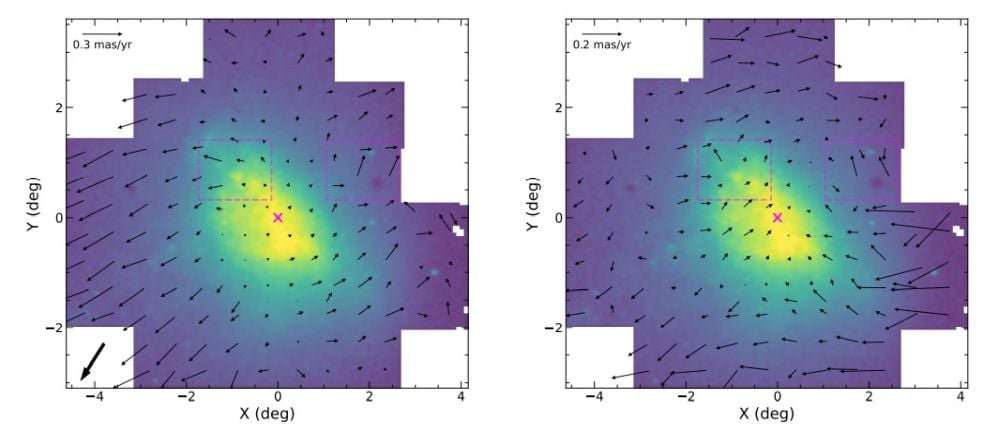 These are residual proper motion maps projected onto the sky plane. The panel on the left shows the motion of stars in the SMC after the bulk systemic motion has been removed. The large black arrow in the box in the lower left shows the SMC's bulk system motion. The panel on the right shows the motion of SMC stars after a best-fitting linear velocity gradient from the left panel is removed. The overall pattern is "... consistent with an LMC-induced tidal stretching, extending into the inner parts," the researchers explain. Image Credit: S. Vijayasree et al. 2026. A&A. DOI: https://doi.org/10.1051/0004-6361/202659431
The work shows that the SMC is expanding due to the influence of its larger neighbour. "For the first time across all stellar populations, the residual proper motion map reveals expansion along the south-east and north-west directions, consistent with LMC-induced tidal forces, detectable even in the central regions," the researchers explain.

Galaxies typically rotate in a coherent fashion, and though the SMC's rotation is observed to be out of the ordinary, polluted by some random motions and streaming of stars, astronomers thought it still behaves like a rotating disk. But this research shows otherwise.
“The results reveal large-scale tidal expansion throughout the Small Magellanic Cloud galaxy and challenge long-standing assumptions that the Small Magellanic Cloud behaves like a rotating disk,” said lead author Vijayasree in a press release. “The study shows that the internal motions of stars in the Small Magellanic Cloud are dominated not by orderly rotation, but by gravitational disturbances caused by repeated encounters with the LMC over billions of years.”
“When I saw the results for the first time, I was really amazed by the quality of the measured stellar motions," said study co-author Dr. Florian Niederhofer from AIP. By combining observations that have been taken over a time baseline of more than a decade, we were able to map the internal kinematics of the Small Magellanic Cloud with a level of detail that is outstanding for observations from the ground.”
The stars in the SMC are moving outward at about 17 km per second. That's a modest speed in astronomical terms, but it's significan in the SMC. Since the SMC is a dwarf galaxy, it isn't very massive compared to other galaxies. As a result, its escape velocity could be as low as 60 km per second. Stars aren't exactly escaping from the SMC, but over billions of years, they could eventually escape or deform the galaxy.
The results show that the SMC is a complex structure, struggling under the gravitational influence of its larger neighbours. It lacks a coherent rotational motion, and even stars in its inner regions are moving outward. The results also show that different populations of stars are moving differently. Older red giant stars in the SMC are moving northward, indicating that they originated from a much older interaction.
"The dynamics of the SMC are highly complex, as confirmed by multiple studies, including the present work," the researchers write. "Recent analyses have highlighted that simple rotating-disk models are insufficient to capture the observed kinematics, a conclusion that is clearly supported by our results, which reveal strong signatures of disequilibrium even in the inner regions."

