Universe Today
For roughly a century, scientists have known that our Universe is in a constant state of expansion. Known as the Hubble-Lemaitre Constant, in honor of the two astronomers who demonstrated it, this law is fundamental to our cosmological models. The rate at which the Universe is expanding, however, has been revised many times over the past century as astronomers have looked farther into the cosmos and further back in time. Knowing the rate of expansion is very important to scientists, as it helps them determine how the Universe began and what its ultimate fate will be.
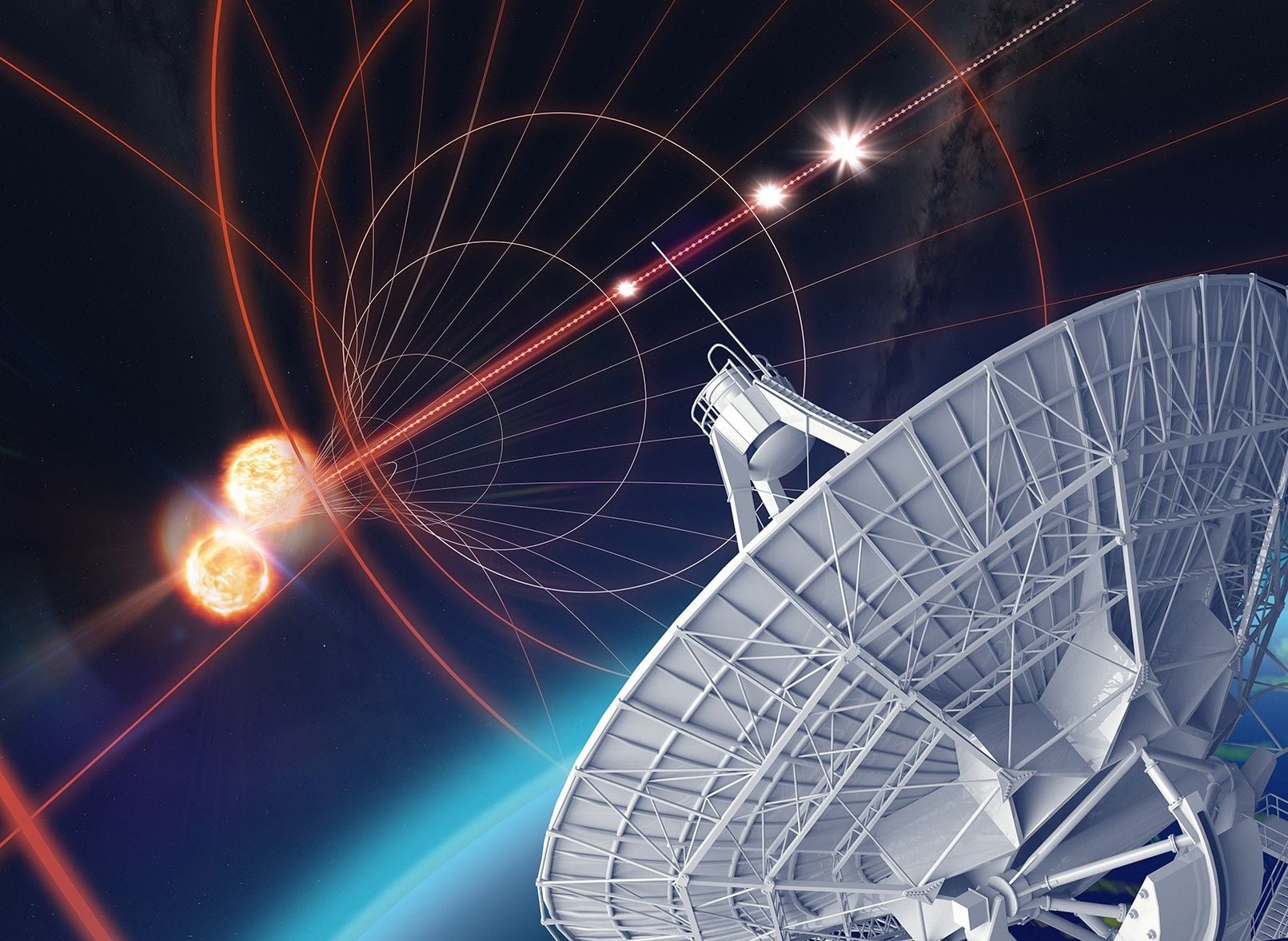
It will also help resolve major cosmological mysteries, such as the existence of Dark Matter and Dark Energy. In a recent study, an international team led by researchers at Swinburne University of Technology (SUT) and Australia's Commonwealth Scientific and Industrial Research Organization (CSIRO) observed the aftermath of two neutron stars colliding. By combining telescope observations and gravitational wave data, they have produced new measurements of the Hubble-Lemaitre Constant.
The team included researchers from Swinburne's Center for Astrophysics and Supercomputing, the ARC Center of Excellence for Gravitational Wave Discovery (OzGrav), Tel Aviv University, the University of Queensland, the Indian Institute of Technology Kanpur (IIT Kanpur), and the California Institute of Technology (Caltech). The paper detailing their findings recently appeared in The Astrophysical Journal.
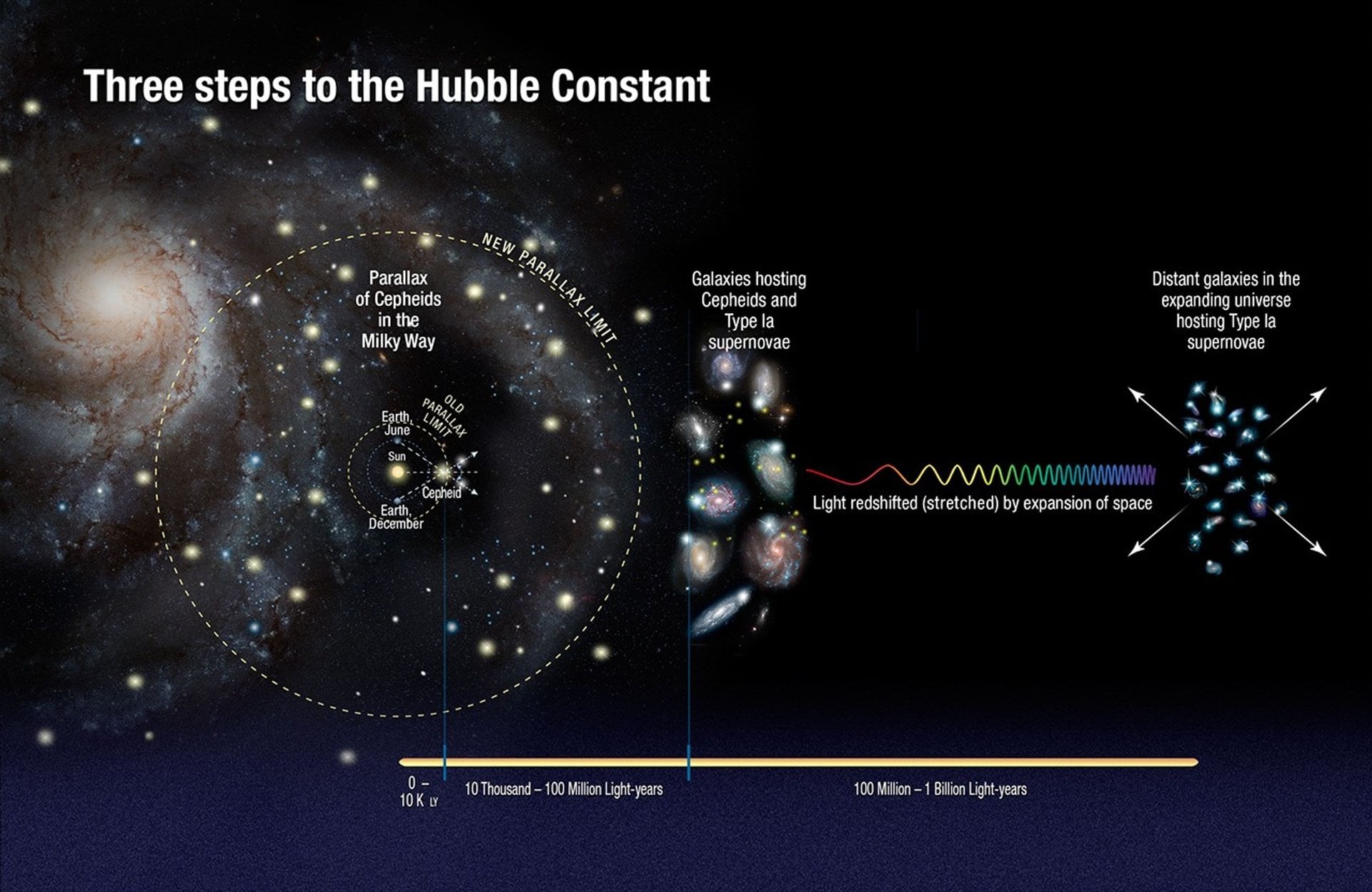 The three steps astronomers used to measure the Universe’s expansion rate, known as the Cosmic Distance Ladder. Credit: NASA/ESA/A. Feild (STScI)/A. Riess (STScI/JHU)
To measure cosmic expansion, scientists rely on distance measurements of galaxies dating back to the early Universe. This requires different methods, depending on how far away the objects are located, known as the Cosmic Distance Ladder. The problem is that the measurements are in "tension" with one another, leading to an ongoing debate among cosmologists known as the Hubble Tension.
To break it down, the first and second "rung" of the Ladder consists of using parallax measurements of nearby stars and "standard candles" (Cepheid Variables and Type Ia supernovae) to measure the distances to objects tens of millions of light-years away. Thanks to the venerable Hubble Space Telescope, astronomers calculated an expansion rate of 67 km/s (41.6 mps) per megaparsec (Mpc) - roughly 3.262 million light-years.
The final rung involves using redshift measurements of the Cosmic Microwave Background (CMB) to calibrate distances spanning billions of light-years. The mapping of this background by the ESA's Planck satellite yielded an estimate of about 73 km/s (45.36 mps) per Mpc. CSIRO’s Dr Kelly Gourdji, the lead author on the paper, explained in a SUT press statement:
One method uses data from the very early Universe -the cosmic microwave background radiation - to make the measurement, while the other uses measurements from relatively nearby supernovae, making it data from the late Universe. Our independent measurement using gravitational waves is a late Universe method, but the result is more consistent with the early Universe value.
Only two possibilities arise from this tension: either one of the measurements is wrong, which becomes more likely as the rungs progress, or our understanding of physics is wrong. By combining data from the High Sensitivity Array (HSA), a global network of telescopes, astrometry data from Hubble, and gravitational-wave data, the Swinburne- and CSIRO-led team was able to provide a new measurement that could help resolve the Hubble Tension. The collision was so powerful that it also sent jets of energetic particles into space, of which the team's observations were crucial to making the measurement.
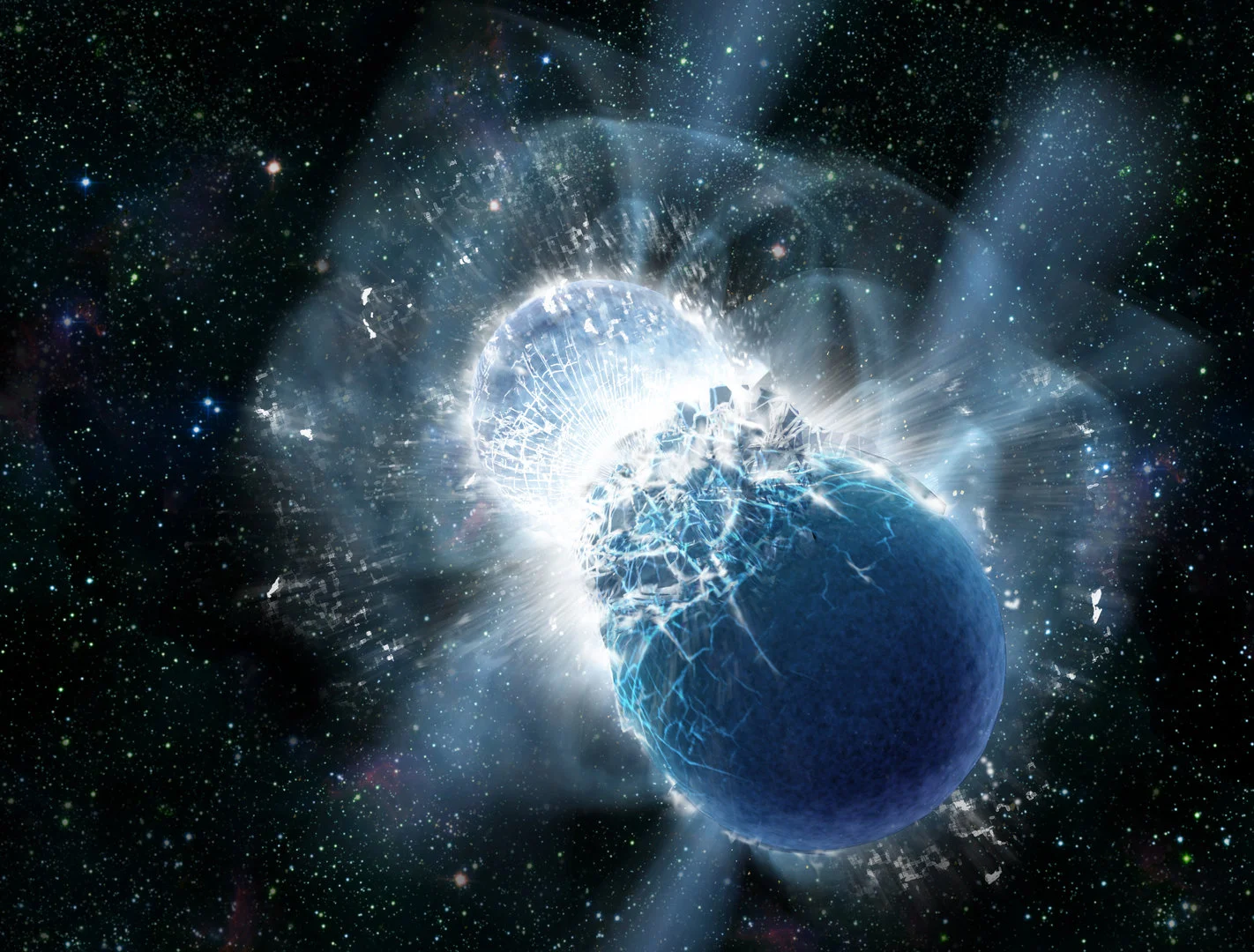 Artist's impression of a binary neutron star merger, or kilonova event. Credit: Dana Berry, SkyWorks Digital, Inc.
The new value obtained from these observations was not as precise as the more established measurements. Still, it is more accurate than previous attempts that relied on GWs - the most compelling evidence to date that GW measurements could help resolve the Tension. Said Swinburne Professor Adam Deller, who led the radio observations used in the research:
These jets are launched for only a couple of seconds, but as they slam into the surrounding gas, they glow for months afterwards. We analyzed almost a year of observations from the Hubble Space Telescope and two different arrays of radio telescopes spread across the USA and Europe. Some astronomers had proposed ways in which both measurements could be correct if our understanding of cosmology was changed - but our measurement argues quite strongly against that solution.
“This would suggest that there is not something wrong with our understanding of cosmology, though we’ll need to examine more neutron star mergers like this one to be sure," added lead-author Dr. Kelly Gourdji, a researcher with CSIRO and OzGrav. "For now, this result adds another data-point for cosmologists to consider in the lively Hubble tension debate."
Further Reading: Swinburne University, The Astrophysical Journal