Universe Today
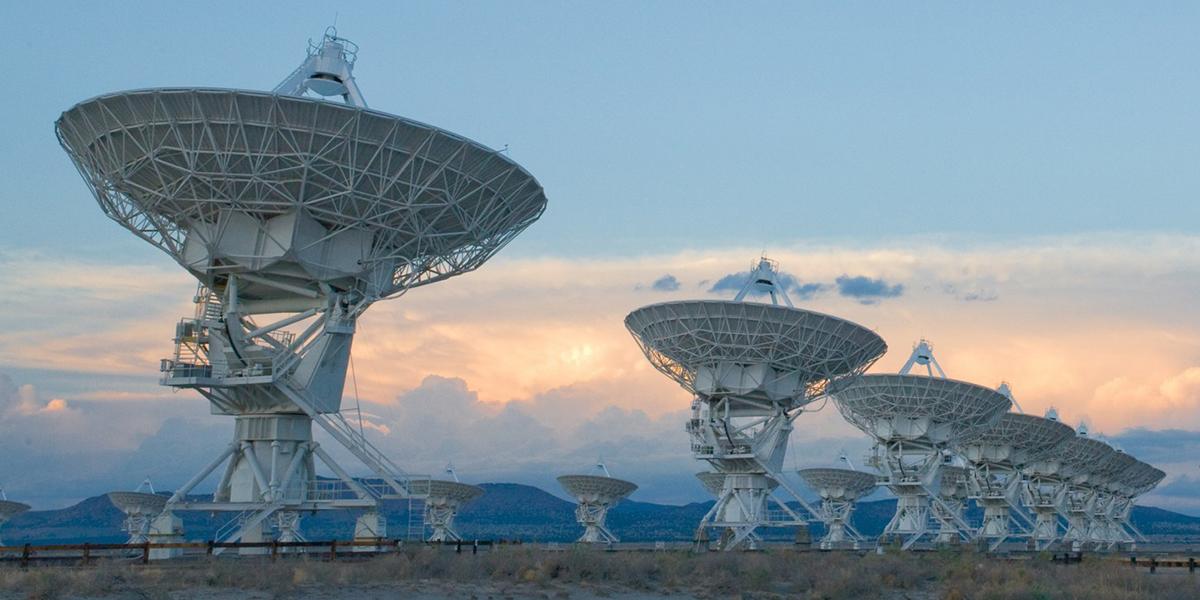
Welcome back to A Brief-ish History of SETI, where we examine the major milestones and foundational principles that have defined the Search for Extraterrestrial Intelligence (SETI). In Part I, we examined the purpose and motivations behind this field of study, as well as how Fermi's big question ("Where is everybody?") helped define the challenges it entails. We also looked at some of the earliest experiments and how they reflected a growing sense of curiosity about the cosmos and our place in it.
Today, we'll take a look at what is arguably the first SETI survey (Project Ozma) and its enduring legacy. In addition to laying the groundwork for future SETI experiments, the project's leader, Professor Frank Drake (considered the "father of SETI" for his pioneering work), would also propose an equation that remains a foundational principle to the field. What's more, the experiment he led would be the first dedicated search for extraterrestrial intelligence (ETI) beyond the Solar System, reflecting a new perspective on life in the Universe.
Prior to this, scientists had confined their searches for extraterrestrial signals to the Solar System, targeting Mars and Venus. But as technology improved and our awareness of the cosmos expanded, so too did our searches.
Looking Beyond
During the 1950s, the concept of using radio astronomy to search for signals of extraterrestrial origin was becoming widely accepted within the scientific community. In September of 1959, Cornell physics professors Giuseppe Cocconi and Philip Morrison published an article titled "Searching for Interstellar Communications." In it, they argued that radio telescopes had become sensitive enough to detect transmissions from other star systems.
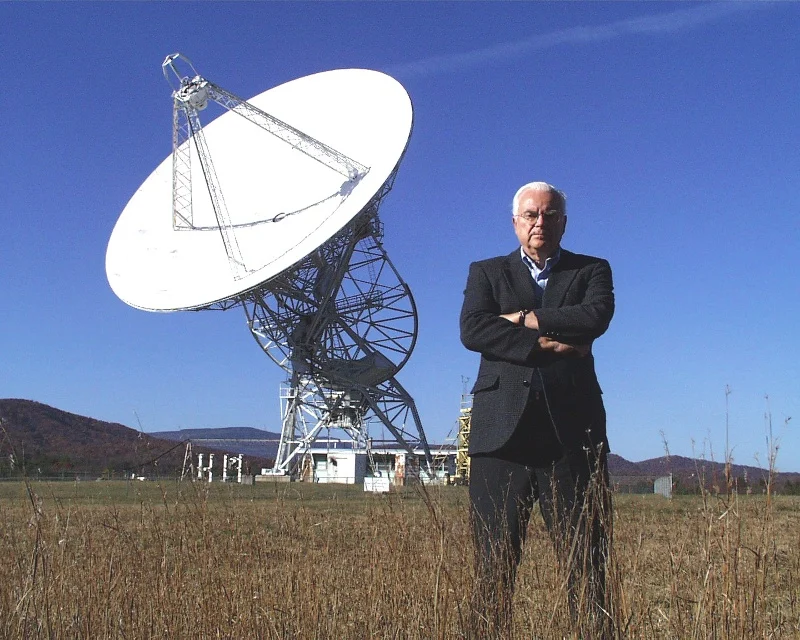 Cornell Professor and SETI pioneer Frank Drake standing in front of the 25-meter Howard E. Tatel Radio Telescope at the Green Bank Observatory. Credit: NRAO/AUI/NSF
In addition, they would address many of the challenges that inspired fellow Cornell Professor Frank Drake to create his famous equation (more on that below). As they wrote:
No theories yet exist which enable a reliable estimate of the probabilities of 1) planet formation; 2) origin of life; 3) evolution of life possessing advanced scientific capabilities. In the absence of such theories, our environment suggests that stars of the main sequence with a lifetime of many billions years can possess planets, that of a small set of planets, two (Earth and very probably Mars) support life, that life on one such planet includes a society recently capable of considerable scientific investigation.
Specifically, they argued that these messages might be transmitted at the same wavelength as radio emissions by neutral hydrogen - 21 cm (1420.4 MHz). As the most common element in the universe, they argued that extraterrestrial civilizations would see this as a logical frequency for radio broadcasts that could be picked up by other civilizations:
Interstellar communication across the galactic plasma without dispersion in direction and flight time is practical, so far as we know, only with electromagnetic waves. Since the object of those who operate the source is to find a newly evolved society, we may presume that the channel used will be one that places a minimum burden of frequency and angular discrimination on the detector.
The following year, Cornell Professor Frank Drake released a paper that encapsulated his thoughts on SETI, titled "How Can We Detect Radio Transmissions from Distant Planetary Systems?" Drake echoed what Cocconi and Morrison said about how "our large antennas and new sensitive receivers" made it possible to detect radio transmissions over interstellar distances. Previewing the famous equation that would bear his name, Drake presented a formula for determining the distance at which signals could be detected:
R = 8 x 10⁻⁶ (Pe A/T)1/2 (t/B)1/4 light-years
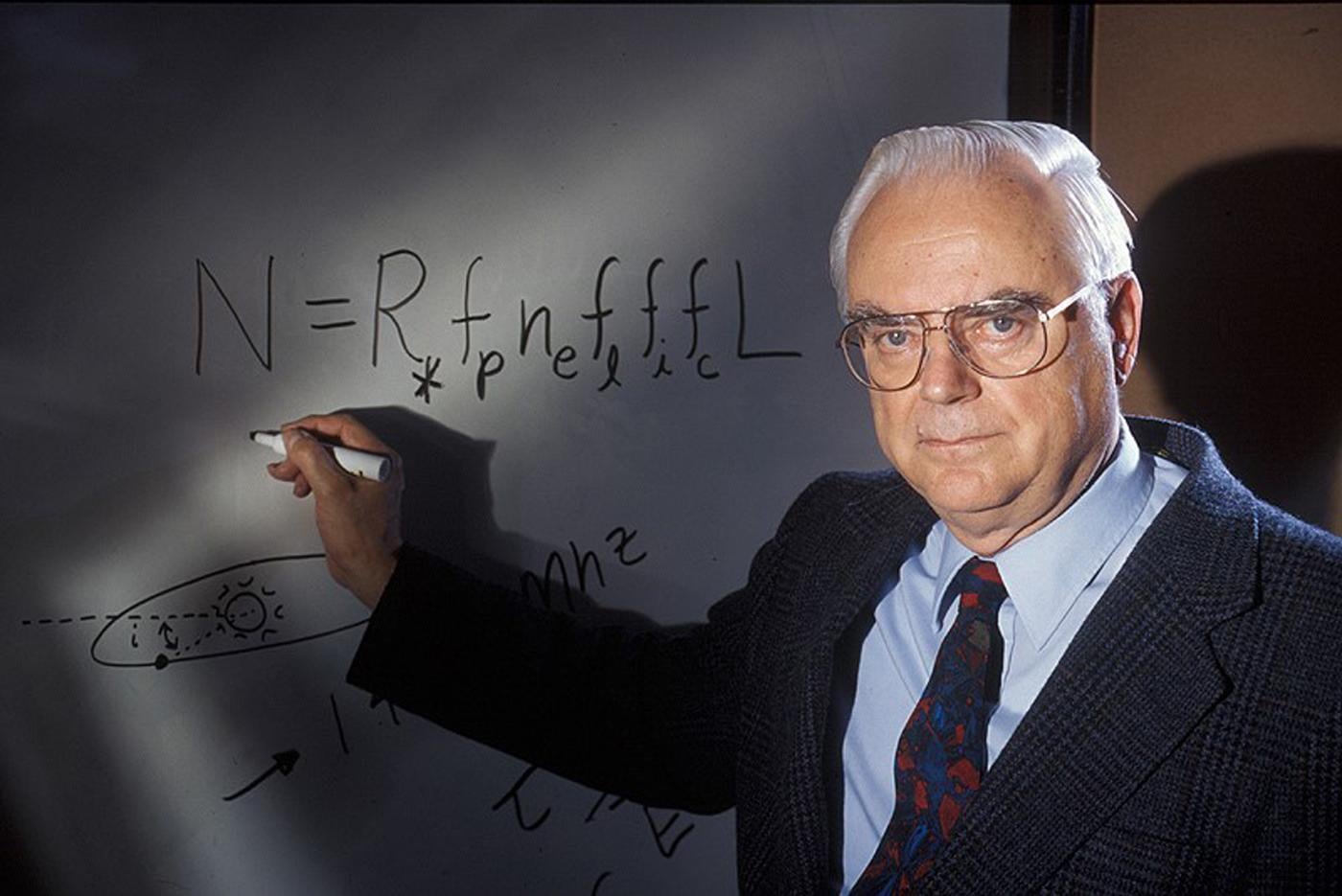 Frank Drake standing in front of a whiteboard showing his famous equation. Credit: SETI Institute
Where R is the distance over which a signal can be observed; Pe is the effective radiated power of the transmitter, in the direction of Earth, expressed in watts; A is the effective area of the receiving antenna, expressed in square meters; T is the excess receiver noise temperature of the receiver used, in degrees Kelvin; t is the receiver averaging time, in seconds; B is the accepted bandwidth of the signal (that is, the bandwidth of the receiver used) in cycles per second.
Ozma and the Drake Equation
In 1960, Frank Drake and his colleagues conducted the first systematic SETI survey at the Green Bank National Radio Astronomy Observatory (NRAO) in West Virginia. It was named Project Ozma after the queen of L. Frank Baum's imaginary land of Oz, a place Baum described as "very far away, difficult to reach, and populated by strange and exotic beings." This survey relied on the observatory's 25-meter dish to monitor the Sun-like stars Epsilon Eridani and Tau Ceti at frequencies near 21 cm for 6 hours a day, between April and July of 1960.
These stars are approximately eleven light-years distant from Earth, are about the same brightness as the Sun, and were assumed (but not known at the time) to have planets. In addition, Tau Ceti is a bit older than the Sun, while Epsilon Eridani is substantially younger, offering the chance to detect a potential civilization early and later development. The project also used existing receivers and other technologies to keep overall costs low, totaling about $2,000 (about $22,390 today).
Although unsuccessful, the survey piqued the scientific community's interest and drew considerable attention to the emerging field. A year later, Drake hosted a symposium at the Green Bank facility, where scientists from across the country (including luminaries such as Carl Sagan) attended to discuss SETI. The meeting was honored with a commemorative plaque that is still displayed in the Green Bank Observatory today. In preparation for this meeting, Drake prepared the equation that would thereafter bear his name. As he said of the equation's creation:
As I planned the meeting, I realized a few day[s] ahead of time we needed an agenda. And so I wrote down all the things you needed to know to predict how hard it's going to be to detect extraterrestrial life. And looking at them, it became pretty evident that if you multiplied all these together, you got a number, N, which is the number of detectable civilizations in our galaxy. This was aimed at the radio search, and not to search for primordial or primitive life forms.
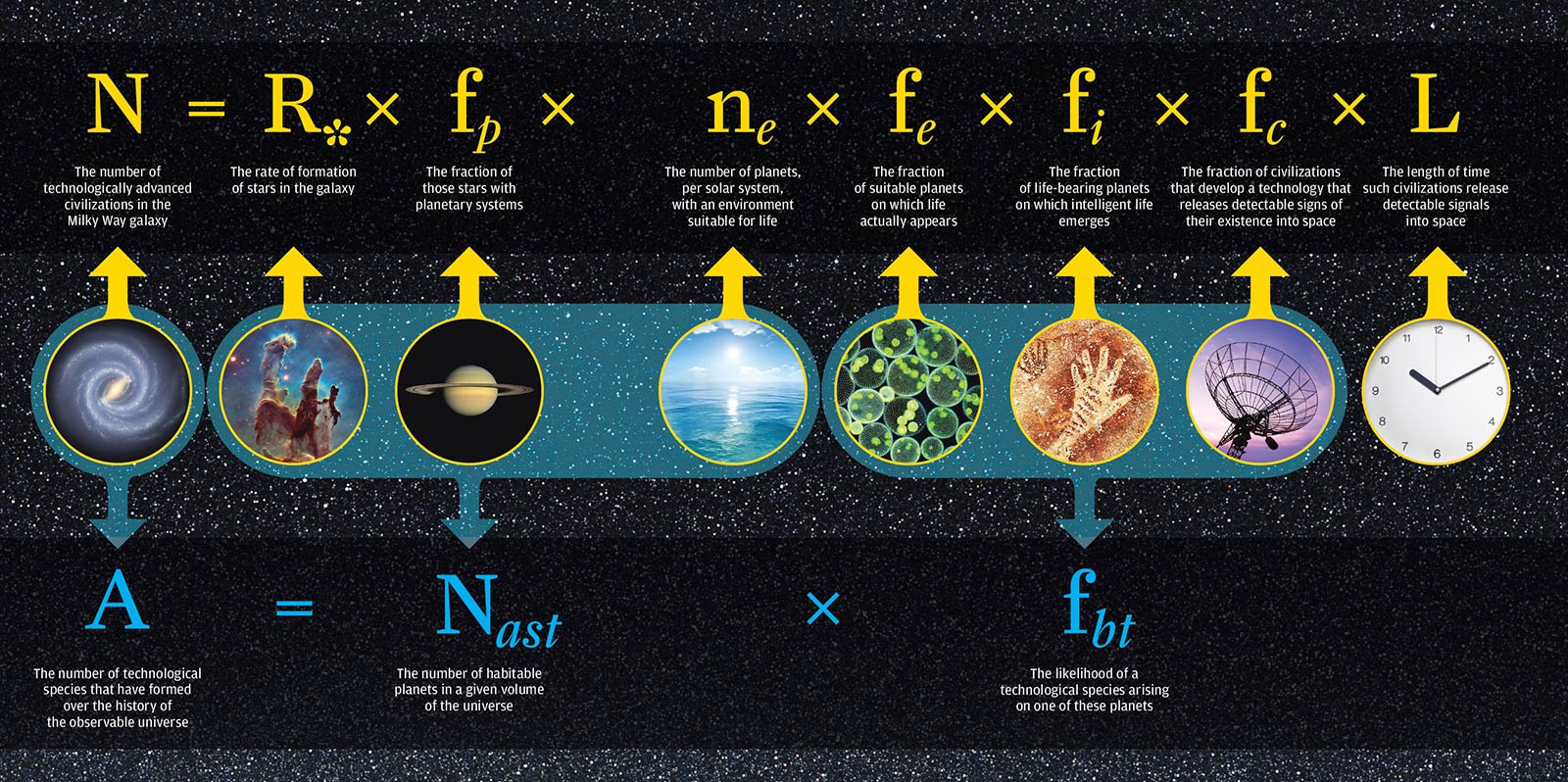 The Drake Equation: a mathematical formula for the probability of finding life or advanced civilizations in the Universe. Credit: University of Rochester.
The formula for the Drake Equation is as follows:
N = R x fp x ne x fl x fi x fc x L*
Where N is the number of civilizations in our galaxy that we might be able to communicate with; R is the average rate of star formation in our galaxy; fp is the fraction of those stars that have planets; ne is the number of planets that can actually support life; fl is the number of planets that will develop life; fi is the number of planets that will develop intelligent life; fc is the number of civilizations that would develop transmission technologies; L* is the length of time that these civilizations would have to transmit their signals into space.
According to Dr. Rebecca Charbonneau, a science historian and Jansky Fellow at the National Radio Astronomy Observatory, Project Ozma is considered the first SETI experiment because it shifted the character of the field. In addition to changes in technology and focus, it was also about timing, taking place during the Cold War and the early days of the Space Race. The launch of the first satellites, the development of intercontinental ballistic missiles, and efforts to send the first humans into orbit fundamentally altered our perceptions of space.
In short, Project Ozma occurred at a time when hopes for achieving humanity's greatest dreams were intermingled with fears of nuclear annihilation. Furthermore, Charbonneau posited that Frank's greatest contribution was not Project Ozma but the Drake Equation. In essence, it changed the way we think of extraterrestrial life and the existence of our species and planet. This was also the result of living in an age when nuclear annihilation was not just considered a possibility but a constant threat.
In this respect, the most significant part of the Drake Equation is L, the longevity of civilizations as a measure of their detectability. This perspective, that all civilizations have a limited life expectancy, has gone on to inform multiple proposals for why humanity has not found evidence of ETIs yet (the Fermi Paradox). With growing concerns of Climate Change amid the "Anthropocene," the notion that civilizations may be inherently self-destructive has only deepened.
By the latter half of the 20th century, the foundations of SETI were well-established, and experiments (proposed and realized) continued and grew increasingly ambitious. Stay tuned for Part III, where we will examine how SETI researchers began to think big! I mean REALLY big!