 Universe Today
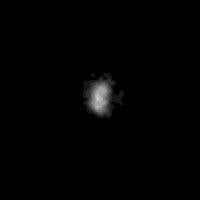
Neptune is definitely the odd one out of the gas giants. It’s tilted at a strange angle, and its moons are completely different from any other gas giant we know of. A new paper, published in Science Advances from researchers at CalTech, posits that might be because Triton, by far Neptune’s largest moon, absolutely obliterated the regular moon system it previously had, except for one particular exception - Nereid.
Let’s start with a little background on Neptune’s moon system. Triton is the 800 lb gorilla (or 2.14 x10^22 kg world) of Neptune’s moon system - but it’s weird. It rotates the opposite direction to Neptune itself, which means it did not form naturally as part of the planetary system. More likely, it was part of a Kuiper Belt Object (KBO) binary, similar to Pluto and Charon, that was captured by Neptune’s gravitational well.
But Nereid is in itself an outlier. Originally discovered in 1949 by Gerard Kuiper (who the Kuiper belt is named after), over 100 years after Triton was discovered, it remained Neptune’s only other known moon until the Voyager 2 flyby of 1989. But its orbit is eccentric to say the least. It’s highly elliptical and lasts 360 days, making astronomers believe for years that it was another captured KBO.
Fraser makes the argument for returning to Neptune.This new study pretty clearly shows that it is not. To prove that, the authors turned JWST’s high resolution infrared camera toward Nereid for the first time. They found that it looks much more like an icy native moon of Uranus or Saturn than a dark, dusty captured KBO. Comparing it to Phoebe, a known captured KBO, Nereid’s water-rich craters look completely different under infrared light. As the authors note in the paper “Nereid’s unique spectrum among outer solar system bodies is not consistent with a scenario where Nereid is captured during the early Solar System’s dynamic instability.”
So that pretty much rules out the possibility of Nereid as a KBO, which leaves the only other option as a naturally occurring moon of Neptune. But why such a weird orbit? Its distance, ellipticality and other factors are different from most other moons in the solar system. To answer this question, the authors turned to simulations.
They used a dynamic simulator called REBOUND to map Neptune as a series of normal, circular moons. Then they hit that nice, neat model with Triton. As the captured KBO entered a highly eccentric backwards orbit, it wreaked absolute havoc with Neptune’s existing moon systems. Most of the original moons were smashed to pieces or ejected from the system altogether as part of this process. Their debris eventually settled down to create Neptune’s current ring system, and some of the tiny “ring-moons” like Proteus.
Even more of an argument as to why we should go back to Uranus & Neptune.But the simulations also showed another feature. In about 20% of all simulation runs, Triton kicked one of the native inner moons that was there before its arrival into a stable, highly elongated, tilted orbit. Just like Nereid’s.
So, in simulation at least, Nereid appears to be an original moon of Neptune that was kicked to its current wacky orbit by the capture of the planetary system’s biggest current resident. If that’s the case, it could offer pristine insight into the formation of the Neptunian system, since its distant orbit would have kept it relatively well preserved compared to other gas giant moons.
We likely won’t be able to confirm that theory until we send another probe that way, though. Planetary Scientists have been clamoring for one for over a decade, to no avail as of yet. But until we do, we can shift our thinking of this specific gas giant moon from that of a captured ice ball to a battle scarred survivor of one of the most violent moonpocalypses the solar system has ever witnessed.
Learn More:
Caltech - The Origins of Nereid, Neptune's Most Eccentric Moon
M. Belyakov et al. - Nereid as a regular satellite of Neptune
UT - Nereid
