 Universe Today
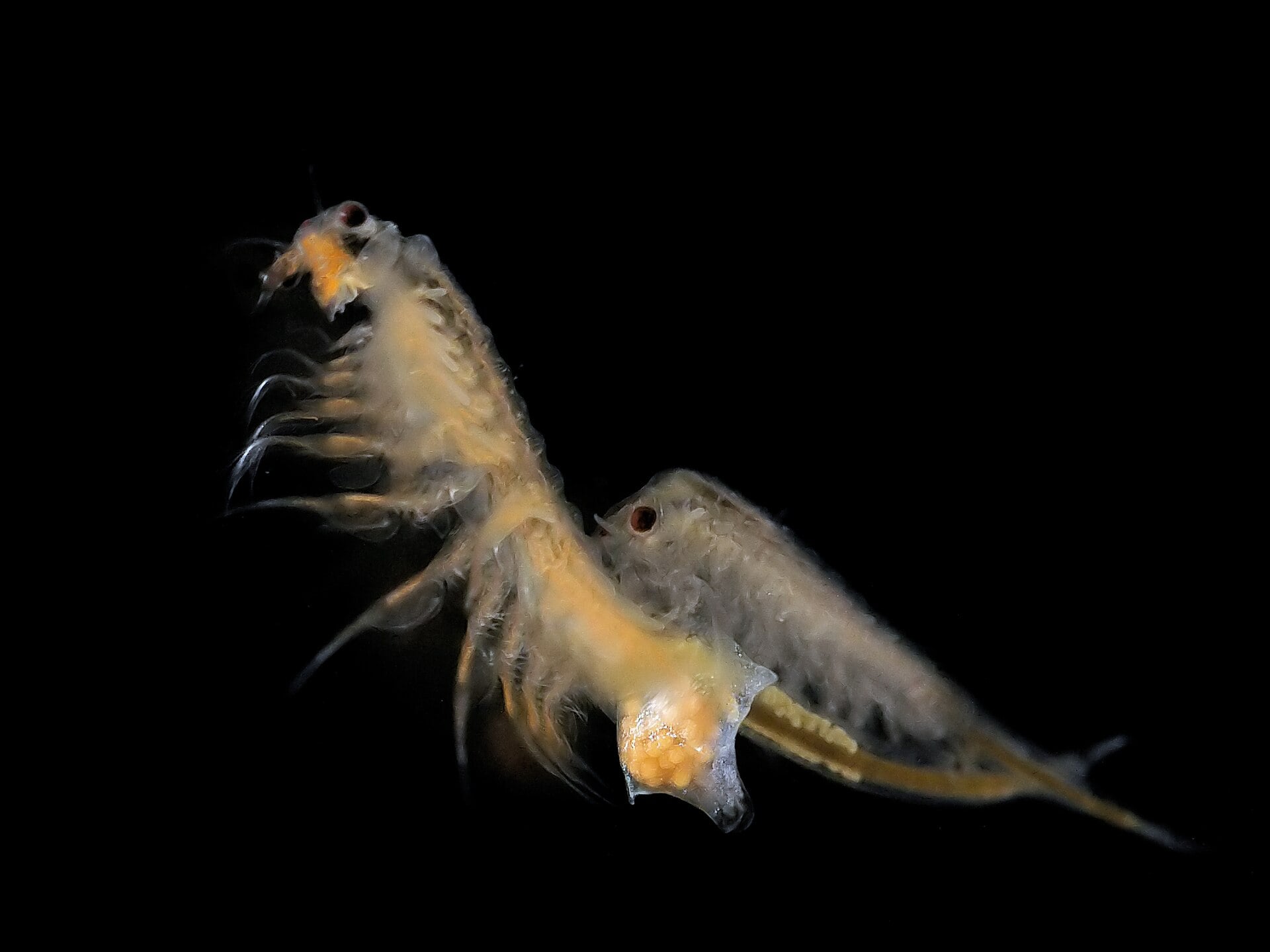
As far as we know, food doesn’t exist naturally in space. We have to bring it with us if we want to explore the final frontier. One of the oldest and most common types of food on planet Earth is seafood, yet we know surprisingly little about how aquatic animals would react to the microgravity environment they would experience in space. A new paper by researchers at Japan’s Okayama University of Science, which was recently published in Microgravity Science and Technology, hopes to tackle that question. It used a novel way to simulate microgravity to watch how crustaceans would react to the space environment, and found that they could likely be good candidates as part of a future space food chain.
Most microgravity experiments on Earth take place in drop chambers or parabolic flights - both of which only offer a few seconds of true “microgravity”, and aren’t suitable for longer duration testing. The International Space Station offers an alternative, but is extremely expensive and has very limited space to run additional experiments. So the researchers turned to an alternative tool - the clinostat.
These specialized chambers rapidly change the orientation their contents are subjected to, varying the gravity field they experience and mimicking at least some of the effects of microgravity. They rotate in such a way that the combination of gravity and centrifugal force will eventually come out to essentially zero over a period of time. These machines work well for single-celled organisms and plants. But they’re not as effective for complex animals.
Fraser discusses what we will eat in space.Typical clinostats rotate relatively slowly - only 10-25 rpm. An agile animal placed in one can reorient themselves quickly enough that the centrifugal force cancellation doesn’t work on them, nullifying the “microgravity” claim that works so well with less complex organisms. So, the researchers thought, why not build one that’s faster.
They went on to design a custom clinostat that rotates at around 130 rpm - more than twice a second. This rapid cycling doesn’t give complex organisms like shrimp or fish enough time to reorient themselves to the Earth’s gravitational field before the machine changes that orientation on them. In other words, speeding up the spinning allows those aquaculture samples to experience true pseudo-weightlessness.
With their new super-charged clinostat, the researchers started experimenting with actual animals. First were juvenile kuruma shrimp. The researchers built a sample box with a digital camera and a light and subjected the shrimp to 15 minutes of microgravity simulation, watching them intently while they tried to eat. The active rotation caused the water inside the sample container to slosh around wildly, creating an estimated 0.15 m/s internal flow.
Vide of the experiment showing some of the shrimp eating in microgravity. Credit - 牧祥 Youtube ChannelTo counteract that sloshing, the shrimp held on to a plastic mesh net that was provided in the container. They also only ate food pellets that appeared directly in front of their mouths rather than actively hunting as they would have in a normal 1G environment. Crucially, when the water flows stopped, the shrimp fed most effectively. Unfortunately, it’s hard to differentiate whether the limited eating behaviors the shrimp did were due to the water sloshing or the microgravity, but the increased activity when the water stopped moving provides good evidence that shrimp will indeed choose to actively eat in microgravity if exposed to it.
The researchers weren’t only watching for feeding behavior - they were also watching for genetic changes. They subjected a group of shrimp to 24 hours of microgravity simulation, then ran a Gene Ontology (GO) analysis comparing their RNA with that of a control group that was just subjected to normal 1G gravity. There were stark changes in the genes that controlled the chitin metabolic process, and also genes that govern the development of their cuticles. Since both of these features are tied to locomotion and a shrimp’s exoskeleton, it strongly suggests that “microgravity” impacts their movement even on a biological level.
Since shrimp are relatively large, and therefore hard to test in statistically significant numbers, the researchers also ran a supporting experiment using Artemia - more commonly known as brine shrimp, or “sea monkeys”. They were subjected to a continuous 4-day rotation in the clinostat, and the researchers watched while they successfully preyed on algae, generated waste from that feeding, and grew significantly in size. In other words, they were living their lives in microgravity, with seemingly no major ill effects.
However, the experiments weren’t all completely successful. Originally the researchers wanted to collect data on some form of fish as well, but the cameras were not up to the task, limiting the results in the paper to non-vertebrates, and creating a big potential opportunity for the next round of research. Luckily, other efforts are attempting to work with fish in space as well, including the Lunar Hatch Program, which hopes to introduce fertilized fish eggs to water on the Moon, and SpaceGenFish, which is developing a fully automated aquaculture system for use on the ISS.
For now, though, much additional research is needed if aquaculture is to play a critical role in supplying future astronauts with a fresh source of meat. Given the success of the technique on Earth, and the ongoing support its space-based equivalent is receiving, this surely won’t be the last time we hear about sea monkeys being used for space experiments.
Learn More:
Okayama University of Science / EurekAlert - First paper published from Space Aquaculture Research: shrimp feeding behavior under simulated microgravity
C. Yokota et al. - In Situ Observation of Shrimp Feeding Process Under Microgravity Environment
UT - How Brine Shrimp Adapted to Mars-like Conditions
UT - Europa Life: Could 'Extreme Shrimp' Point To Microbes On That Moon?

