 Universe Today
There are parts of the universe that are extremely hard to see, even for our most advanced telescopes. Gas and dust don’t emit any light, and are only visible by the light that they happen to block from stars and galaxies. Magnetic fields are even harder since regular light typically passes right through them. However, according to a new paper available in pre-print on arXiv, by Manisha Caleb of the University of Sydney and their co-authors, we’re currently commissioning a potentially game-changing new tool that could use a particularly violent astronomical phenomenon to provide new insight into these hard to see places.
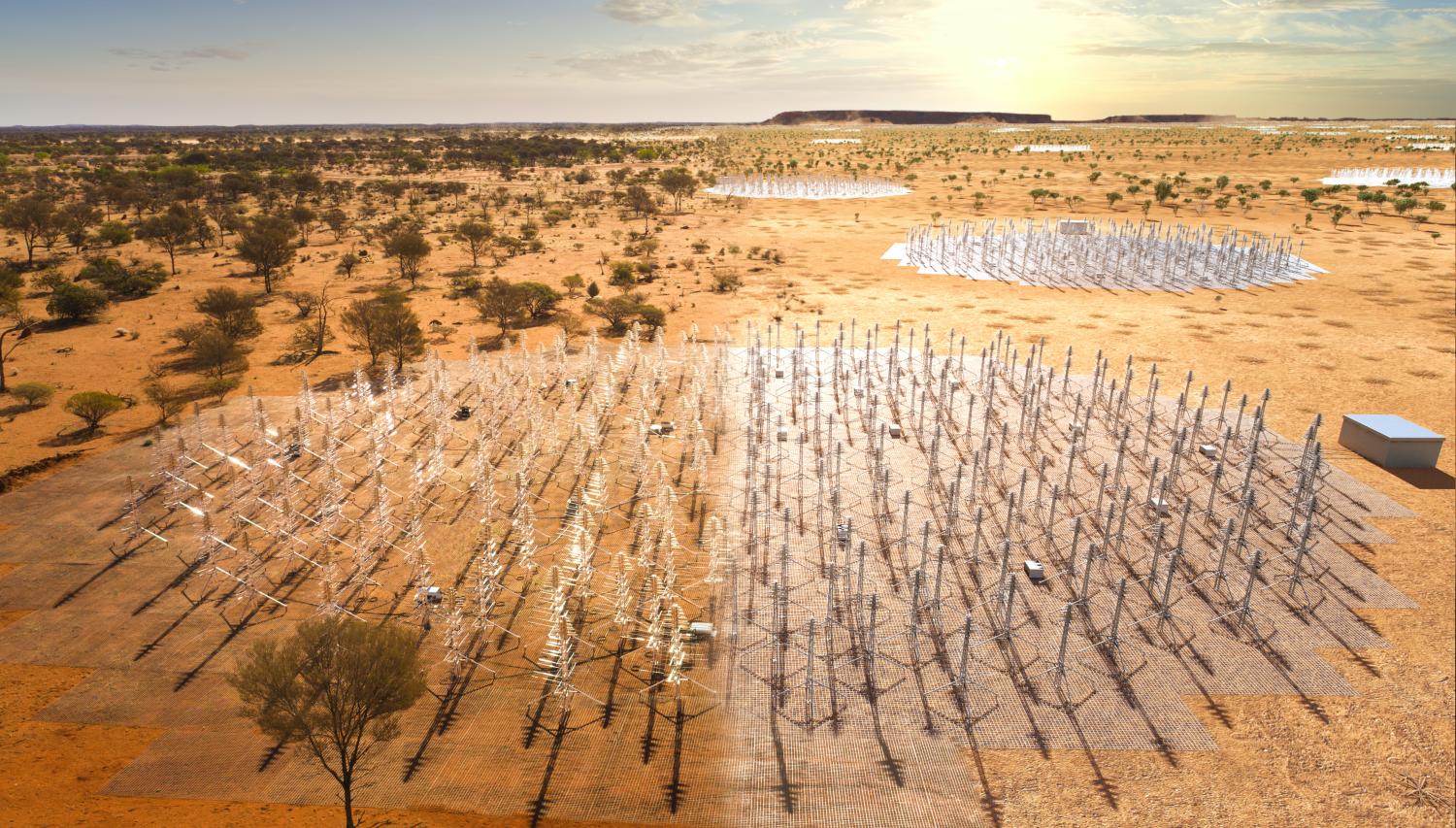
That tool is the Square Kilometre Array (SKA), which we’ve reported on numerous times during its development and commissioning process. This continent-spanning telescope will be the most powerful radio telescope ever built once it’s officially brought online. But that hasn’t stopped astronomers dreaming of ways they can potentially use it already.
One way they are planning to use it is to watch Fast Radio Bursts. These temporary, high energy bursts from the cosmos can act as the perfect cosmic flashlight if we happen to be looking at them with a radio telescope.
Fraser interviews Fred Watson, Australia’s Astronomer at Large.To be clear, SKA won’t be busy finding as many FRBs as possible. That crown will likely go to a wide-field array like the DSA-2000 array in Nevada or CHIME (Canadian Hydrogen Intensity Mapping Experiment) in Canada, which are expected to catch up to 10,000 FRBs a year. But what the SKA lacks in scope it makes up for in sensitivity. It will be able to find the faintest FRBs we’ve ever seen, and its SKA-low array in Western Australia will be looking at incredibly low frequencies that we’ve never seen an FRB with before.
There are several aspects of the signal from an FRB that the paper showcases as important “fingerprints”. First is known as the “dispersion measure” - as an FRB travels through normal matter, the low frequency signals are delayed, allowing cosmologists to measure the amount of normal matter the signal passed through. If, on the other hand, it passes through a magnetic field, the polarization of a radio wave will twist, which the SKA can then detect. Traveling through plasma gives a third distinct twist, or more specifically a scattering, to the data, allowing astronomers to estimate how much plasma laid in between the FRB and the SKA.
The paper also lays out three important scientific tests they plan to do with these high-power cosmic flashlights. First is to weigh the photon. Yes you read that correctly. We’ve been taught in introductory physics classes for decades that the fundamental particle of light has no mass. But that is an assumption, and FRBs offer us a way to test that to a level of precision that is impossible with anything we can do on Earth. Since FRBs travel billions of light years, if photons possess even a miniscule amount of mass, low energy radio waves will travel slightly slower than high energy ones, and the SKA will be able to detect that speed difference given the distances those waves will have to travel.
Fraser discusses the mystery of FRBs.A second seems to be a favorite pastime of physicists everywhere - testing Einstein. Measuring how the gravity of massive galaxy clusters affects different frequencies of an FRB will allow researchers to test the Equivalence Principle, a core component of the Theory of General Relativity. The SKA will be capable of detecting those minute differences at a sensitivity well beyond anything available today.
The third is a search for dark matter. If ultra-light dark matter exists, it should form dense objects called “solitonic cores” inside galaxies. The SKA should be able to pick up a dispersion pattern that can reveal the tell-tale density signatures of these cores if an FRB happens to pass through one of them.
It will be a few years before the SKA is fully up and operational. But as more and more use cases become defined, the astronomical and cosmological communities are likely to grow more and more excited for the new capabilities the system offers. This is surely not the last paper brimming with ideas for how to use it.
Learn More:
M. Caleb et al - Fast Radio Bursts as Cosmological Probes
UT - The Square Kilometre Array Will Revolutionize the Hunt for Alien Life
UT - Astronomers Detect Most Distant Fast Radio Burst Ever
UT - Fast Radio Bursts are Helping to Locate the Universe's Missing Matter

