 Universe Today
Astrobiology has long been split into two camps: a search for "biosignatures" and a search for "intelligence." These look for very different things, but they also leave a huge gap in between. It took 3.5 billion years for us to go from the first microbe to a civilization that sent radio waves out into the cosmos. Detecting life in between those stages is a relatively untouched aspect of astrobiology—which is also the focal point of a new paper, "Signs and Signatures of Intelligence", available in pre-print on arXiv, by astrobiologist Julia DeMarines.
Before we get into that missing middle ground, we should review the two typical astrobiological categories. Biosignature searches focus on chemical traces like oxygen and methane that suggest biological activity. Whereas “technosignatures” represent the observable products of advanced technology - like radio waves or massive planetary scale engineering projects.
Civilizations don’t just pop up from microbes and start emitting radio waves, though. It’s an evolutionary process that takes billions of years. If an alien civilization had turned a telescope towards the Earth 10,000 years ago (or alternatively, is viewing the Earth from 10,000 light years away), it wouldn’t have seen any radio waves. But it also wouldn’t have been looking at a world only covered in simple microbes. So how do we quantify this “middle ground” and incorporate it into our larger study of astrobiology?
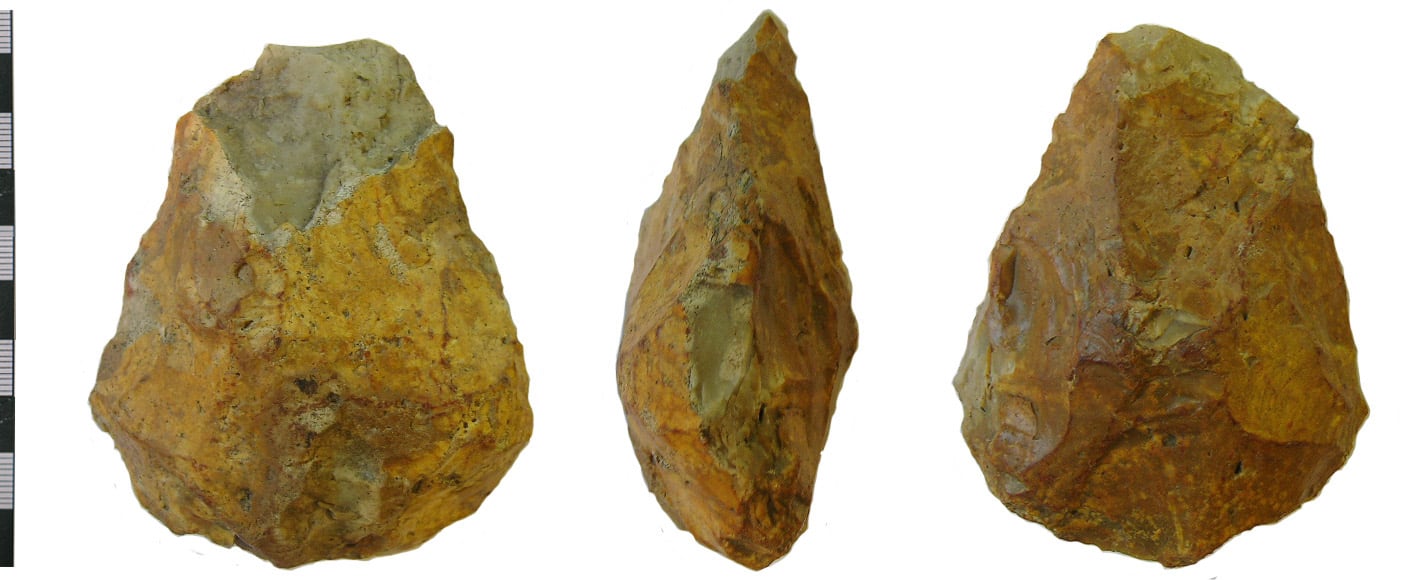
Fraser discusses the step-by-step process we're using to look for life.DeMarines suggests using a new term called noosemiotics, which represents an empirical research framework for the search for noosignatures. So what is a noosignature? According to "Signs and Signatures of Intelligence", it's a structured trace that a mind leaves on a medium. That sounds very philosophical, but there are some hard bounds to it. They can be physical, such as stone tools or architecture, and they can be signal-based, such as complex animal communication. But a crucial detail is they must remain detectable as the product of intelligence, even if we can't decipher what they mean.
Examples have already cropped up on Earth. We might never be able to decipher the Indus Valley script, but we know that it was created by someone with intelligence. It is a physical residue of cognitive activity, which can be easily differentiated from simply biological processes.
But how would you actually measure this? DeMarines suggests using a new idea called Assembly Theory, which measures the "assembly index" of an object. This is the number of joining operations required to construct it from basic elemental components. If an object has an assembly index above a certain threshold, this means it cannot simply arise by random chance; it requires a mind to make it.
Fraser discusses the chemistry of life with Dr. Lee Cronin.Earth has tools going back 3.3 million years that would pass this test, such as the Lomekwian assemblage. But noosignatures don’t have to just be tools. DeMarines points out that agriculture significantly impacted Earth’s nitrogen cycle around 8,000 years ago, leaving a detectable trace of intelligence behind thousands of years before we ever invented a radio dish.
The beauty of this idea is that it captures the worlds that developed intelligence of some level but whose intelligences then failed to solve the coordination problem to sustain a (at least moderately) cooperative planetary civilization. They might have lasted for geological time scales but never sent a single radio signal. In this case, a noosignature might be the only evidence that intelligence existed on a given world at all.
As DeMarines points out, the idea is still very new and has a lot of kinks to work out. Noosignatures will decay over time if not maintained - information requires a physical substrate to persist long enough for our telescopes to be able to detect it. But also, natural self-organization can be hard to distinguish from noosignatures. Assembly Theory is still in its infancy when dealing with macroscale archeological structures such as complex crystals that can be naturally grown.
More importantly, relatively few scientists have explored this problem. At this year's Astrobiology Science Conference, there were 23 dedicated sessions on biosignatures, 1 on technosignatures, and 0 dedicated sessions for intelligence research, with only one abstract. Maybe, with the publication of "Signs and Signatures of Intelligence", astrobiologists will start to look at astrobiological signatures as more of a continuum rather than a graph with two distinct peaks. If they do, there's a chance they'll start discovering planets where life falls into this middle category. That is a possibility that should get everyone in the field excited.
Learn More:
J. DeMarines - Signs and Signatures of Intelligence
UT - The Search for Advanced Civilizations is Going Real-Time

