 Universe Today
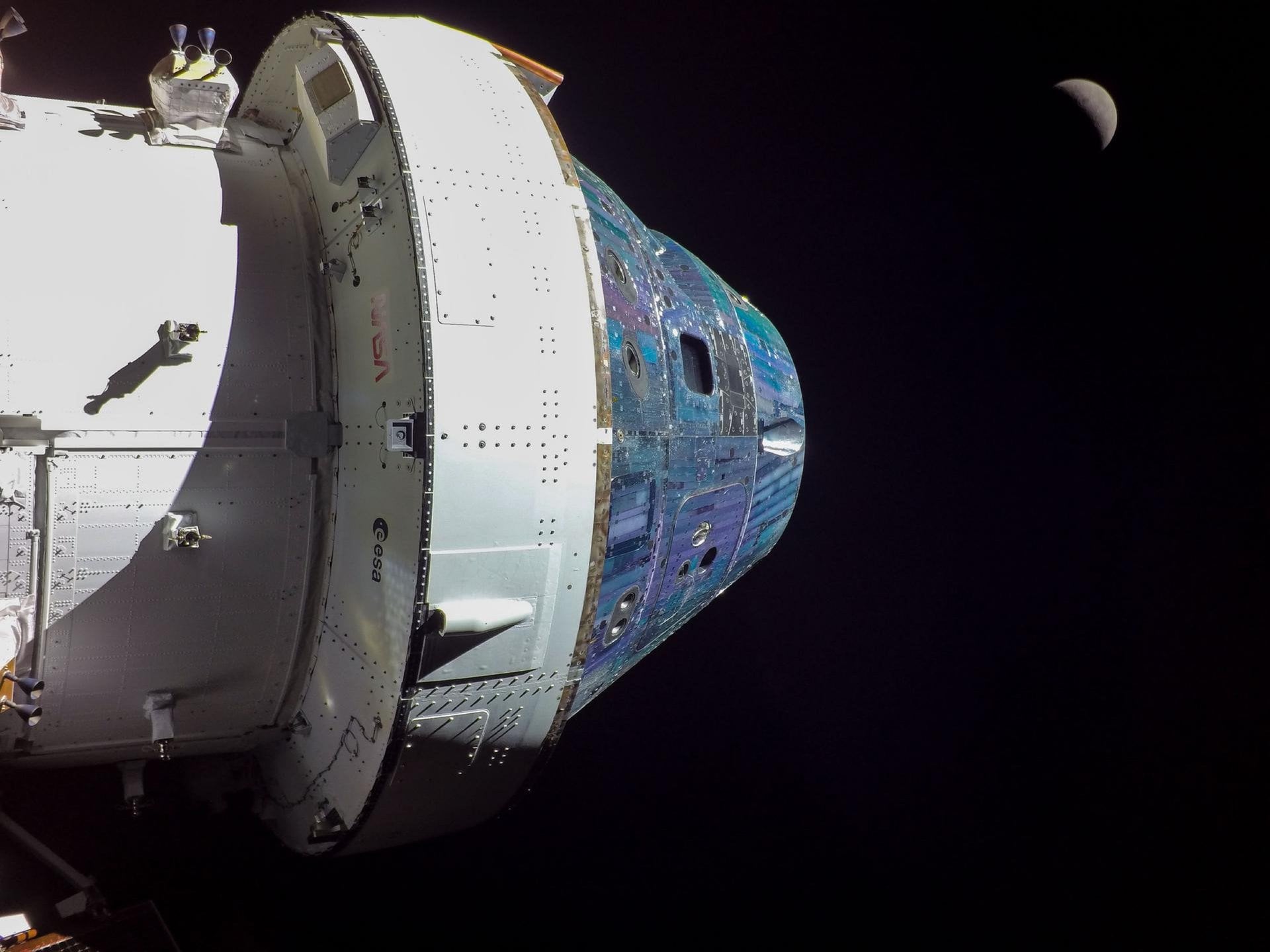
Shielding astronauts from the killer radiation they face is a central challenge facing any designer of a deep-space crewed mission. Even relatively low levels of exposure for long periods of time can lead to everything from central nervous system damage to cancer. But current solutions, such as passive water shells or active superconducting magnets, have their own limitations. To get around those, a new paper, available in pre-print on arXiv by Valerio Parisi and a team of researchers from Italy and Germany, looks at the feasibility of using a permanent magnet (and its associated permanent magnetic field) to potentially block some of that deadly radiation without the costs of competing technologies.
First, let’s look at the specific types of radiation that make it so dangerous. One is Galactic Cosmic Rays (GCR), which are continuous, extremely good at getting through things, and seem to come from everywhere. Another is a ferocious burst of protons known as a Solar Particle Events (SPE) - essentially a solar storm directed at a spacecraft. Each of these have the potential to devastate the biological payload of any deep-space craft - including living humans.
The most common way to protect from these radiation sources is simply putting a bunch of stuff between them and the fragile biological systems. This technique relies on pass, low atomic number materials, such as aluminum, polyethylene, or, in many cases, water (which is needed for many other biological functions on a deep-space craft. The problem with this technique is weight. The tyranny of the rocket equation means that getting enough material into orbit to protect the crew from an SPE is extraordinarily expensive - and could amount to bringing tens of tons out of Earth’s gravity well.
Fraser talks about the process of building an artificial magnetosphere.Another alternative that has been the focus of much research lately are superconducting magnets. These have the obvious advantage of supplying up to a 1-Tesla magnetic “shield” around a craft, but they come at a huge potential cost. They require continuous cryogenic cooling, and constant power supply for both the cooling system and magnets themselves. If either power to either of those components disappears (such as if a stray cosmic ray flips a transistor), the shield fails entirely, and the crew are subjected to the full force of all the radiation.
To address these problems, the authors turned to a middle-ground alternative - permanent magnets. These are well understood, incredibly robust, and don’t require any power to operate. They also weigh much less than other “passive” solutions, limiting the impact of the rocket equation on their economic viability. To prove their idea, the researchers mapped out an analytical model to see if a set of Neodymium-Iron-Boron (NdFeB) permanent magnets could alter the trajectory of a collimated proton beam (essentially a mock SPE).
The short answer is - yes, it can, but only up to certain energy levels. The authors created an array of 1,482 permanent magnets measuring 3x3x3cm each, and packed them all into a 1 square meter area. Weighing in at less than 300kg, this permanent shield ended up deflecting approximately 20% of the incoming solar particles in the 0.1 to 10MeV energy range.
Magnetic fields aren’t the only solution to radiation - hydrogel seems to work as well, according to this video from Fraser.Functionally, that 20% was actually indicative of what the permanent magnets were really doing - deflecting lower energy particles. Essentially, they acted as a “high pass” filter, allowing higher energy protons to zip right through while pushing the lower energy ones aside. But that wasn’t the only technical difficulty with this system.
The biggest one is that it doesn’t block GCRs at all. The protective field itself is highly directional, and since GCRs are chaotic and coming from all directions, it does very little to defend against them. What’s more, there is a chance that protons themselves smashing into the magnet could cause “secondary” radiation, such as neutrons or gamma rays. While this might not turn any of the astronauts into the Hulk, it could inadvertently actually increase a localized radiation dose if one of them happens to be in the wrong place at the wrong time. Even magnets wear down over time, though, so the final technical hurdle would be the long-term demagnetization of the neodymium, which would reduce its protective shielding value over time.
Despite all its downsides, even some shielding is better than none at all, and there might very well be a place for permanent magnets in a hybrid system that combines all three techniques of radiation mitigation. To prove this idea out further, the team plans to continue to pursue it with advanced Monte Carlo simulations to see how it would react in chaotic, multi-directional environments. After all, astronauts will need all the help they can get to make sure they don’t end up being irradiated too much before reaching their deep-space destination.
Learn More:
V. Parisi et al. - A First-Order Assessment of Permanent Magnet Deflection for Space Radiation Protection
UT - Flexible 3D-Printable Shielding for Extreme Environments
UT - A Magnetic Bubble Could Protect Astronauts From Dangerous Space Radiation
