 Universe Today
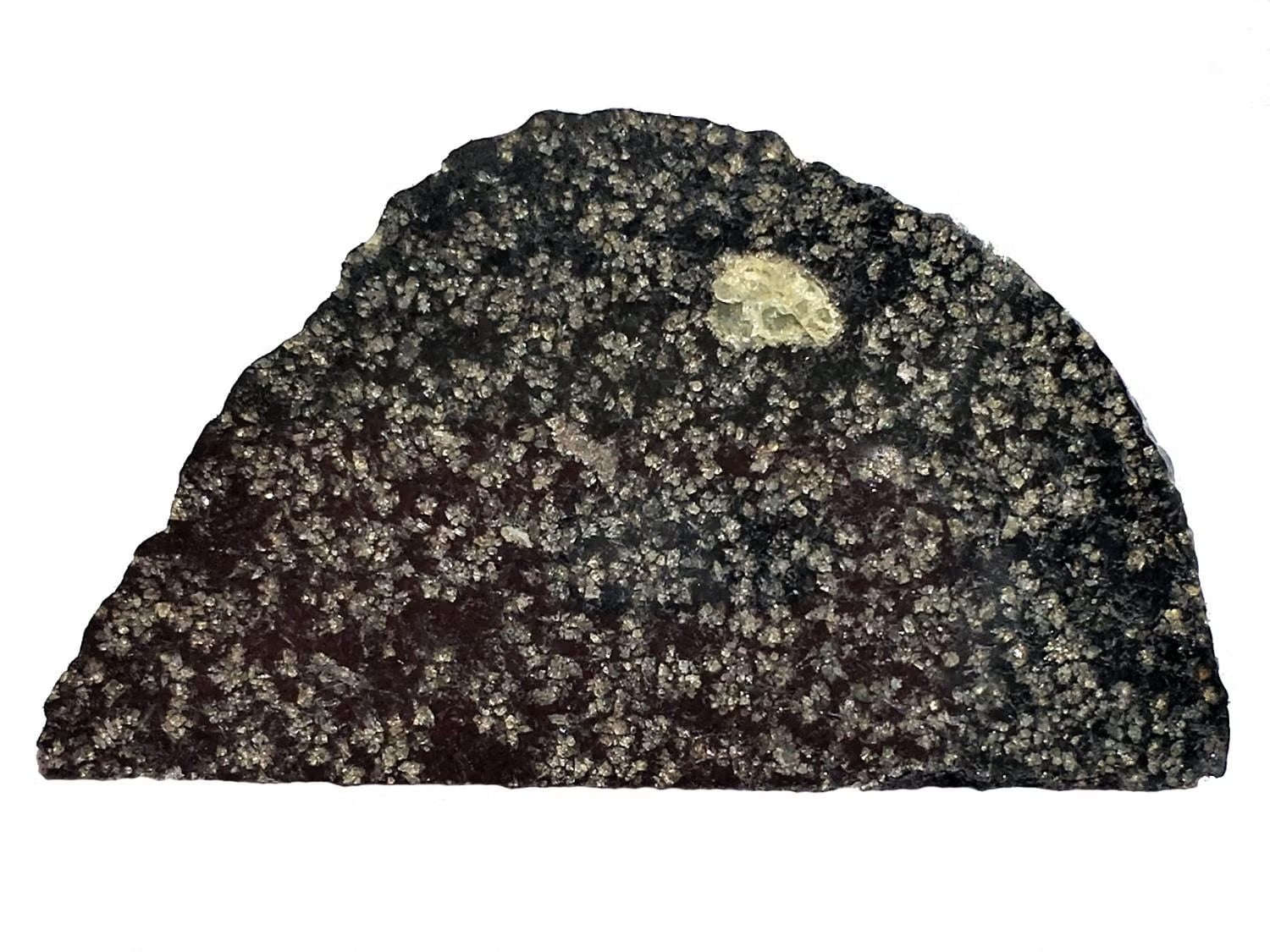
Meteorites are (usually) gifts from the heavens. They provide unique insights to parts of the solar system that we couldn’t access otherwise - either because it's too expensive, or because the solar system itself has evolved since it was formed. A new paper from researchers at the University of Colorado Boulder details how one particularly famous meteorite offers a window into just such a bygone age of the solar system - and the failed planet that was a part of it.
The meteorite in question is known as Northwest Africa 12774 (NWA 12774), which was found in the Sahara Desert in 2019. It is an angrite, an extremely rare type of meteorite - so rare that only 68 of the 80,000 or so known meteorites are in the category. One important feature of angrites is that they are silica-poor - meaning they lack silicon dioxide that comprises most of the rocks on large rocky worlds like Earth and Mars.
This lack of silicon led scientists to believe for decades that the Angrite Parent Body (APB) - i.e. whatever floating world is the source of angrite meteorites - had to be a relatively small asteroid no more than 200 km in radius. Large protoplanets, like the ones that eventually formed the Earth and Mars, have massive gravity that eventually heats up its interior causing the rocks there to melt in a process called differentiation. During this melting process, heavier metals sink to the core, while lighter material, like silicates, float upward to form a crust. Since NWA 12774 was extremely silica-poor, researchers had previously assumed it hadn’t undergone that process.
Fraser and Pamela discuss meteorites from other worlds.Smaller worlds don’t undergo differentiation, making their composite material much less silica-rich. However, the CU Boulder researchers noticed something about the composition of NWA 12774 that intrigued them. They noticed crystals of a mineral called clinopyroxene. And specifically, they noticed that clinopyroxene was rich in aluminum, which is measured by a metric called the Ca-Tschermak’s (CaTs) component.
Aluminum-rich clinopyroxene is a dead give away that the rock its embedded in was formed under massive pressure. But to determine just how much pressure, the researchers had to develop a novel technique they called the CaTs-liquid geobarometer, which used a thermodynamic tool to analyze how exactly the aluminum-rich clinopyroxene could form. And their calculations yielded a pretty incredible number - 17.56 kilobars.
For comparison, the pressure at the bottom of the Marianas Trench, the lowest point in Earth’s Ocean, is only 1 kilobar. That means these rocks were formed at pressures more than 17 times higher than anything found on Earth’s surface. In other words, they weren’t formed on a 200km wide asteroid.
https://www.google.com/url?source=gmail&sa=E&q=https://www.youtube.com/watch%3Fv%3DUIxr_pDIjac Fraser discusses how we can tell where meteorites come from.
So just how big was the world these rocks formed on? The researchers used other cues, such as the sharp edges of the crystals, which means they weren’t baked inside a planetary core for millions of years. It’s more likely that NWA 12774 experienced some sort of rapid ascent, like a volcanic eruption on its parent world, and then crystallized at a relatively shallow depth of less than 200km.
Combining the fact that the rock likely formed at less than 200km with the fact that it experienced 17.5 kbar of pressure means that the host planet must have been massive. The minimum calculated radius for the APB in this context is around 1,800km - about equivalent to Earth’s Moon. But the paper (and accompanying press release) mentions that, in some cases, the APB’s radius is up to 3,300km - about equivalent to Mars.
Unfortunately meteorites are all we have left of this early protoplanet. It was destroyed sometime in the early solar system by a catastrophic collision - likely what created the original angrite meteorites. But if it's any consolation, much of the material was probably absorbed into other planets, including Earth. So, instead of looking at NWA 12774 as a rogue piece of a forgotten world, maybe we can think about it as a piece of a lost one that just rejoined some of its fellow protoplanetary material, albeit it billions of years later.
Learn More:
CU Boulder - Rare meteorite provides evidence of giant early planet
A. S. Bell, L. Waters, & M. Ghiorso - High-pressure clinopyroxene in Northwest Africa 12774 and new geobarometric evidence for a planetary embryo-sized angrite parent body
UT - Neutron Scans Reveal Hidden Water in Famous Martian Meteorite
UT - Meteorites: Why study them? What can they teach us about finding life beyond Earth?

