 Universe Today
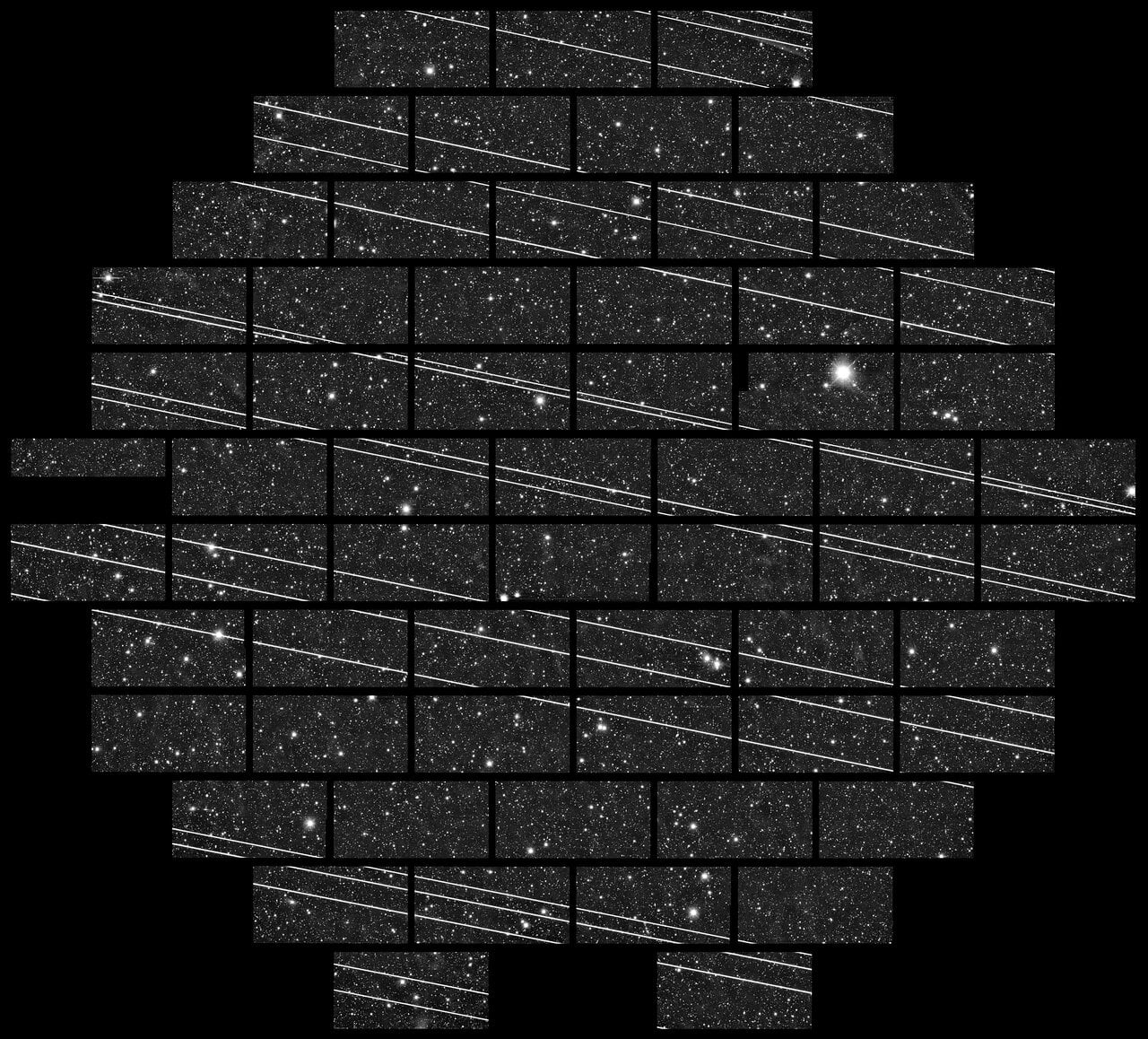
Unfortunately there’s more bad news to report on the clear skies front. A new paper, available in pre-print on arXiv from researchers at NASA’s Ames Research Center, reports that 73.3% of images the agency’s new SPHEREx space telescope collected between May and September of last year were contaminated by at least one artificial satellite trail. And it’s only going to get worse from here.
Unfortunately this doesn’t come as a surprise. The Spectro-Photometer for the History of the Universe, Epoch of Reionization, and Ices Explorer (SPHEREx) was designed to map the entire sky in near-infrared light. Meaning it would have long exposure times and cover a very large chunk of the visible sky at any one time. Both of which are a recipe for interruption from orbiting satellites.
Typically this type of light pollution is primarily associated with ground telescopes. But, SPHEREx is an orbital satellite, traveling along an orbit that is 700km above the Earth’s surface. Apparently even that wasn’t enough to escape from the light trails. On average there were 2.18 trails per exposure, most of which are concentrated in an “X” pattern that mimics the orbital paths of the satellite megaconstellations.
Fraser discusses the potential limit to how many satellites we can launch.There appears to be no easy way to handle this interruption, either. SPHEREx uses an automated “sample up-the-ramp” algorithm to protect itself from stray cosmic rays. When a sudden energy blast from one of those rays hits a pixel, the system halts data collection on that pixel to prevent saturation. But commercial satellites are now so bright that they are triggering this system without the help of any stray cosmic rays.
The resultant images have what the authors describe as “railroad” tracks, where the blinding center of the trail is scrubbed out but parallel lines running alongside it are permanently etched into the science imagery. As a result, the images lose the photometric data of anything hidden beneath the rails.
As if that news wasn’t bad enough, SPHEREx isn’t the only one suffering from this fate. A few years ago another team led by Sandor Kruk published a study that found the fraction of Hubble images crossed by satellites rose from 2.8% in the early 2000s to 5.9% in 2021. Admittedly Hubble doesn’t take as wide of shots as SPHEREx, but the fact that one of the most venerable space telescopes still operating is suffering from the same problem is not a good sign.
Fraser discusses the advantages of using ultra-black paint - though that won’t solve all of the contamination issues.Satellite designers have tried various efforts to mitigate this problem, including dark coatings or specialized visors to reduce their optical brightness. But newer systems, such as direct-to-cell towers or AI data centers, are up to four times larger than existing satellites, eliminating any potential benefit of darker coatings and cementing them as some of the brightest objects in the sky.
And it’s only going to get worse from here. Recent FCC filings have been made to approve up to 2 million satellites in Low Earth Orbit, as compared to the 20,000 or so currently in orbit. If those are approved and launched, simulations from the new paper forecast that 100% of SPHEREx’s images would be polluted by a satellite trail, a significant increase from the current ~73% contamination rate. And the average image would have 189 trails in it.
Needless to say, that is catastrophic for observational platforms below or in the orbital plane where those satellite megaconstellations exist. And various groups have been ringing the alarm bell about this potential catastrophe for years at this point. Unfortunately, there seemingly hasn’t been any movement on coming up with an international agreement to do anything about it. Hopefully this paper will serve as another forcing function to finally do so.
Learn More:
A.S. Borlaff et al - SPHEREx confirms predictions for artificial satellite trail pollution in Low Earth Orbit
UT - Satellites Have Brightened the Skies by About 10% Across the Entire Planet
UT - Satellite Constellations Are Too Bright, Threatening Astronomy and Our Night Sky

