 Universe Today
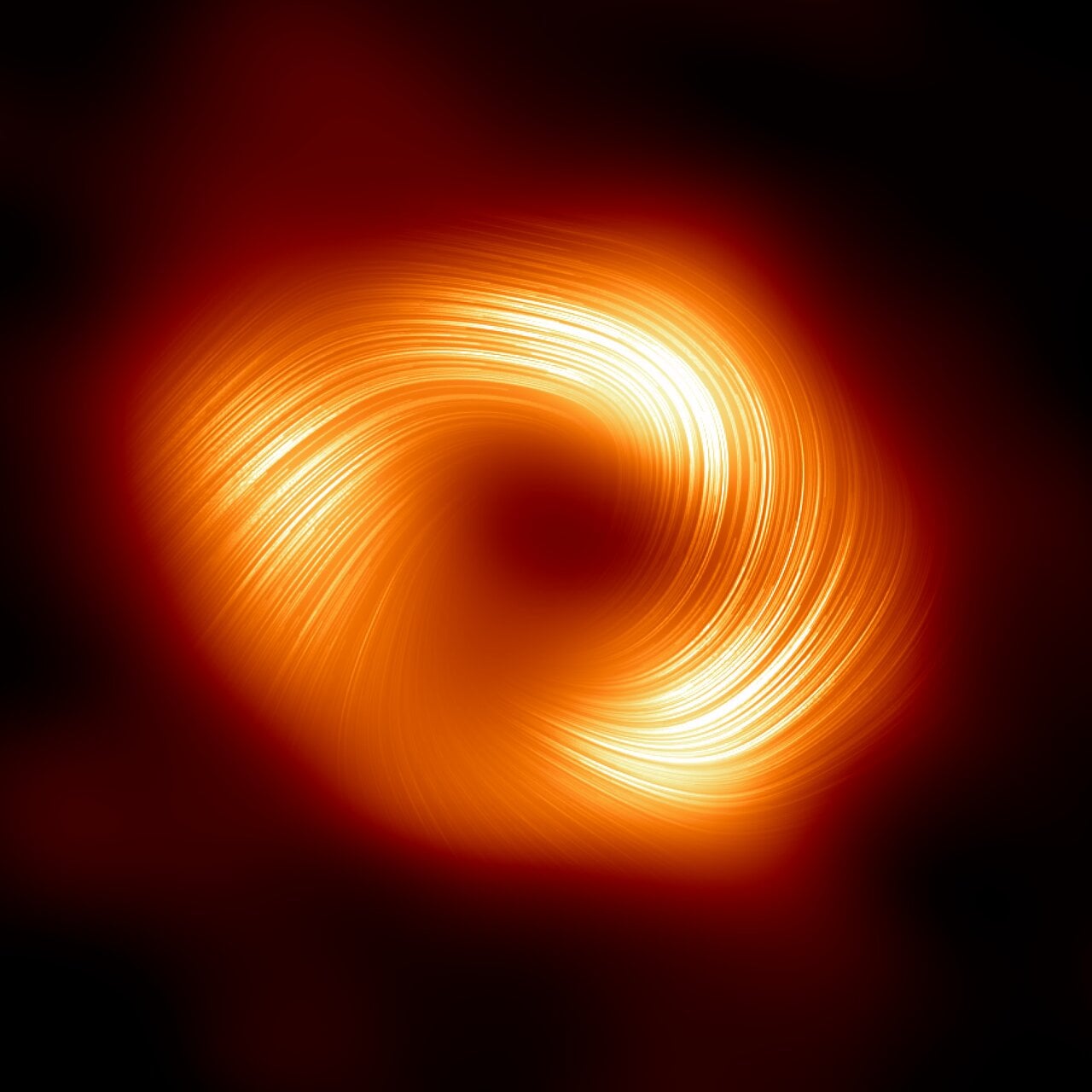
Despite their depiction as massive monsters that simply suck in everything, including light, astronomers know black holes actually spin. And they spin really, really quickly at that. Determining just how quickly is key to understanding how they impact their immediate vicinity, but also the galaxies that surround them. A new paper by Tegan Thomas of the University of Virginia and her colleagues, available in pre-print on arXiv, has some good news and bad news on that front. The bad news is we currently can’t determine how fast black holes are actually spinning. The good news is that, hopefully in the next few years, we will have a new tool that will allow us to.
There are two main theories about the maximum spin velocity of a black hole. The first one was developed by Kip Thorne back in the 1970s that theorizes that the maximum speed a black hole can spin is 99.8% the speed of light - with the only thing holding it back being photons emitted from its accretion disc pushing back on the spin of the black hole itself. The other was put forward in 2004 by Charles Gammie at the University of Illinois Urbana-Champaign and his co-authors. It theorizes that the maximum speed of a black hole’s spin is 93.75% the speed of light, and it’s held back by highly magnetized jets that effectively put the brakes on the black hole’s rotation, forcing it to spin down.
For decades there has been a debate about which of these two maximum spin rates is correct. And recently we’ve collected plenty of never-before-seen data on the physical properties of black holes. So can we currently settle this debate once and for all?
Fraser talks about the EHT's image of Sgr A*No, is the simple answer. Our current crop of telescopes simply isn’t good enough. The best we have is the Event Horizon Telescope (EHT), which famously took the first ever direct image of a black hole around 10 years ago. The EHT is an absolute marvel of engineering, coordinating radio dishes from across the globe to create a single coherent image. But, even at its best it's limited to 20 microarcseconds of resolution.
To determine if the EHT could differentiate the spin of a black hole at that resolution, the authors turned to a very advanced type of model called a 3D General Relativistic Magnetohydrodynamics (GRMHD) simulation. They then simulated Sgr A* as if it was spinning at the theoretical maximum limits and let the model simulate the plasma ring swirling around it. Then they utilized a ray-tracing software, similar to those found in video games, to generate synthetic radio images that could potentially be picked up by the EHT.
Unfortunately, to the EHT, a black hole at either of those maximum spin rates looks exactly identical. The overall accretion rate of the plasma is almost exactly the same between the two models. And the relativistic jets created by the black hole are essentially indistinguishable in the EHT data. Perhaps most importantly, at the EHT’s resolution, the light curves, linear polarization, and circular polarizations of the signals almost entirely overlap.
Fraser talks about a new method to measure a black hole's spin.So if the EHT can’t distinguish between these two spin models, what can? The answer might lie in another, harder to detect feature of the black hole’s immediate environment - its photon ring. Inside the blurry ring of plasma in images like those created by the EHT is a vanishingly thin but absurdly bright circle of light. That’s the photon ring, which is made up of light rays that were trapped by the black hole’s gravity, made at least one rotation around it, and then escaped in Earth’s direction, to be picked up by sensors here, assuming they were sensitive enough.
But no sensor on Earth can actually reach that level of sensitivity - to the order of 5µas. Luckily, we might soon not be limited to sensors on Earth. Enter the Black Hole Explorer (BHEX). This mission is currently on the drawing board as a NASA Small Explorer mission, slated for the coming decade. Its intention is to place a radio telescope in Earth’s orbit, and allow it to work in tandem with critical components of the EHT, such as the Green Bank Telescope (GBT) or the Atacama Large Millimeter/submillimeter Array (ALMA). By extending the EHT into space, BHEX should create an interferometer large enough to directly observe the photon ring of Sgr A*.
If and when it launches, the BHEX will be critical in determining the precise shape of this ring for Sgr A*. And while our local black hole might not be spinning at the maximum speed allowable by the laws of physics, it could at least point us in the direction of what we would need to look for in order to determine that maximum speed. Ultimately, the debate that has been ongoing for decades might only be a few years away from a final answer - but it remains to be seen what that answer will be.
Learn:
T. A. Thomas et al. - Observational Properties of Near-Maximally Spinning Supermassive Black Holes
UT - Black Holes are Spinning Faster Than Expected

