Book Review: Return to the Moon

By Mark Mortimer - January 21, 2006 12:10 PM UTC | Space Exploration
For anyone who's managed a program, they know that the best time to consider options is before the program begins, long before. Rick Tumlinson and Erin Medlicott present their book Return to the Moon at the start of the US's program to return to the Moon and Mars. In it, they offer a choice selection of articles by very experienced specialists, all whom have the same ambition. All these people want to see this US program put people on the Moon successfully and to the greatest advantage of all of us. Their other desire is that this program contain the right mix of government and private initiatives that will maintain people in space for a long time.
Continue reading

Icy Martian Glaciers

By Fraser Cain - January 21, 2006 04:21 AM UTC | Planetary Science
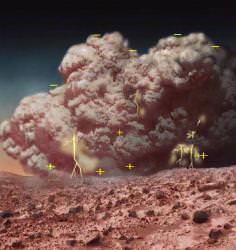
Photographs taken of the surface of Mars show evidence that glaciers once scoured away at its surface. Since the Red Planet is so dry, where did they come from? Scientists think that Mars' tilt towards the Sun changes very rapidly, and there was a time only a few million years ago when parts of the planet got much warmer during the summer. Glaciers could form on the flanks of the planet's larger mountains, and grow to be several hundred metres thick after just a few thousand years.
Continue reading

World's Largest Telescope

By Fraser Cain - January 21, 2006 02:38 AM UTC | Telescopes
Europeans have begun funding what will eventually become the world's largest telescope: the Square Kilometre Array. The first step is a four-year study that will consult astronomers and engineers from around the world to decide what will make the best design. It will then be developed in stages, with parts coming operational over the next decade, and completion by 2020. Once complete, this extremely sensitive radio telescope will help probe the nature of dark matter, confirm Einstein's predictions about relativity... and let us watch television shows broadcast from nearby stars.
Continue reading

New Horizons Blasts Off for Pluto

By Fraser Cain - January 21, 2006 01:42 AM UTC | Missions
NASA's New Horizons spacecraft finally launched from Cape Canaveral, Florida on January 19th. Travelling away from Earth at a speed of 13 kilometers per second (8 miles per second), the small piano-sized spacecraft will encounter Pluto on July 2015 after a long 9-year journey. Along its way, New Horizons will pass by Jupiter in 2007 and continue its journey to the Kuiper belt after investigating Pluto and its moon Charon.
Continue reading

Self-Repairing Spacecraft

By Fraser Cain - January 21, 2006 01:23 AM UTC | Space Exploration
After launch, spacecraft are on their own. They have no way to repair damage from the tiny micrometeorites that inevitably chip away at them. But now researchers at ESA are working on a protective seal that could give spacecraft a self-healing mechanism. This seal is made of glass fibres containing an adhesive material. Once a meteorite pierces the glass coating, the liquid adhesive and a separate hardener flow out to seal the wound and then turn solid.
Continue reading

Saturnian Storms About to Merge

By Fraser Cain - January 20, 2006 12:20 PM UTC | Planetary Science
In this photograph taken by Cassini, two storms are visible raging across the surface of Saturn; they're reaching out and interacting with each other. The larger storm, on the left, is at least 2,500 km (1,600 miles) across, and the smaller storm is about a quarter of its size. They have long threadlike arms reaching out to each other, and it's expected that they merged a few days after this photo was taken.
Continue reading

Satellites on a Budget - High Altitude Balloons

By Nancy Atkinson - January 20, 2006 06:18 AM UTC | Observing
Paul Verhage has some pictures that you'd swear were taken from space. And they were. Amateur Radio High Altitude Ballooning allows individuals to launch functioning satellites to "near space" at a fraction of the cost of traditional rocket launch vehicles. Paul's balloons have been as high as 35 km, and the photographs he's taken are out of this world.
Continue reading

Asteroid Broke Up 8.2 Million Years Ago

By Fraser Cain - January 19, 2006 11:23 AM UTC | Planetary Science
Astronomers think they've found evidence that an asteroid broke up about 8.2 million years ago, scattering dust around the Solar System. The discovery was made by US and Czech Republic researchers who found a layer of helium 3 in oceanic sediment - this isotope is normally quite rare. This evidence matches computer simulations on a group of asteroid fragments in the asteroid belt that were once part of a larger object called Veritas. It was likely the biggest asteroid break up or collision in the last 100 million years.
Continue reading

Juventae Chasma on Mars

By Fraser Cain - January 19, 2006 10:25 AM UTC | Planetary Science
This image, taken by the European Space Agency's Mars Express spacecraft, shows Juventae Chasma, in the Lunae Planum region of Mars. The feature is located north of Valles Marineris, and its floor is covered with dunes. In the north-east region of the valley is a mountain composed of bright, layered material which scientists think contains mostly sulphate deposits.
Continue reading

Kuiper Belt-Like Disks Around Two Nearby Stars

By Fraser Cain - January 19, 2006 10:13 AM UTC | Stars
After surveying 22 nearby star systems, NASA's Hubble Space Telescope has discovered two bright debris disks that resemble our own Kuiper Belt, a ring of icy rocks outside the orbit of Neptune. These disks encircle the kinds of stars that probably have habitable zones and planets, and fall into two types: wide and narrow belts. Both disks are about 60 light years away from Earth, and look remarkably similar to our early solar system.
Continue reading

Natural Particle Accelerator Discovered

By Fraser Cain - January 18, 2006 11:13 AM UTC | Physics
A fleet of NASA and ESA spacecraft have spotted an immense jet of electrically charged particles in the solar wind between the Earth and the Sun. The jet is at least 200 times as wide as the Earth and occurs because magnetic field lines clash together in a process called "magnetic reconnection". These jets are similar to ones which form in the Earth's magnetic field, but at a much larger scale.
Continue reading

Kuiper Belt Moons Might Be More Common

By Fraser Cain - January 18, 2006 10:19 AM UTC | Planetary Science
Just a few years ago, Pluto was considered unusual for Kuiper Belt Objects because it has a moon. Now three of the four largest KBOs have been discovered with moons, and it's causing astronomers to reconsider how this came about. Only 11% of smaller KBOs have a moon, and probably captured them with gravity. But the moons for the larger objects likely formed when similarly-sized planetoids collided together, and the debris turned into their moons.
Continue reading

Hit and Run Planets

By Fraser Cain - January 18, 2006 01:52 AM UTC | Exoplanets
The composition of many planets, asteroids and meteorites could be explained by the theory of "hit-and-run" collisions. Scientists originally believed that the four terrestrial planets (Mercury, Venus, Earth and Mars) were formed slowly over time as material built up by accretion. But it's entirely possible that objects sideswiped each other, and continued on; although, with both parties pretty banged up. Large objects don't even have to touch to do massive damage to each other through their gravitational influence.
Continue reading

The Stars That Shouldn't Be

By Fraser Cain - January 16, 2006 10:08 AM UTC | Stars
Arizona astronomers have found a collection of stars that really shouldn't exist. They're located in the debris of NGC 2782, which is the result of a merger between a Milky Way-sized galaxy and a smaller galaxy. These kinds of mergers are very common in the Universe; however, they usually leave behind debris that doesn't contain the right ingredients to form stars - neutral hydrogen gas and molecular gas. But NGC 2782 has regions with stars that formed after the collision.
Continue reading

Bringing Stardust Home

By Nancy Atkinson - January 16, 2006 05:30 AM UTC | Missions
NASA's Stardust spacecraft returned to Earth early Sunday morning, bringing with it particles from a comet. Two members of Stardust's Navigation Team discuss the challenges of bringing this spacecraft back home.
Continue reading

What's Up This Week - January 16 - January 22, 2006

By Fraser Cain - January 16, 2006 05:16 AM UTC | Observing
Greetings, fellow SkyWatchers! The busiest place to be as the week begins is the "Beehive" and the peak of the Delta Cancrid meteor shower, but if you're clouded out, dont worry - the Coma Berenicids will be along mid week. Come along as we explore Messier objects and one of the finest carbon stars around - R Leporis. So grab those binoculars or telescopes and head out into the night because...

Here's what's up!
Continue reading

Huygens Celebrates a Year on Titan

By Fraser Cain - January 14, 2006 01:00 AM UTC | Planetary Science
Just over a year ago, the European Space Agency's Huygens probe touched down on the surface of Titan, Saturn's largest moon. The mission was an outstanding success, and revealed amazing images of a world both alien and familiar. During its nearly 3-hour descent, the probe measured powerful winds and sampled an atmosphere that contains a complex organic chemistry - possibly the same molecules present when our Earth was very young.
Continue reading

Dark Matter Galaxy?

By Fraser Cain - January 13, 2006 12:12 PM UTC | Extragalactic
Astronomers think they might have found a "dark galaxy", that has no stars and emits no light. Although the galaxy itself, located 50 million light years from Earth, is practically invisible, it contains a small amount of neutral hydrogen which emits radio waves. If astronomers are correct, this galaxy contains ten billion times the mass of Sun, but only 1% of this is hydrogen - the rest is dark matter.
Continue reading

Black Holes Churn Up Interstellar Dust

By Fraser Cain - January 12, 2006 11:52 AM UTC | Black Holes
The supermassive black holes at the heart of most galaxies put out so much energy they churn the interstellar dust that surrounds them. NASA's Chandra X-Ray Observatory recently took a series of images of 56 elliptical galaxies, and revealed that the hot gas and dust blasting out X-rays have a different distribution from the stars we can see. This gas and dust should have settled down millions of years ago, but it appears that these black holes are feeding so voraciously that they're continuously stirring up the material.
Continue reading

Magnetic Slinky in Space

By Fraser Cain - January 12, 2006 11:04 AM UTC | Physics
Astronomers from UC Berkeley University have recently discovered a spiraling magnetic field in space, wrapped around a long, thin cloud of gas and dust called the Orion Molecular Cloud. The coiled magnetic field has pulled this gas cloud into a thin filament. Astronomers have suspected that magnetic forces can define the shape of interstellar clouds, but they haven't seen evidence for it, until now. The Orion Molecular Cloud contains two stellar nurseries; one in the belt region, and another in the sword region of the Orion constellation.
Continue reading

The Next Orion Nebula

By Fraser Cain - January 12, 2006 05:08 AM UTC | Stars
The Orion Nebula is one of the most magnificent objects in the night sky, but it won't last forever. Fortunately, astronomers now think they know where its successor will show up. A glowing gas cloud in the constellation Cassiopeia called W3 has just begun to shine with newborn stars. In just 100,000 years, it should be blazing in the night sky; just as the Orion Nebula fades from view. W3 was recently found to have a collection of massive protostars packed tightly together, eating away at a surrounding cocoon of gas and dust that obscures them from view.
Continue reading

Gigantic Galactic Companion Discovered

By Fraser Cain - January 12, 2006 04:56 AM UTC | Extragalactic
An international team of astronomers have turned up an enormous companion galaxy to our Milky Way - it was hiding in plain sight. The star cluster is only 30,000 light years from Earth, and contains thousands of stars spread over an area 5,000 times larger than the full Moon in the sky. These stars don't fall within the Milky Way's spiral arms, galactic bulge or spherical halo, so astronomers figured they must belong to some other object. It's probably the remnant from an ancient galactic merger.
Continue reading

Planet Finding Instrument Should Allow Many Discoveries

By Fraser Cain - January 12, 2006 04:45 AM UTC | Exoplanets
A new instrument called Exoplanet Tracker has turned up an extrasolar planet orbiting a star 100 light years away. This instrument is designed to detect subtle shifts in starlight as a star moves back and forth through interactions with its planet. The Exoplanet Tracker is much cheaper than traditional spectrographs, costing only $200,000, and capable of being installed on lower power telescopes. Although this version can only watch one star at a time, future improvements should allow it to monitor 100 stars simultaneously.
Continue reading

Best Orion Nebula Image Ever Taken

By Fraser Cain - January 12, 2006 04:33 AM UTC | Stars
This outstanding photograph of the Orion Nebula was taken by the Hubble Space Telescope. The space-based observatory built up the photograph over the course of 105 orbits around the Earth. The full sized image contains a billion pixels, and astronomers were able to discover 3,000 stars of various stars. Hubble also spotted a collection of possible brown dwarfs, which aren't large enough to sustain fusion reactions in their cores.
Continue reading

Vega Has a Cool Dark Equator

By Fraser Cain - January 11, 2006 06:22 AM UTC | Stars
According to new observations from the National Optical Astronomy Observatory, Vega appears to have a huge difference in temperature between its equator and poles. Vega is the 5th brightest star in the sky, completing one rotation every 12.5 hours. Its high rotation speed flattens out the star, so that it's equator is 23% wider than its polar diameter. This result confirms the theory that rapidly rotating stars are cooler at their equators.
Continue reading

Binary Systems Can Support Planets

By Fraser Cain - January 11, 2006 05:06 AM UTC | Exoplanets
A new computer simulation developed at the Carnegie Institution suggests that planets can form and survive around binary star systems. Astronomers previously believed that the complex gravity would make gas and dust too unstable to form planets, but this simulation indicates that this gravity might actually accelerate the process, causing large clumps to form in a matter of only 1,000 years. Since 2 out of 3 stars are members of multiple star systems, this raises the number of planets that might be in the Universe.
Continue reading

Book Review: Fred Hoyle's Universe

By Mark Mortimer - January 10, 2006 06:21 AM UTC | Cosmology
Salmon have an heriditary instinct to swim upriver against the stream. The same inate drive pushes some scientists to replace theories of the day with their own perceptions. These avant garde specialists are unafraid to tackle mainstream ideas in the belief that their views are correct. Jane Gregory's book, Fred Hoyle's Universe shows how Fred Hoyle fits this description of an original thinker in his near ceaseless, lifetime espousement of fresh ideas. The current of conformity never seemed to be too daunting as he went about following his own pursuits.
Continue reading

The North Star is Really Three Stars

By Fraser Cain - January 09, 2006 09:17 AM UTC | Stars
Polaris, or the North Star, is one of the most famous stars in the sky. But did you know it's actually a triple star system? In a small telescope it's easy to see two stars, but it took the massive resolving power of the Hubble Space Telescope to spot the third. By resolving this third star, astronomers hope to be able to accurately measure Polaris. This is very important because Polaris is a member of a special class of stars called Cepheid variables which are used by astronomers to measure distances.
Continue reading

Massive Star Cluster Discovered

By Fraser Cain - January 09, 2006 08:28 AM UTC | Stars
This beautiful photograph taken by the Spitzer Space Telescope shows a region of space containing one of the largest clusters of stars ever seen. It appears to weigh in at 20,000 times the mass of our Sun, and contains at least 14 red supergiant stars. These supergiant stars are about as large as stars can get, and will die a violent supernova death within only a few million years. Spitzer used its infrared instrument to peer through the thick gas and dust that shrouds the centre of the Milky Way, obscuring them from view.
Continue reading

How the Milky Way Got its Warp

By Fraser Cain - January 09, 2006 08:08 AM UTC | Milky Way
Astronomers have discovered that nearby satellite galaxies, the Large and Small Magellanic Clouds, are interacting with local dark matter to warp the disk of the Milky Way. It was originally believed that the Magellanic Clouds had too little mass to affect the shape of the Milky Way. Researchers from UC Berkeley have created a simulation that includes data about the Milky Way's dark matter. As the Magellanic clouds orbit our galaxy, they introduce a warp to our galactic disk that matches observations.
Continue reading

What's Up This Week - January 9 - January 15, 2006

By Fraser Cain - January 09, 2006 05:29 AM UTC | Observing
Greetings, fellow SkyWatchers! If you're not "seeing double" yet, you will by the end of the week as we explore the wonderful world of multiple stars systems. There will be plenty of lunar features to keep you busy and some history to study as well, so be sure to put on a coat if it's cold and head out tonight, because...

Here's what's up!
Continue reading

Star Orbiting a Medium Sized Black Hole

By Fraser Cain - January 06, 2006 08:52 AM UTC | Black Holes
Astronomers have found evidence of monstrous black holes at the heart of galaxies with the mass of millions of stars, or ones with just the mass of a single star. But not much in between (100 to 10,000 stellar masses). One of the newest pieces of evidence for a medium-sized black hole was captured by NASA's Chandra X-Ray Observatory. It measured the orbit of a star trapped in a death spiral around one of these medium-mass black holes.
Continue reading

Hazy View of Saturn

By Fraser Cain - January 06, 2006 08:22 AM UTC | Planetary Science
This moody image of Saturn was taken by Cassini on December 5, 2005. It was taken using a special combination of the spacecraft's spectral filters to reveal delicate haze in its upper atmosphere. A methane-sensitive filter makes the high altitude features stand out, while a polarizing filter makes the small haze particles bright. The small white dot at the right side of the rings is Saturn's moon Dione.
Continue reading

10 Days Until Stardust Returns

By Fraser Cain - January 06, 2006 08:09 AM UTC | Missions
NASA's Stardust spacecraft performed its 18th and second-to-last flight maneuver on January 5th, perfecting its aim for Earth. On January 15, 2006, the spacecraft will release its sample return capsule, which will re-enter the Earth's atmosphere. The capsule is carrying particles collected by Stardust as it passed through the tail of Comet Wild 2. NASA will then fly the capsule back to the Stardust Lab at the Johnson Space Center in Houston.
Continue reading

Charon has no Atmosphere

By Fraser Cain - January 05, 2006 08:43 AM UTC | Planetary Science
Astronomers from MIT and Williams College were fortunate enough to be watching Pluto's moon Charon at the moment that it passed in front of a very dim star. By measuring how the light from this star dimmed as it passed behind the tiny, distant moon, they were able to come up with a very accurate measurement of Charon's size (606 km or 377 miles). They also determined that the moon doesn't have any appreciable atmosphere, lending evidence that it was formed when something smashed into a proto-Pluto millions of years ago.
Continue reading

When a Meteor Slashed Mars

By Fraser Cain - January 05, 2006 08:13 AM UTC | Planetary Science
This image, taken by ESA's Mars Express spacecraft, shows an unusually shaped impact crater Hesperia Planum region of Mars. The crater is approximately 11 x 24 km (7 x 15 miles) across and has ejecta surrounding it where molten rock splashed around when a meteor carved it out. While most impact craters are circular, this elongated shape means that the space rock hit Mars at an extremely low angle (less than 10 degrees). Similar craters have been seen on the Moon.
Continue reading

Superbubble Complex N44

By Fraser Cain - January 05, 2006 08:00 AM UTC | Stars
The powerful Gemini telescope produced this amazing photograph of the N44 superbubble complex (also known to astronomers as NGC 1929). A cluster of hot, young stars have pushed out a cavernous bubble in this nebula 325 by 250 light-years across. Additional smaller bubbles can be seen inside the nebula, which could have been formed by collapsing gas and dust.
Continue reading

A Supernova Every 50 Years

By Fraser Cain - January 05, 2006 07:49 AM UTC | Stars
A team of European astronomers has calculated the rate that supernovas are exploding in the Milky Way: approximately one goes off every 50 years. They came to this calculation by measuring the amount of gamma rays coming from radioactive aluminum at the centre of the Milky Way. They were able to estimate that there's a total of approximately three solar masses of radioactive aluminum in the galaxy - produced by supernova exploding every 50 years or so.
Continue reading

What's Up 2006 - Download it Free

By Fraser Cain - January 05, 2006 05:51 AM UTC | Observing
I'm sure some of you noticed we missed this week's What's Up, and I apologize, my whole family was a little sick this week, so I wasn't able to put much work into the website. However, I have a big surprise for all of you. Tammy has been hard at work for the last 4 months writing a book... for you.

What's Up 2006 - 365 Days of Skywatching

This is a FREE 407-page downloadable book containing What's Up material for every day in 2006. You can download the book to your local computer, go to the day you like and print off the page to take outside with you nicely formatted. It's also got tons of other material including general skywatching advice, equipment selection, and hundreds of beautiful photographs. We've been working pretty hard on this. :-)

And yes, this book is absolutely free. Download it, send it to your friends, print it off. Oh, and if you could tell everyone you know, we'd really appreciate it. :-) We'll still be having the same old web content as well, and some additional material to support the book. I'm still getting that all together, but I didn't want to delay the release any longer.

Also, this is an experiment, so give me any feedback you have, suggestions for improvements, etc.

Fraser Cain
Publisher
Universe Today
Continue reading

Leading the Way Back to the Moon

By Nancy Atkinson - January 04, 2006 11:19 AM UTC | Space Exploration
The centerpiece of NASA's Vision for Space Exploration is the new spacecraft that will carry astronauts to the moon, Mars and beyond. Jeff Hanley, appointed as Constellation Program manager in October, discusses the development of the new Crew Exploration Vehicle, the role of the International Space Station, and the path of the 'Vision.'
Continue reading

Shadows on the Moon

By Fraser Cain - January 04, 2006 04:52 AM UTC | Planetary Science
When the Apollo astronauts stepped out onto the lunar surface, they were the first human eyes to see this alien landscape. And one of the strangest things that they saw were the shadows. On Earth, our shadows aren't black, but blue, thanks to the scatter light passing through our atmosphere. But on the Moon, which has no atmosphere, the shadows are utterly black. The darkness of the shadows was one of the first things that Neil Armstrong noticed as he stepped off the lunar module and onto the surface of the Moon.
Continue reading

Tethys Floating Past Saturn

By Fraser Cain - January 04, 2006 04:17 AM UTC | Planetary Science
This natural colour photograph shows Saturn's moon Tethys going past the planet's huge globe with the thin line of rings curving at the horizon. The craters Odysseus (top) and Melanthius (bottom) are also visible on Tethys surface. This image was captured at a distance of approximately 2.5 million kilometers (1.6 million miles) from Saturn by the Cassini spacecraft narrow-angle camera on Dec. 3, 2005.
Continue reading

Pluto is Colder Than Charon

By Fraser Cain - January 03, 2006 08:34 AM UTC | Planetary Science
Pluto is far away from the Sun, so you'd think it should be cold - but it's actually colder than astronomers were expecting. Its temperature was taken using the Submillimeter Array (SMA) on Mauna Kea in Hawaii, which was able to distinguish between Pluto and its moon Charon. Pluto is about 43 K (-382 degrees F), while Charon is 10 degrees warmer. Scientists think that heat from the Sun is converting nitrogen ice on Pluto to gas, which cools it down, similar to evaporation effect when something wet feels colder.
Continue reading

Podcast: Gravity Tractor Beam for Asteroids

By Fraser Cain - December 29, 2005 07:25 AM UTC | Planetary Science
Forget about nuclear weapons, if you need to move a dangerous asteroid, you should use a tractor beam. Think that's just Star Trek science? Think again. A team of NASA astronauts have recently published a paper in the Journal Nature. They're proposing an interesting strategy that would use the gravity of an ion-powered spacecraft parked beside an asteroid to slowly shift it out of a hazardous orbit. Dr. Stanley G. Love is member of the team and speaks to me from his office in Houston.
Continue reading

First Galileo Satellite is in Orbit

By Fraser Cain - December 29, 2005 02:22 AM UTC | Missions
ESA's first Galileo satellite blasted off from the Baikonur Cosmodrome on Wednesday, atop a Russian Soyuz-Fregat rocket. The global positioning spacecraft is called Giove A, and it will demonstrate key technologies that the future Galileo satellites will use as well. It's also carrying radiation detectors on board, to give mission planners an idea of the radiation environment where the constellation will fly.
Continue reading

Chandra Looks at the Earth's Aurora

By Fraser Cain - December 29, 2005 01:41 AM UTC | Solar Astronomy
A team of scientists turned the Chandra X-Ray Observatory back at the Earth, and closely observed the north polar region ten times during 2004. They have discovered low-energy (0.1 - 10 kilo electron volts) X-ray emissions from the Earth's auroral activity. The colour of the X-ray arcs represent the intensity of the X-ray generation, with red indicating the maximum brightness.
Continue reading