Integral Uses the Earth to Search for Cosmic Radiation

By Fraser Cain - February 13, 2006 08:13 AM UTC | Missions
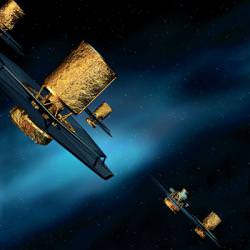
ESA scientists are observing Earth from space using the Integral gamma ray observatory to find out how the continuous, high energy of cosmic radiation is originally produced. Earth itself isn't the main target of Integral; instead, it's looking at what can be seen as the Earth passes in front of these radiation sources. This diffuse, high-energy radiation is known as the 'cosmic X-ray background', and astronomers think it's produced by deep space supermassive black holes.
Continue reading

What's Up This Week - February 13 - February 19, 2006

By Fraser Cain - February 13, 2006 05:27 AM UTC | Observing
Greetings, fellow SkyWatchers! The Full Snow Moon holds court as the week begins, making it a great time to spot some atmospheric phenomena. That won't stop us from seeing "double" as we meet the "twins" of Gemini and hitch a ride with the celestial charioteer - Auriga. Get out your scopes and binoculars. The sky is the limit and all you need to know is...

What's up!
Continue reading

Astrophoto: M-82 by Russell Croman

By Fraser Cain - February 10, 2006 10:12 AM UTC | Extragalactic
Hollywood has a long love affair with battles involving huge ships at close quarters both on the sea and in deep outer space. Always a crowd pleaser, these action packed scenes pit the destiny of each crew against the other as their vessels approach and often collide in a burst of smoke and pyrotechnics. Somewhat similar situations occur throughout the cosmos when two island universes approach and are drawn together, not by testosterone induced aggression but by the attractive force of gravity with explosive effects that occur on a galactic scale!
Continue reading

Podcast: There Goes New Horizons

By Fraser Cain - February 10, 2006 06:29 AM UTC | Missions
Take a look through any book on our Solar System, and you'll see beautiful photographs of every planet - except one. Eight of our nine planets have been visited up close by a spacecraft, and we've got the breathtaking photos to prove it. Pluto's the last holdout, revealing just a few fuzzy pixels in even the most powerful ground and space-based telescopes. But with the launch of New Horizons in January, bound to arrive at Pluto in 9 years, we're one step closer to completing our planetary collection - and answering some big scientific questions about the nature of objects in the Kuiper Belt. Alan Stern is the Executive Director of the Space Science and Engineering Division, at the Southwest Research Institute. He's New Horizon's Principal Investigator.
Continue reading

The Moon has Alps Too

By Fraser Cain - February 10, 2006 03:05 AM UTC | Planetary Science
If the Winter Olympics were held on the Moon, the best spot would be on the Lunar Alps. This is a region of the Moon similar in size and shape to Europe's Alps. Of course, with 1/6th the gravity, skiers could do some amazing tricks. Unlike Europe's Alps, which formed over millions of years, the lunar Alps were formed in a relative instant 4 billion years ago when a gigantic asteroid struck the Moon, and carved out Plato crater.
Continue reading

Channels and Pits on Mars

By Fraser Cain - February 10, 2006 02:24 AM UTC | Planetary Science
This photograph shows the amazing pits and ?grabens? in the Phlegethon Catena region of Mars. These are regions of terrain that have sunk down relative to their surroundings, but planetary geologists aren't exactly sure why. One possibility is that the subsurface eroded away and the surface fell into the pits that were created, or it might be from tension cracks in the region causing it to collapse. The photograph was taken by the High Resolution Stereo Camera (HRSC) on board ESA's Mars Express spacecraft.
Continue reading

A Closer Look at Telesto

By Fraser Cain - February 09, 2006 01:03 AM UTC | Planetary Science
This false-colour view taken by NASA's Cassini spacecraft shows the surface features and color variation on the moon Telesto. Similar to Pandora, the smooth surface of this Trojan moon suggests that it's covered with a mantle of fine, dust-sized icy material. The small moon Telesto is about 24 kilometers (15 miles) wide. Cassini captured this image at a distance of approximately 20,000 kilometers (12,000 miles) with its narrow-angle camera on December 25, 2005.
Continue reading

Mega Solar Systems Discovered

By Fraser Cain - February 08, 2006 10:05 AM UTC | Exoplanets
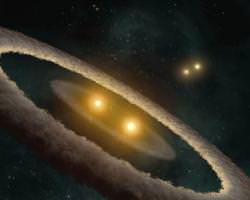
NASA's Spitzer Space Telescope has discovered potential solar systems surrounding two massive stars, 30 and 70 times the mass of our Sun. These stars generate intense solar winds, so it's surprising that disks of material could last near them long enough to form planets. Astronomers believe these disk contain massive quantities of icy material, similar to the Kuiper belt in our own Solar System, but extending out 60 times more distant than Pluto's orbit.
Continue reading

DVD Review: Dune - Extended Edition

By Mark Mortimer - February 08, 2006 06:35 AM UTC | Space Exploration
Being a messiah can't be easy. For one thing, you have to have many disadvantaged people to lead. As well, you'd need some extraordinary skills to convince them to follow and to make your leadership a success. Just becoming a messiah isn't any easier as David Lynch shows in Dune ? Extended Edition, his cinematic version of Frank Herbert's book. For here, not only do messianic images need to appear but they must do so for a society living thousands of years in the future, on another planet. And this is the story of Dune, of a distant messiah who arrives on a distant planet where people are waiting for a saviour.
Continue reading

Hubble View of a Pinwheel-Shaped Galaxy

By Fraser Cain - February 08, 2006 03:30 AM UTC | Extragalactic
This photograph taken by the Hubble Space Telescope shows the pinwheel-shaped galaxy NGC 1309. Some of the interesting features are the bright blue areas of star formation in its spiral arms, the ruddy dust lanes in its structure, and yellowish central population of older stars. NGC 1309 is also home to Type Ia supernovae SN 2002fk, which astronomers are measuring to help determine the rate of expansion of the Universe.
Continue reading

The Case of the Stolen Stars

By Fraser Cain - February 07, 2006 11:28 AM UTC | Milky Way
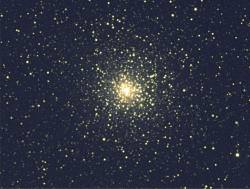
At some point in the distant past, our own Milky Way robbed the low-mass stars from globular cluster M12. This cluster is about 23,000 light-years away in the constellation of Ophiuchus, and it's known to contain about 200,000 stars. What's unusual is that they're nearly all 20 to 80% the mass of our Sun; a surprisingly high ratio compared to the rest of the Milky Way. Astronomers estimate that M12 has ejected more than a million stars into the galactic halo, never to see them again.
Continue reading

Young Enceladus

By Fraser Cain - February 06, 2006 11:02 AM UTC | Planetary Science
It's easy to see the "wrinkly" features on the surface of Saturn's moon Enceladus. This actually means that portions of its surface are relatively young, and largely clear of impact craters. Its geologically active southern polar region is seen at the bottom of the image. This photo was taken on December 24, when Cassini was 108,000 kilometers (67,000 miles) from Enceladus.
Continue reading

Book Review: Saturn V

By Mark Mortimer - February 06, 2006 06:29 AM UTC | Missions
As rockets go, the Saturn V will remain as the champion of its century. A concerted engineering effort brought theory into the hard cold realm of facts, figures and data sheets. Alan Lawrie and Robert Godwin in their book Saturn V go back to the testing phase of these leviathans and recall the glories when modules passed tests or the tragedies of failures. For behind the roar and the flame of the rocket's exhaust, were countless validations and verifications that ensured this man-rated rocket performed 'nominally'.
Continue reading

What's Up This Week - February 6 - February 12, 2006

By Fraser Cain - February 06, 2006 05:59 AM UTC | Observing
Greetings, fellow SkyWatchers! The Moon is back in style and this week we'll be studying lunar features as well a bright stars and open clusters. For viewers in western North America, hope for clear skies as the Moon occults the Plieades! Time to get out your scopes and binoculars and turn an eye towards the sky, because....

Here's what's up!
Continue reading

Hot Halo Surrounds Distant Galaxy

By Fraser Cain - February 04, 2006 03:09 AM UTC | Extragalactic
New Chandra observations of spiral galaxy NGC 5746 have revealed a large halo of hot gas surrounding the optical disk of the galaxy. This halo extends for more than 60,000 light years, but the galaxy itself doesn't seem to show any sign of active star formation. Computer simulations show that the hot gas is probably from the gradual inflow of intergalactic material left over after the galaxy first formed. Halos like this had been predicted on computer, but not seen around a galaxy until now.
Continue reading

Rough and Tumble Hyperion

By Fraser Cain - February 04, 2006 02:48 AM UTC | Planetary Science
Cassini captured this image of Saturn's moon Hyperion during a distant encounter in December, 2005. Hyperion is only 280 km (174 miles) across, and is covered with closely packed pits, giving it a spongy appearance. This photo was taken when Cassini was 228,000 kilometers (142,000 miles) from Hyperion.
Continue reading

Claritas Fossae on Mars

By Fraser Cain - February 04, 2006 02:27 AM UTC | Planetary Science
This is an image of the Claritas Fossae region on the surface of Mars. The photograph was taken by ESA's Mars Express spacecraft, and shows a region approximately 200 km x 1150 km (125 miles by 715 miles). The area is located roughly south-east of the Tharsis volcano group, and shows evidence of ancient tectonic and volcanic activity, as well as many meteor strikes.
Continue reading

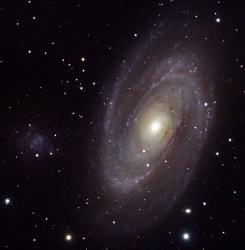
Astrophoto: M-81 by Tom Davis

By Fraser Cain - February 04, 2006 02:22 AM UTC | Extragalactic
In the Northern hemisphere, winter solstice marks the shortest period of daylight during the year. The long nights host an annual parade of familiar constellations and stars, like Orion the hunter, Taurus the bull, brilliant Sirius and ruddy Aldebaran. But to star gazers and astrophotographers alike, the Northern winter also signals the opening of galaxy season; when some of the brightest and most interesting island universes are poised above the horizon for much of the evening.
Continue reading

System Maps Microfossils in 3-D

By Fraser Cain - February 02, 2006 03:00 AM UTC | Astrobiology
Paleobiologists have produced 3-D images of ancient fossils - 650 to 850 million years old - embedded within rocks. This astounding accomplishment uses a technique called Raman spectroscopy, which allows scientists to see the structure of these ancient fossils in three-dimensions. This could be useful for future rock samples returned from Mars since would allow scientists to detect and analyze microfossils without actually damaging them.
Continue reading

The New 10th Planet Is Larger than Pluto

By Fraser Cain - February 02, 2006 02:42 AM UTC | Planetary Science
Astronomers have confirmed that the newly discovered 10th planet is larger than Pluto. Nicknamed 2003 UB313 for now, the new planet has a diameter of 3,000 km (1,850 miles) which is 700 km (435 miles) larger than Pluto. These new observations were made using a sensitive sensor on the IRAM 30-m telescope that measured the heat emitted by the new object, and found it had a similar reflectivity to Pluto. This allowed them to calculate its size.
Continue reading

Binary Icy Asteroid in Jupiter's Orbit

By Fraser Cain - February 02, 2006 02:26 AM UTC | Planetary Science
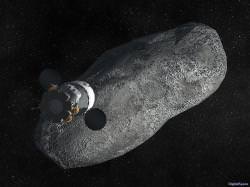
UC Berkeley researchers have performed a detailed analysis on a binary pair of asteroids circling near Jupiter's orbit, and believe they're mostly water ice covered with a layer of dirt. These objects probably started out as small Kuiper belt objects, and then were captured at one of Jupiter's Trojan points - a gravitational eddy in space where solar system material can collect.
Continue reading

Most Milky Way Stars Are Single

By Fraser Cain - February 01, 2006 12:47 PM UTC | Stars
For many years astronomers have known that massive, bright stars are usually found to be in multiple star systems. But a recent study by Charles Lada of the Harvard-Smithsonian Center for Astrophysics suggests that most stars are actually all alone. A new study on low-mass stars - such as red dwarfs - has found that these stars rarely occur in multiples and that they are more abundant than high-mass stars, such as the Sun. Since planets form more easily around single stars, they could be more common than previously thought.
Continue reading

Neutron Star Swapping Leads to Gamma-Ray Bursts

By Fraser Cain - February 01, 2006 12:17 PM UTC | Physics
Scientists think they're closing in on the cause of gamma ray bursts: merging neutron stars. It was originally believed that this happened when huge stars in a binary system both turned into neutron stars, and eventually smashed into each other. But astronomers think that neutron stars in globular star clusters could eventually pair up. The stars are packed so closely together, that they often exchange partners; a neutron star could swap a regular star out for another neutron star.
Continue reading

Dione's Tectonic Faults

By Fraser Cain - February 01, 2006 01:51 AM UTC | Planetary Science
This Cassini photograph highlights tectonic faults and craters on Saturn's moon Dione. This enhanced-colour view was created by merging ultraviolet, green and infrared photographs into a single image which was then superimposed over top of clear-filter image. The photographs were taken on December 24, 2005, when Cassini was 151,000 kilometers (94,000 miles) from Dione.
Continue reading

Stardust Placed Into Hibernation

By Fraser Cain - January 31, 2006 01:51 AM UTC | Missions
Having successfully delivered its fragile payload of comet and interstellar dust samples, Stardust is a spaceship without a purpose. This week, NASA controllers sent a series of commands that put the ship into a hibernation mode. With every system turned off, except it solar arrays and receive antenna, Stardust should be able to remain in good health for years. NASA is considering future missions they could give the spacecraft.
Continue reading

The Smell of Moondust

By Fraser Cain - January 30, 2006 11:47 AM UTC | Planetary Science
When the Apollo astronauts returned to their lunar landers, they all noticed that the moondust - which had clung to their boots and suits - had some interesting properties. For starters, it smelled like spent gunpowder; as if someone had just fired a gun in the lander. Apollo 17's Jack Schmitt came down with a brief case of extraterrestrial hay fever. It could be that the relatively damp interior of the lander causes particles from the solar wind to evaporate into the air.
Continue reading

What's Up This Week - January 30 - February 5, 2006

By Fraser Cain - January 30, 2006 06:16 AM UTC | Observing
Greetings fellow SkyWatchers! The week begins as we have a look into the "Fishmouth" - M43. Then it's time to get Sirius as we learn how and when to look for a white dwarf star. As the Moon returns, we'll have a look at its features as well as some bright sky objects. So keep an eye on the sky, because...
Here's what's up!
Continue reading

Podcast: Galactic Exiles

By Fraser Cain - January 28, 2006 01:22 AM UTC | Milky Way
Young hot blue star - the supermassive black hole has spoken, it's time for you leave the galaxy. When binary stars stray too close to the centre of the Milky Way, they're violently split apart. One star is put into an elliptical orbit around the supermassive black hole, and the other is kicked right out of the galaxy. Dr. Warren Brown from the Harvard-Smithsonian Center for Astrophysics was one of the astronomers who recently turned up two exiled stars.
Continue reading

Dione's Colour Map

By Fraser Cain - January 27, 2006 10:30 AM UTC | Planetary Science
This false colour image shows subtle variations across the surface of Dione, one of Saturn's moons. Scientists created this view by combining ultraviolet, green and infrared images into a single photograph that highlights the different regional colour differences. The images were taken on December 24, 2005 when Cassini was 597,000 kilometers (371,000 miles) from Dione.
Continue reading

The Spacesuit Satellite

By Fraser Cain - January 27, 2006 02:08 AM UTC | Missions
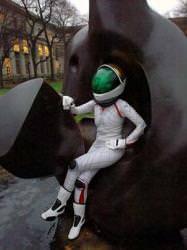
On the 3rd of February the strangest satellite ever constructed will be launched into orbit by astronauts on board the International Space Station (ISS). The satellite, called SuitSat, is an empty old spacesuit. It's equipped with 3 batteries, a radio transmitter and internal sensors to measure temperature and battery power. The satellite will continuously transmit its conditions to Earth while orbiting it. SuitSat will be broadcasting a radio signal that can be easily heard from the ground using an FM radio tuned to 145.990 MHz.
Continue reading

Rhea's Impact Basins

By Fraser Cain - January 27, 2006 01:31 AM UTC | Planetary Science
This enhanced colour image of Rhea shows how this Saturnian moon has been pounded by impacts over millions of years. The two large impact basins at the top of Rhea are very old because they're overprinted by many smaller impacts. The ray like structure on the moon's eastern side comes from a relatively recent impact that sprayed material across Rhea's surface. Cassini took this image on December 23, 2005.
Continue reading

Two Stars Kicked Out of the Milky Way

By Fraser Cain - January 26, 2006 08:53 AM UTC | Stars
Two stars have been spotted streaking out of the Milky Way, never to return. These stars are part of a new class of objects which astronomers have dubbed "exiles". These are stars which were once part of a binary system that strayed too close to the supermassive black hole at the heart of the Milky Way. The pair is torn apart, and the exiled star is fired off on a trajectory that will take it out of our galaxy. These events occur about once every 100,000 years.
Continue reading

2005 Was the Hottest Year

By Fraser Cain - January 26, 2006 04:42 AM UTC | Planetary Science
Did 2005 feel like a scorcher? Well, you're right. According to NASA researchers, 2005 was the warmest year for planet Earth in more than a century. Scientists have used weather stations on land, ships on the ocean, and satellite measurements from space to keep track of average global temperatures. Over the last 100 years, temperatures have risen on average by 0.8° C or about 1.4° F. And the five warmest years were 2005, then 1998, 2002, 2003 and 2004.
Continue reading

Tethys and Tiny Atlas

By Fraser Cain - January 26, 2006 04:07 AM UTC | Planetary Science

Two of Saturn's moons are captured in this Cassini image, Tethys and tiny Atlas which is at the centre of the image, just outside Saturn's A ring. At 1,071 kilometers (665 miles) wide, Tethys is much bigger than Atlas, which is a mere 32 kilometers (20 miles) wide. A couple of faint ringlets are also visible in the Encke Gap on the right. This image was take on December 21, 2005, at a distance of nearly 2 million kilometers (1.2 million miles) from Tethys.
Continue reading

Life Doesn't Change Terrain Much

By Fraser Cain - January 26, 2006 03:46 AM UTC | Astrobiology
Even through life has flourished on Earth for billions of years, it doesn't seem to make much of an impact on our planet's landscapes. A team of scientists from UC Berkeley did an extensive survey of landscapes across the planet, and couldn't find any place that was obviously modified by lifeforms; from large grazing animals to microscopic bacteria. The only effect seems to be that lifeforms will tend to round off sharp hills. So landscapes once covered with life on Mars might have a higher chance of being smoother and less jagged.
Continue reading

Icy Extrasolar Planet Discovered

By Fraser Cain - January 26, 2006 03:12 AM UTC | Exoplanets
Astronomers have discovered an extrasolar planet only 5 times larger than the Earth orbiting a star in the Sagittarius constellation. They used a technique called microlensing, where a star briefly passes in front of a more distant star, acting as a lens that magnifies its brightness. In this case, the planet passed in front of the star as well and created a second brightening that allowed astronomers to measure its mass. The planet is likely very cold, as it orbits about three times the distance of the Earth to the Sun, and its parent star is a colder red dwarf.
Continue reading

Prometheus and Dione

By Fraser Cain - January 25, 2006 12:41 PM UTC | Planetary Science
Two of Saturn's moons, Prometheus and Dione, are visible in this photograph taken by Cassini. Prometheus is the tiny, irregularly-shaped speck embedded inside Saturn's F ring. Dione, off to the left, is 1,123 kilometers (700 miles) wide. Cassini took this photograph on December 20, 2005 when it was approximately 2.5 million kilometers (1.6 million miles) from Dione and 2.2 million kilometers (1.4 million miles) from Prometheus.
Continue reading

Book Review: On to Mars 2

By Mark Mortimer - January 25, 2006 05:33 AM UTC | Planetary Science
Mars, both God of War and seductive planet. Its reddish hue bathes us in tempestuous delight, stirring our minds and our passions. Drawing us onto this beckoning delight is a collection of papers, stories and songs compiled by Frank Crossman and Robert Zubrin under the title, On to Mars - Volume 2. Each contributing author adds their own little ray of hope that soon Mars will have been visited by people.
Continue reading

Opportunity Begins Its Third Year on Mars

By Fraser Cain - January 24, 2006 11:45 AM UTC | Missions
NASA's Opportunity rover began its third year of operations on the surface of Mars today. Opportunity and its partner Spirit are now working through their extended missions that last through September 2006. The rovers are a little worse for wear; however. Spirit's rock abrasion tool is so worn down, it can't actually grind down rock layers, and the steering motor on Opportunity's front right wheel has broken down.
Continue reading

What's Up This Week - January 23 - January 29, 2006

By Fraser Cain - January 23, 2006 11:39 AM UTC | Observing
Greetings, fellow SkyWatchers! If it's been awhile since you've stepped outside to view the stars, be sure to have a look at the beautiful combination of Mars, Aldeberan and Betelguese. If what's happening hasn't made you see "red" yet, then watch as the Moon steals away Antares by mid-week! Come along as we explore the Sun and take on deep sky studies. Get out your scopes and binoculars - or just turn your eyes to the skies, because...

Here's what's up!
Continue reading

Icy Epimetheus

By Fraser Cain - January 23, 2006 07:16 AM UTC | Planetary Science
NASA's Cassini spacecraft took this photograph of Saturn's small icy moon Epimetheus as it faded away behind Saturn's rings and atmosphere. This image was captured by Cassini's narrow-angle camera on December 20th from a distance of 2.3 million kilometers (1.4 million miles) from Epimetheus.
Continue reading

Predicting Titan's Weather

By Fraser Cain - January 23, 2006 07:01 AM UTC | Planetary Science
A new computer model has been developed to help scientists explain the strange weather systems on Saturn's moon Titan. Images of Titan have been built up over the last few years by observations by NASA's Cassini spacecraft, as well as photographs taken from Earth-based telescopes. These models accurately predict how ethane and methane clouds form in Titan's atmosphere; especially near the moon's southern pole.
Continue reading

NASA's IMAGE Mission Ends

By Fraser Cain - January 23, 2006 06:46 AM UTC | Missions
NASA recently shut down its Imager for Magnetopause-to-Aurora Global Exploration (IMAGE) program, wrapping up 6 years of operations. During its lifetime, the spacecraft was used to measure the structure and dynamics of the Earth's external magnetic field. It was launched in March 2000, and it stopped responding to commands from the ground in December 2005. Engineers believe that its power supply subsystems failed, shutting it down entirely.
Continue reading

Book Review: Return to the Moon

By Mark Mortimer - January 21, 2006 12:10 PM UTC | Space Exploration
For anyone who's managed a program, they know that the best time to consider options is before the program begins, long before. Rick Tumlinson and Erin Medlicott present their book Return to the Moon at the start of the US's program to return to the Moon and Mars. In it, they offer a choice selection of articles by very experienced specialists, all whom have the same ambition. All these people want to see this US program put people on the Moon successfully and to the greatest advantage of all of us. Their other desire is that this program contain the right mix of government and private initiatives that will maintain people in space for a long time.
Continue reading

Icy Martian Glaciers

By Fraser Cain - January 21, 2006 04:21 AM UTC | Planetary Science
Photographs taken of the surface of Mars show evidence that glaciers once scoured away at its surface. Since the Red Planet is so dry, where did they come from? Scientists think that Mars' tilt towards the Sun changes very rapidly, and there was a time only a few million years ago when parts of the planet got much warmer during the summer. Glaciers could form on the flanks of the planet's larger mountains, and grow to be several hundred metres thick after just a few thousand years.
Continue reading

World's Largest Telescope

By Fraser Cain - January 21, 2006 02:38 AM UTC | Telescopes
Europeans have begun funding what will eventually become the world's largest telescope: the Square Kilometre Array. The first step is a four-year study that will consult astronomers and engineers from around the world to decide what will make the best design. It will then be developed in stages, with parts coming operational over the next decade, and completion by 2020. Once complete, this extremely sensitive radio telescope will help probe the nature of dark matter, confirm Einstein's predictions about relativity... and let us watch television shows broadcast from nearby stars.
Continue reading

New Horizons Blasts Off for Pluto

By Fraser Cain - January 21, 2006 01:42 AM UTC | Missions
NASA's New Horizons spacecraft finally launched from Cape Canaveral, Florida on January 19th. Travelling away from Earth at a speed of 13 kilometers per second (8 miles per second), the small piano-sized spacecraft will encounter Pluto on July 2015 after a long 9-year journey. Along its way, New Horizons will pass by Jupiter in 2007 and continue its journey to the Kuiper belt after investigating Pluto and its moon Charon.
Continue reading