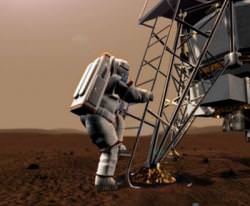
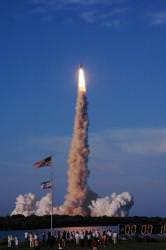
Television, with its 20 second sound bites, has done much to alter our attention spans and our expectations for news delivery. Robert Godwin takes on this challenge and has prepared the pocket space guide
Apollo 11 for our reading pleasure. Though needing a little bit longer than the typical TV newsclip, it is perfect for those wanting a colourful, informative guide about this space flight without getting into the nitty gritty details.
Continue reading
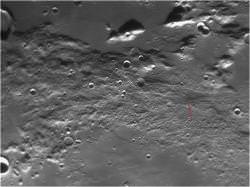
In this image of Saturn's moon Tethys, it's possible to see the giant Ithaca Chasma cutting a swath across its surface. The chasm is 100 km (60 miles) long and 4 km (2 miles) deep in places. Cassini took this photograph on November 28, 2005 when the spacecraft was approximately 1.1 million km (700,000 miles) away from Tethys.
Continue reading
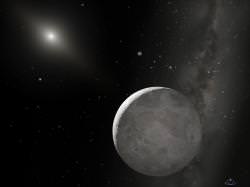
Hulett Keaton took this picture of the Northern Horizon on a clear North Georgia night. Keaton used a Cannon AE-1 riding atop Celestron GT scope.
Do you have photos you'd like to share? Post them to the
Universe Today astrophotography forum or
email them to me directly, and I might feature one in Universe Today.
Continue reading
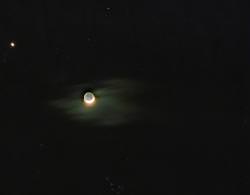
Hulett Keaton took this picture of Kembles Cascade on crisp, cold North Georgia night. Keaton used a Cannon AE-1 riding atop Celestron GT scope.
Do you have photos you'd like to share? Post them to the
Universe Today astrophotography forum or
email them to me directly, and I might feature one in Universe Today.
Continue reading
A planet forming disk located about 375 light-years from Earth has been found to contain some of the building blocks of life: acetylene and hydrogen cyanide. The chemicals were discovered around "IRS 46" using NASA's infrared Spitzer Space Telescope. When mixed with water in a laboratory, these chemicals create a soup of organic compounds, including amino acids and a DNA base called adenine.
Continue reading
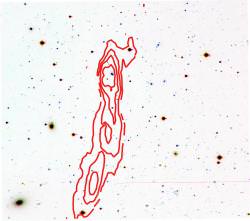
A team of Italian astronomers have discovered that a pulsar racing through the Milky Way has a comet-like trail blazing behind it. The object is called Geminga, and it was previously found to have twin jets of material blasting from its poles. This new, longer tail, was uncovered by studying data archived by NASA's Chandra X-Ray Observatory. Geminga is only 500 light-years away from Earth, and moving quickly across our field of view giving astronomers a unique opportunity to study such an exotic object.
Continue reading
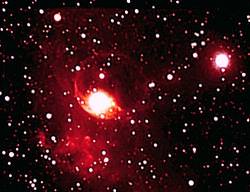
Greetings, fellow SkyWatchers... I hope everyone around the world is enjoying the peace and joy the holidays bring. Why not stay up late and view one of the bluest objects in the cosmos - the "Hubble Variable Nebula!" Let's not forget Venus, the "Witch Head" or the "Rosette." For viewers in northern Australia, you're in for a year end treat as the Moon occults Antares. The year ends on a dark note as we reach New Moon and the "Hunter" becomes the hunted. Be sure to keep your eyes on the skies because...
Here's what's up!
Continue reading
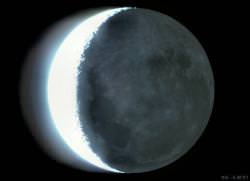
Have you ever wondered if meteors are raining down on the Moon? On November 7, NASA scientists used a special video camera to record a small explosion on the Moon. Travelling at a speed of 27 km/s (17 miles/s), the small meteoroid slammed into the lunar surface close to Mare Imbrium (the Sea of Rains). NASA meteor expert Bill Cooke suggests that the meteoroid was part of the Taurid meteor shower that hit Earth between late October and early November 2005.
Continue reading
Two ESO telescopes captured stars at different points of the stellar lifecycle in this photograph of star cluster NGC 2467. This cluster, located in the southern constellation Puppis, contains the open clusters Haffner 18 (centre) and Haffner 19 (middle right). And at the heart of Haffner 18 the stars at various ages. Mature stars are in the middle; a newborn star that has just started blazing is in the bottom left; and a dust cloud containing embryonic stars is in the right-hand corner.
Continue reading
Continue reading
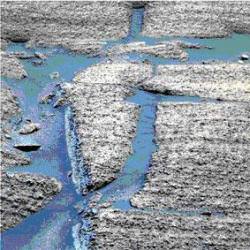
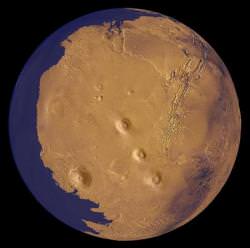
The Meridiani Planum region on Mars is currently the home of NASA's Opportunity Rover. But scientists believe that the entire region was covered with water millions of years ago, and could have been home to life. A new study is proposing that the area might have been much less wet than previously believed. A key element discovered by Opportunity could have been created by sulphur-bearing volcanic steam, and not water sediment layered down.
Continue reading
The Christmas Tree Cluster, also known as NGC 2264, is a well known star cluster in the Monoceros (the Unicorn) constellation. It got its nickname because it looks like a tree in visible light. But this view, taken with NASA's Spitzer Space Telescope, shows what it looks like in infrared light. Normally obscured by thick dust, individual newborn stars packed together in the cluster can be seen shrouded in the nebula.
Continue reading
NASA's Hubble Space Telescope has helped discover new rings and two small moons orbiting Uranus. The largest ring is twice the size of the planet's previously known rings, and went undiscovered until now because they're so far away from the planet. Scientists think that particles in these rings are slowly spiraling away from Uranus, so there must be some source constantly replenishing them with new material.
Continue reading
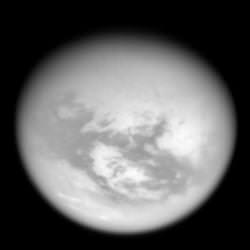
Cassini took this beautiful image of Titan with its orange surface shining against the purple halo of its atmosphere. The photograph was made by using separate blue, green and red spectral filters and then combining this with an ultraviolet image. This image was taken by Cassini's narrow-angle camera on the May 5, 2005, at a distance of approximately 1.4 million kilometers (900,000 miles) from Titan.
Continue reading
ESA's SMART-1 spacecraft is using a new technique to reveal details on the surface of the Moon. The spacecraft has been taking a series of images, only seconds apart, with its Advanced Moon Imaging Experiment (AMIE) instrument. The same location is imaged at different infrared wavelengths. Scientists back at ESA can then stack up the images to see the same spot on the Moon, imaged in all these different wavelengths, and notice any unusual features on the lunar surface.
Continue reading
An Ariane 5 rocket blasted off from the Guiana Space Centre on December 21, carrying two satellites into orbit: ESA's MSG-2 satellite and India's INSAT-4A telecommunications satellite. Ground tracking stations received good telemetry information from both satellites, indicating they were put into their proper orbits. ESA's MSG-2 will provide high-resolution images of the Earth's weather activity, while INSAT-4A will provide broadcast television and high-speed data services above the Indian subcontinent.
Continue reading
Want to know where new galaxies are going to be born? Just look for clumps of dark matter. Although dark matter is completely invisible to any kind of detector we have today, this mysterious substance can warp radiation by its gravity. Astronomers have used Hubble and the Subaru Telescope to map out the distribution of dark matter in an area of sky 5 times larger than the full Moon. Wherever dark matter is at its thickest, galaxies are likely to form.
Continue reading
Continue reading
If you're going to fly in space, you need some kind of propulsion system. Chemical rockets can accelerate quickly, but they need a lot of heavy fuel. Ion engines are extremely fuel efficient but don't generate a lot of power, so they accelerate over months and even years. A new thrusting technology called the Helicon Double Layer Thruster could be even more efficient with its fuel. Dr. Christine Charles from the Australian National University in Canberra is the inventor.
Continue reading
After years in space, and having successfully collected samples from a comet, NASA's Stardust spacecraft is almost home. If all goes well, the spacecraft will release its sample capsule on January 15, 2006. Four hours after it's released, the sample container will enter the Earth's atmosphere at a velocity of 46,440 kilometers per hour (28,860 miles per hour). The container will land at the US Air Force Utah Test and Training Range, southwest of Salt Lake City.
Continue reading
High energy electrons are a menace to space travel. They can disrupt satellite electronics and pose a serious threat to the health of astronauts. Over the past 5 years, ESA's Cluster spacecraft have revealed how these electrons are given so much energy by the Earth's magnetosphere. Scientists now know that intense solar storms can cause the magnetosphere to wobble, releasing a flood of high-energy electrons.
Continue reading
Scientists think they might have finally found the wreckage of the ill fated Beagle 2 Mars mission. Grainy photographs from NASA's Mars Global Surveyor show what could be the spacecraft and protective airbag system. Instead of landing flat on the surface of Mars, it looks like it bounced into a crater and rolled around inside. Even though the lander was designed for a rough landing, this was probably more than it could have handled.
Continue reading
Italian and French researchers are about to spend a full year in one of the most inhospitable places on Earth: Antarctica. But it's paradise compared to what astronauts would face if they stepped out on the surface of Mars. As part of its Aurora Exploration Programme, ESA is considering a human mission to Mars by 2030. One stage of this exploration program is the Concordia station in Antarctica, which simulates many of the conditions and constraints that astronauts would face living on Mars.
Continue reading
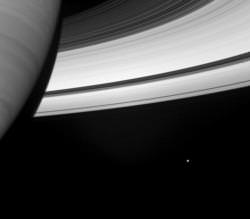
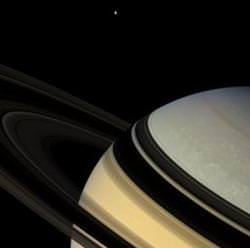
Cassini has captured this amazing image of two Saturian moons: Mimas and Helene, hiding behind the planet's ringplane. The large, bright moon is Mimas, illuminated on its right side by the Sun. The tiny dot to its left is the tiny Trojan moon Helene. This moonlet is only 32 kilometers (20 miles) across, and shares the same orbit as Dione. This image was taken on November 2, 2005.
Continue reading
Even though they explode in an instant, the after effects of supernovae can be seen for hundreds of years. Astronomers have observed the remains of three supernovae that flashed in our skies hundreds of years ago. Careful image analysis found concentric arcs of light moving outwards from where the supernovae exploded. Light from these explosions has bounced off of clouds of interstellar gas, and is now visible to astronomers like an echo can be heard when sound bounces off a distant object.
Continue reading
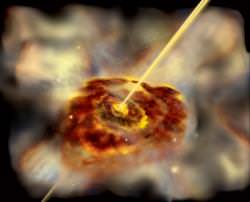
One of the big problems with Earth-based observatories is our own atmosphere. It distorts the light from distant objects, always making them a little blurry. The giant W.M. Keck observatory in Hawaii uses a laser to create a bright virtual star in the sky so astronomers can calculate and remove these distortions to create amazingly clear views of the night sky. Its latest target is the centre of our own Milky Way which is thought to hide a supermassive black hole.
Continue reading
Astronomers have used the ESO's Very Large Telescope to measure the stellar vibrations of a nearby star. The team studied Alpha Centauri B, one of our closest neighbours - only 4.3 light-years away - and relatively similar to our own Sun. Churning gas in the star's outer layers creates low-frequency sound waves that bounce around inside the star and cause it to pulse in and out slightly. The star only changes about a dozen metres every four minutes, but that makes enough of a change in the wavelength of light we see to be able to detect it.
Continue reading
NASA's Grace Earth observation satellite has created the first, comprehensive survey of the entire Greenland ice sheet. The spacecraft found that the volume of ice is decreasing by 162 cubic kilometres per year (39 cubic miles), which is higher than all previously published estimates. This ice melt is contributing 0.4 millimeters (.016 inches) per year to global sea level rise. Grace was also able to measure detailed changes in the surface of the sea floor after the Sumatran earthquake and resulting tsunami that happened almost a year ago.
Continue reading
Tom Gwilym took this picture of M42 from his backyard observatory in Renton, WA. Tom used Orion 80ED with Canon 10D DSLR and IDAS light pollution filter.
Do you have photos you'd like to share? Post them to the
Universe Today astrophotography forum or
email them to me directly, and I might feature one in Universe Today.
Continue reading
Mike Salway took this collection of planetary images over the year 2005 . Mike's planetary imaging includes pictures of Mars, Saturn and Jupiter.
Do you have photos you'd like to share? Post them to the
Universe Today astrophotography forum or
email them to me directly, and I might feature one in Universe Today.
Continue reading
NASA is in the final stage of preparations for the launch of its New Horizons spacecraft, destined to lift off for Pluto in January 2006. If all goes well, New Horizons will blast off January 17, 2006 atop an Atlas V rocket; the launch window extends until February 14, 2006. The spacecraft will make a gravity slingshot past Jupiter in 2007, and arrive at Pluto as early as mid-2015.
Continue reading
The physical constants of the Universe are thought to have remained unchanged since the Big Bang; many predictions made by cosmologists depend on it. An international team of researchers are using the National Science Foundation's Robert C. Byrd Green Bank Telescope (GBT) to see if things really have gone on unchanged for billions of years. They're looking to measure two universal constants: the ratio of mass between protons and electrons, and something called the fine structure constant.
Continue reading
Equality is a rallying call for many. The emancipation of women gave ladies the right to vote, obtain education, achieve gainful employment and have an equal chance at being a national leader. However, this freedom doesn't extend to all nations nor to all industries. In the book
Women in Space by David Shayler and Ian Moule, we read how women have made many startling contributions to aerospace and are also well on their way to being an accepted part of space programs. By listing their many achievements, the authors demonstrate that women can equally contribute, but only if and when society lets them.
Continue reading
This beautiful photograph shows Saturn's moon Rhea, partially obscured by the rings. The material surrounding the ring is probably on the planet's equatorial plane, extending farther out from the ring's main core. This image was taken on Oct. 30, 2005, at a distance of approximately 689,000 kilometers (428,000 miles) from Saturn.
Continue reading
Instruments on board Cassini have confirmed that Saturn's faintest ring is being created by particles emitted by its icy moon Enceladus. Scientists are amazed that this tiny, supposedly dead moon has such active volcanoes. Some unknown process is heating up the interior of Enceladus, especially near the southern pole, causing this plume of ejected material. Most of the larger particles probably reimpact the moon, but the smaller ones are pushed into orbit around Saturn by sunlight.
Continue reading
Greetings, fellow SkyWatchers... I hope you have your shopping done, because this is going to be one exciting week! We'll start off with awesome barred spiral NGC 1300 and move on to study both a white and red dwarf star. We'll pass through the Delta Arietids meteor stream, reach Winter Solstice and search out new cluster Collinder 62. The next morning we'll pass through the stream of comet 8/P Tuttle and hunt down Mercury. But the early morning excitement hasn't ended as the Moon will occult Beta Virginis and Venus comes to a standstill. Not enough? Then hang on as we explore multiple system Theta Orionis and watch as asteroid Vesta slides by bright star Delta Geminorum. Still up for more? Then enjoy a very special Christmas morning as the Moon occults Spica and the night brings around the one and only "Christmas Tree Cluster!" It's time to dance among the winter stars, because...
Here's what's up!
Continue reading
Continue reading
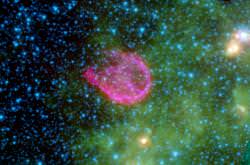
NASA's Chandra X-Ray Observatory has taken a new photograph of SN 1006; a supernova that appeared in the sky in 1006, and blazed more brightly than Venus. We now know that SN 1006 announced the death of a star located approximately 7,000 light years from Earth. It's likely that a white dwarf star was siphoning matter away from a companion star. When its mass exceeded the limit of stability, it exploded.
Continue reading
A study of ice samples extracted from deep underneath Greenland's ice sheet could help scientists recognize methane-producing bacteria on Mars. ESA's Mars Express spacecraft recently turned up evidence of methane in the martian atmosphere. The source of this methane could be from a class of bacteria called Archaea. Although the best place to look for microbes would be from ice several hundreds of metres down, there should also be meteor craters where rock has been recently exposed.
Continue reading
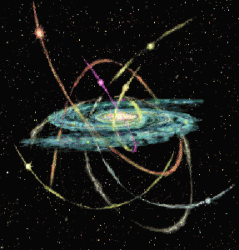
Like all spiral galaxies, our own Milky Way has magnificent spiral arms. We're just inside the galaxy, so we don't get a good view of them. An international team of radio astronomers have revised the distance to the Milky Way's Perseus spiral arm. They used a simple method called triangulation, where the angles to various stars are measured when the Earth is at opposite sides of its orbit. The previous estimates are probably off because the stars are moving more quickly than astronomers realized, which added errors to the calculations.
Continue reading
This photograph shows two of Saturn's ring shepherd moons surrounded by halos of icy particles: Prometheus (at left) and Pandora (at right). Prometheus tugs at Saturn's rings pulling a stream of particles towards it as it orbits the giant planet. Cassini took this image on October 29, 2005 when it was approximately 459,000 kilometers (285,000 miles) from Pandora and 483,500 kilometers (300,500 miles) from Prometheus.
Continue reading
An international team of astronomers have analyzed a recent short gamma-ray burst, and they think it's the last scream of a neutron star being gobbled up by a black hole. The burst was discovered on July 24, 2005 by NASA's Swift satellite, and then astronomers performed followup observations with a variety of instruments. The length of the explosion and the wavelengths of radiation emitted have led astronomers to the conclusion that it had to be a neutron star colliding with a black hole.
Continue reading
Astronomers have discovered a dusty disk around a young star that could be in the process of forming new planets. The star, which is approximately the size of our own Sun, was observed using NASA's Spitzer Space Telescope. The star, known as HD 12039, is about 30 million years old; the age at which astronomers believe the terrestrial planets in our Solar System had nearly formed. Based on Spitzer's analysis to date, it looks like only 1-3% of young Suns have a disk like this surrounding them.
Continue reading
With Christmas approaching, I just wanted to give you a final reminder about the
Year in Space 2006 calendar. This 144-page spiral-bound desk calendar has 53 full-colour space photographs, so you can gaze into infinity as you plan your week. It's filled with space trivia, sky events, daily Moon phases, and additional calendars. Universe Today readers can save at least 27% off the suggested retail price and pay only $10.95 USD by ordering online. There's free shipping in the U.S., and deeper discounts for multiple copies.
Click here to visit their website.
Fraser Cain
Publisher
Universe Today
P.S. And congratulations to Andrea from Madison, Wisconson who won the calendar giveaway I did last week. Nice going!
Continue reading
Continue reading
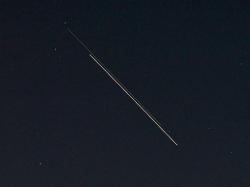
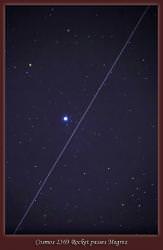
Rick Gatley took this picture of a contrail shadow from Texas. This picture was taken the cockpit of a BeechJet 400A flying westbound at 40,000 feet over the Texas coast.
Do you have photos you'd like to share? Post them to the
Universe Today astrophotography forum or
email them to me directly, and I might feature one in Universe Today.
Continue reading
Shahriar Davoodian took this picture of M42 on 8th December, 2005 from Damavand, Iran. Shahriar used Meade 8" LX90 with Canon EOS 300D camera.
Do you have photos you'd like to share? Post them to the
Universe Today astrophotography forum or
email them to me directly, and I might feature one in Universe Today.
Continue reading
In this Cassini image, Saturn's rings cast dark shadows across the face of the giant planet. The three bright arcs in the image are the three well-known gaps in Saturn's rings: the Cassini Division, the Encke Gap and the Keeler Gap. Cassini took this image on October 29, 2005 when it was 446,000 kilometers (277,000 miles) from Saturn.
Continue reading
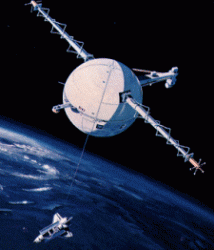
JAXA engineers are working hard to recover their ailing Hayabusa spacecraft. The spacecraft has been out of contact since December 9th, after it turned suddenly from a fuel leak. Hayabusa was supposed to return to Earth in June 2007, but JAXA is concerned that it won't have enough fuel to make this date, so they'll probably push the return back to 2010. Unfortunately, they have no way of knowing if Hayabusa actually retrieved a sample from Itokawa during its close encounter.
Continue reading
ESA's XMM-Newton observatory has turned up hot gaseous halos around several spiral galaxies. These ghostly veils have been seen surrounding "starburst galaxies", which are going through a tremendous amount of star formation - but not around the more common kinds of galaxies. Unlike a starburst galaxies, which concentrates their halos, regular galaxies will have simmering star formation stretching across them entirely. These halos can contain up to 10 million solar masses of gas.
Continue reading