 Universe Today
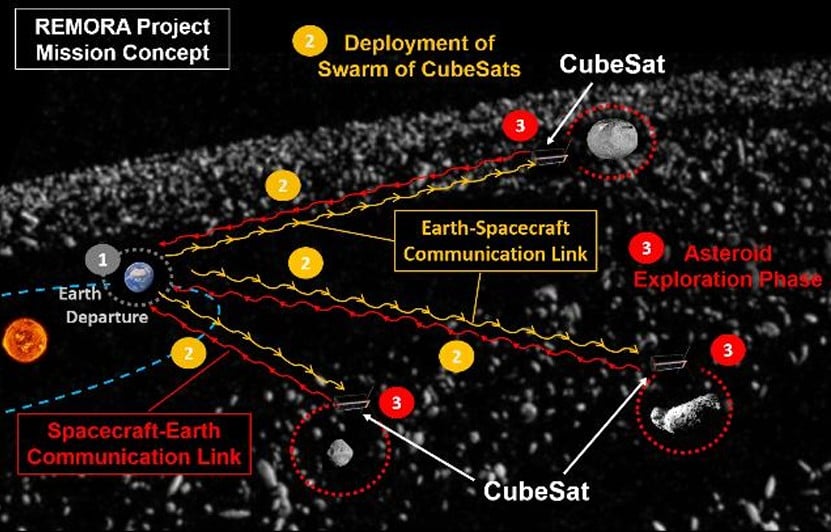
To truly understand what an asteroid is made up of, we need to send a probe to it. Remote sensing from ground-based telescopes, or even orbiting observatories, and only do so much. A new white paper submitted to the UK Space Agency’s 2035 Space Frontiers programme, pitches just such a mission architecture. Called the REndezvous Mission for Orbital Reconstruction of Asteroids (REMORA), the plan calls for a swarm of autonomous CubeSats to tag, track, and characterize multiple near-Earth asteroids.
The United Kingdom itself is in a bit of a weird place when it comes to asteroid science. It has some of the world’s best researchers who have contributed to projects like the Double Asteroid Redirection Test (DART) and OSIRIS-REx’s sample return mission to the asteroid Bennu. However, it lacks a dedicated, domestic, funding stream to launch its own asteroid exploration missions. Obviously the whitepaper’s authors, such as Stefania Soldini of the University of Liverpool, have a vested interest in seeing such a domestic funding pipeline develop - but they do have a point.
REMORA hopes to solve that problem. Billed at an extremely low €50M Mini-F class mission budget, this mission would develop a fleet of 6 CubeSats that would hitch a ride to known near-Earth asteroids to characterize them. Named after the famous remoras that attach themselves to (and have a symbiotic relationship with) sharks, the plan would be for each individual CubeSat to attach to (or closely orbit) an individual asteroid to study it in a detail far remote sensing simply won’t allow.
Fraser discusses whether we will mine asteroids.Managing this would typically require a whole fleet of operators back on Earth - and blow the modest budget completely out of the water. To alleviate that burden, the team is working on a software they call Near-Earth Asteroid Regions (NEAR), which is designed to calculate fuel-minimal reserves on the fly, allowing the tiny satellites to navigate near an asteroid without requiring direct operator input. That suite of software is broken up into several components still under development, including dynNEAR for dynamic modeling and goNEAR for the pathfinding.
But software is only useful if it has hardware to run out, and that is where the white paper points out another advantage the UK (or specifically the lead author’s home University of Liverpool) has - the Zero-G Astrolab. Boasting the “flattest floor in the UK”, which lab allows for hardware-in-the-loop testing with physical prototypes floating across the epoxy air bearing system that makes up that floor.
But the University of Liverpool isn’t the only advantage the UK has in space. Surrey has famously developed a small satellite industry cluster, including Surrey Satellite Technology, LTD (SSTL). The whitepaper pushes for a Phase 0 pilot study to help integrate these scientific missions into the payload of future SSTL missions as a proof of concept.
Fraser discusses what we need to do to find killer asteroids.The timing couldn’t be better - in 2029, the 350 m wide asteroid Apophis will pass closer to the Earth than some of our geosynchronous communications satellites, and will be visible to the naked eye in part of the UK. That year is also the UN’s International Year of Asteroid Awareness and Planetary Defence, and one weak point we still have in our planetary defense capabilities is the ability to catch asteroids coming from the sunward direction (like the one that exploded over Chelyabinsk, Russia in 2013.
REMORA is designed specifically to solve problems like that blind spot. But, given the rough budgetary constraint the UK is currently under, it seems like a long shot that such a mission architecture would be funded anytime soon. That being said, the UK’s space agency isn’t the only organization that could benefit from the country’s infrastructure - so maybe this mission architecture is worth a look by other private and public organizations alike.
Learn More:
S. Soldini et al. - Enabling tomorrow's planetary defence and space resource economy: Autonomous fleet-based asteroid rendezvous missions
UT - Finding 40,000 Asteroids Before They Find Us
UT - The Asteroid Hunter

