Universe Today
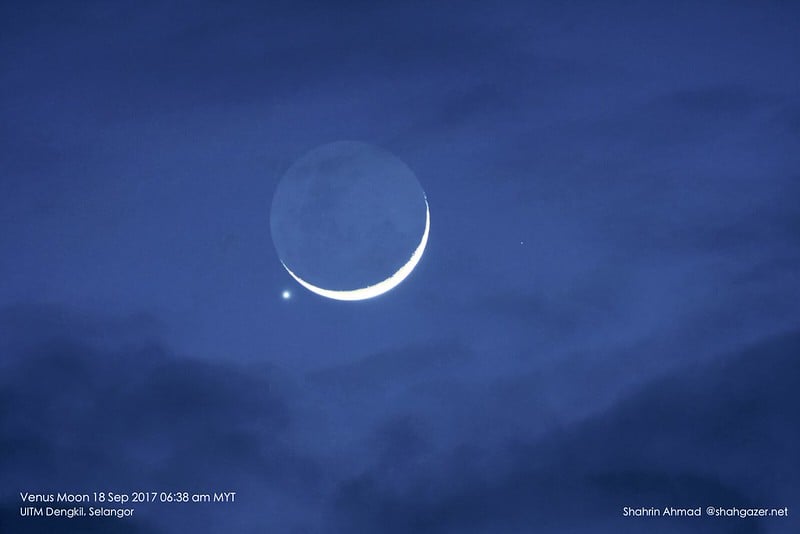
Get ready for ‘The Great North American Daytime Lunar Occultation’ as the Moon blots out Venus on the 17th.
If you’re like us, you’ve been following the close conjunction of Jupiter and Venus in the June dusk sky. Next week, the Moon enters the evening scene, and actually occults (passes in front of) the planet Venus in what promises to be one of the top skywatching events for 2026.
This is actually the first of three lunar occultations of Venus for 2026: the other two occur on September 14th for southeast Asia, and November 7th for the southern tip of South America. Still, it's rare to see the two brightest natural objects in the sky (after the Sun) meet up in the daytime sky.
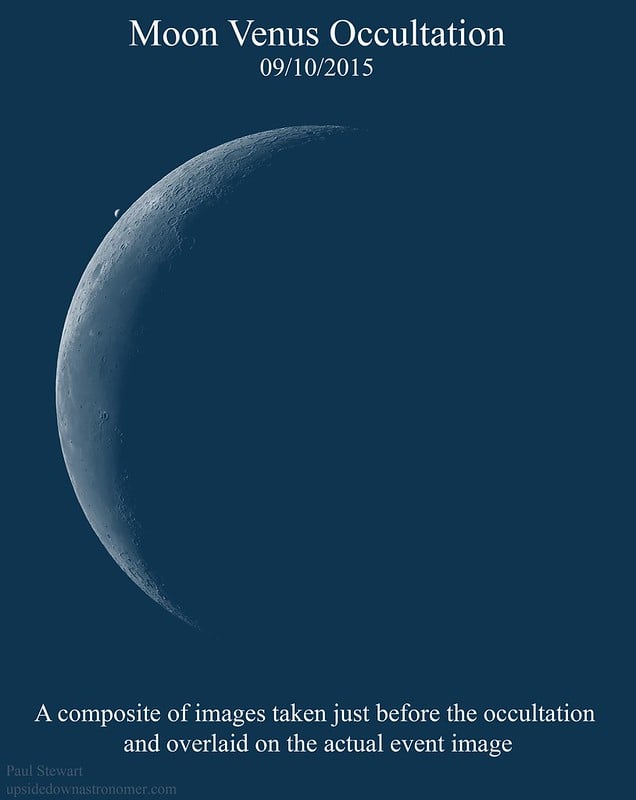 The Moon meets Venus in 2015. Credit: Paul Stewart.
It’s also rare to see the Moon greet Venus a good distance from the Sun. Venus never strays farther than 47 degrees from the Sun as seen from the Earth. This month’s occultation sees Venus 38 degrees from the Sun, just under two months from greatest eastern (dusk) elongation on August 15th.
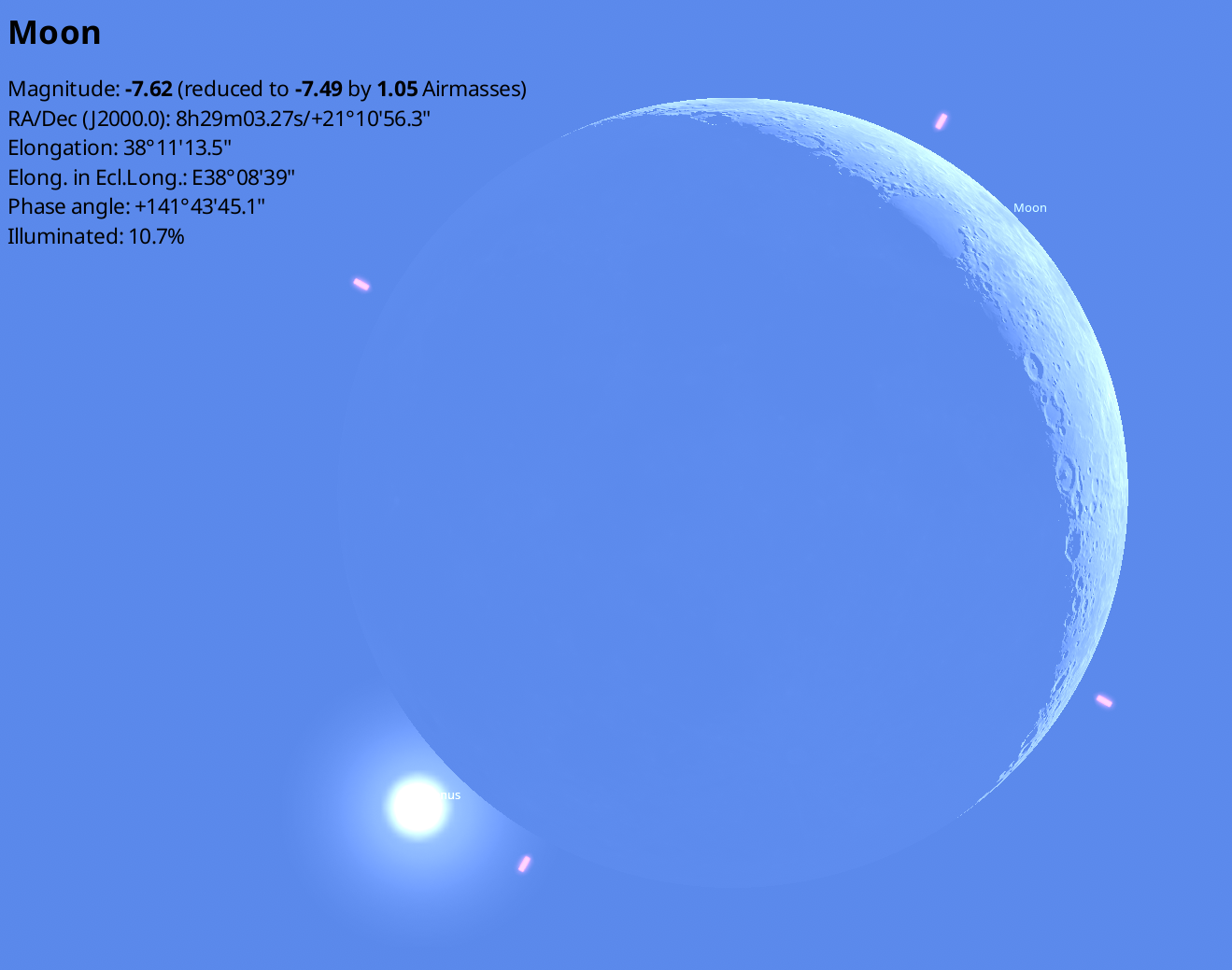 The Moon approaches Venus on the 17th. Credit: Stellarium.
The event occurs on the afternoon of Wednesday, June 17th, centered on 20:40 Universal Time (UT). The occultation transpires for northeastern South America under dark skies after sunset, and the Caribbean, the contiguous United States (CONUS), northern Mexico and southern Canada in daytime skies before sunset.
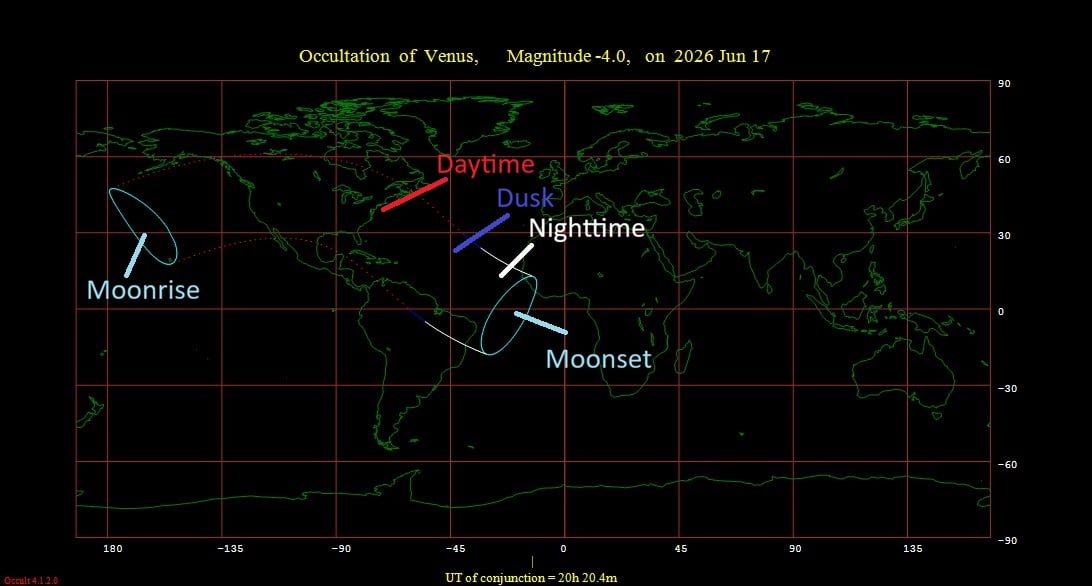 The visibility footprint for the June 17th occultation of Venus by the Moon. Credit: Occult 4.2.
The Moon is an 11% illuminated, waxing crescent as it approaches Venus. The Moon will take 29 seconds to cover the 74% illuminated, 15” disk of Venus. Venus shines at about -4th magnitude during the event.
The Moon passes New phase on June 15th, and slides 2.5 degrees north northeast of Mercury on the evening of the 16th. Mercury also reaches greatest elongation 24.5 degrees east of the Sun just one day prior. If you’ve never seen Mercury for yourself, this coming week is a good time to try and cross the innermost world off of your skywatching life-list.
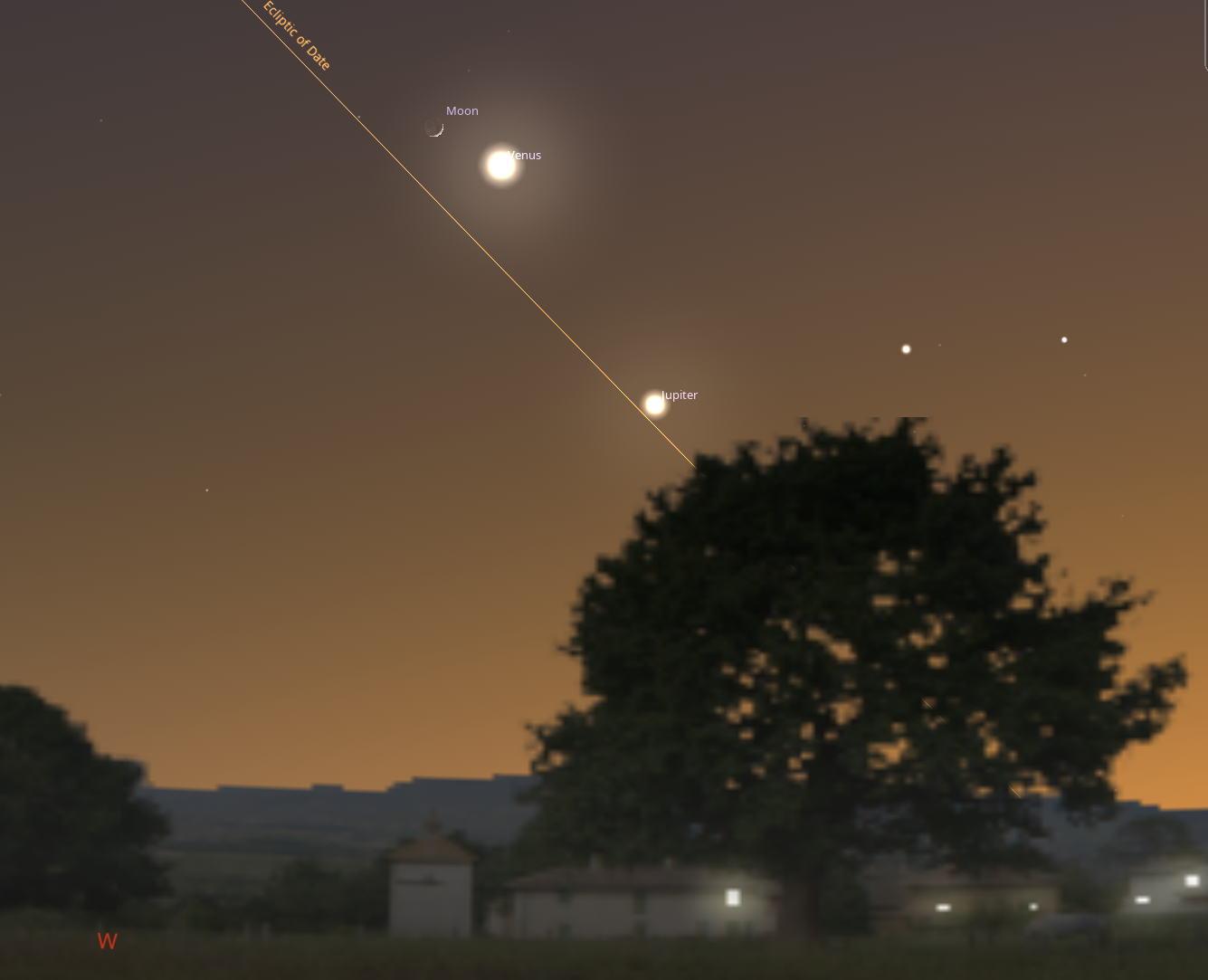 Looking west on the evening of June 17th. Credit: Stellarium.
Venus is the one planet that’s prominent enough to see during a daytime occultation. Here’s a strange fact: the Moon actually has a much lower albedo than Venus, with a reflectivity of less than 14%, versus 70% for the Venusian cloud tops. Up close, the lunar surface bares the appearance of worn asphalt. Concentrating what little reflected light the Moon does return into a small patch of sky, translates its dull gray into pearly white in the eye’s view.
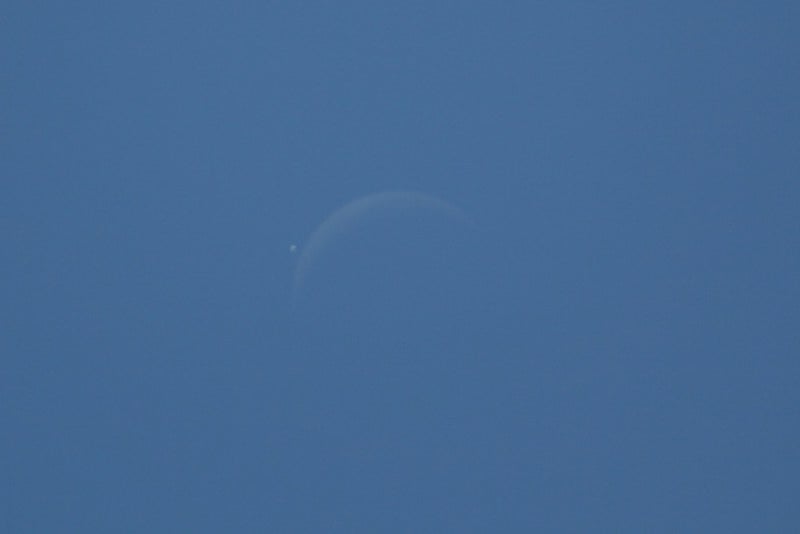 The daytime Moon paired with Venus from 2012. Credit: Rob Sparks.
Probably the toughest challenge will be homing in on the slim crescent Moon against the daytime sky. Be sure to select an observing site that blocks the Sun out of view. You don't want to accidentally aim at the dazzling and dangerous Sun, not even for a split second. From your shadowed site, carefully scan the sky with binoculars until you find the Moon. You'll be surprised how easy it is to see the Moon and Venus in the broad daylight, once you know precisely where to look for the pair.
This is one of the last favorable lunar occultations of Venus for the CONUS until 2029-2031.
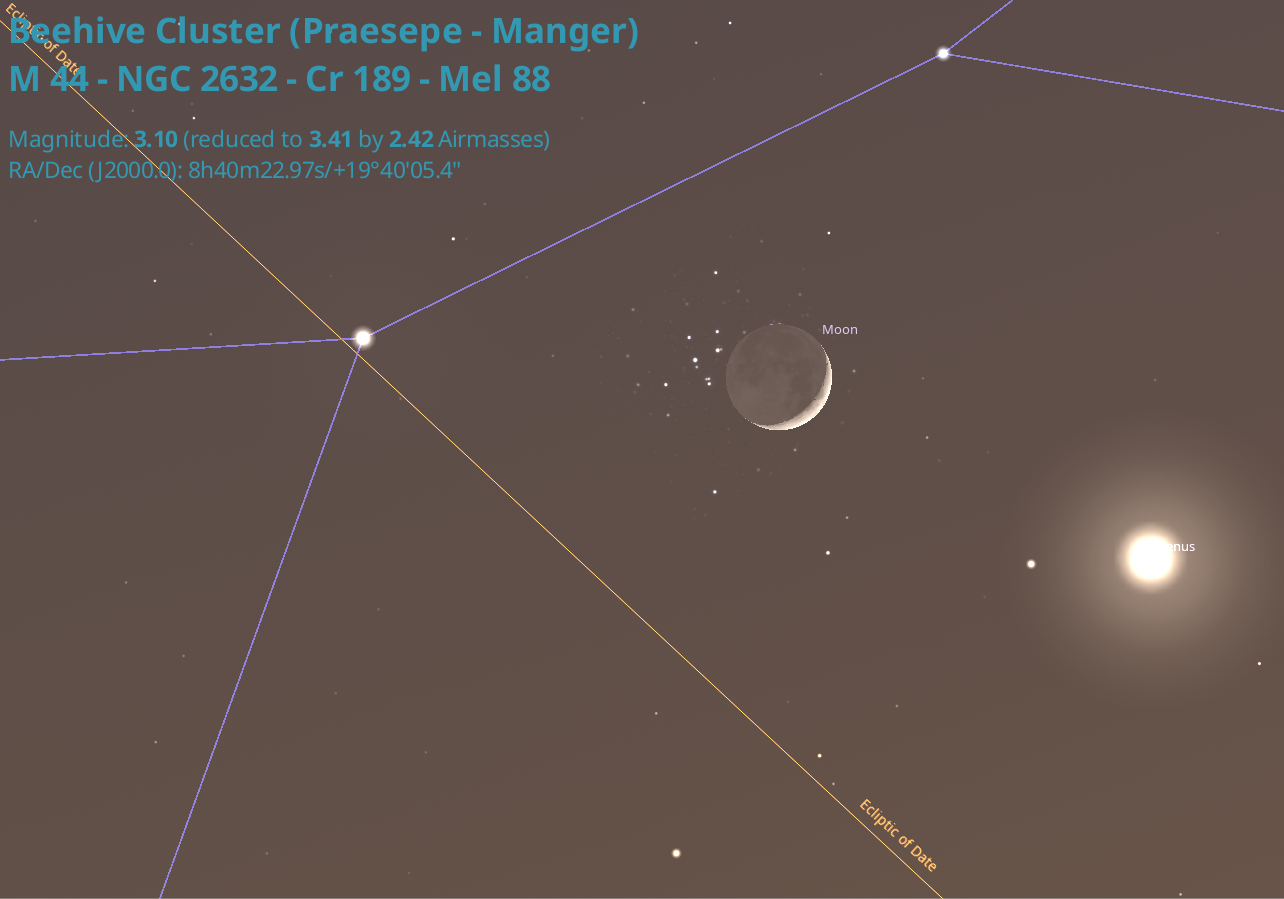 The Moon versus M44 on the evening of June 17th. Credit: Stellarium.
But wait until dusk, and you’ll see an encore performance, as the slender waxing crescent Moon also occults the open star cluster Messier 44 (Praesepe) in the heart of the constellation Cancer. This occurs just scant hours after the Venus event. This favors the southeastern U.S. at dusk. Venus follows suite and also transits just north of the cluster on June 19th.
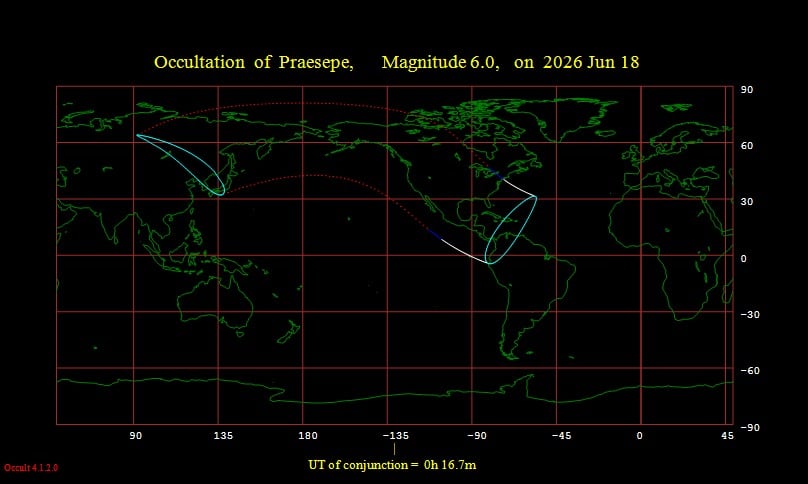 The visibility footprint for the lunar occultation of M44 on June 17th. Credit: Occult 4.2.
Seeing Venus in the daytime requires persistence. Certainly, a deep blue high contrast sky will help.
The event will be well suited to capturing on video, but beware of auto-focus mode, which often stubbornly refuses to lock on to the daytime Moon. A wide field view of the Moon paired with Venus should display the two nicely, as the planet slips behind the dark limb of the Moon. The International Occultation Timing Association (IOTA) has a list of ingress/egress times for select locations in the path, and Stellarium can help you zero in on exact times for your site.
Don’t miss the 'Great American Occultation,' as a great opportunity to do a little daytime sidewalk astronomy with friends.