 Universe Today
One of the hardest things to calculate for an asteroid is its mass - but it is such a critical feature. It determines how much of an impact it would have if it hits something, or how many resources are potentially available on it. But to accurately measure it we typically use optical sensing and a guesstimate of its density based on its spectral profile. A new paper suggests a completely novel way to use the Laser Interferometer Space Antenna (LISA) flagship mission to potentially provide highly accurate mass calculations for nearby asteroids without any change in hardware.
Obviously the spectral density guess isn’t ideal - we can estimate the mass of an asteroid with up to 10% uncertainty for less than 35% of near-Earth asteroids. Most of those highly accurate measurements are actually done on binary asteroid systems, where we can use complex orbital dynamics to calculate how big each part of the pair is - or in some cases we get lucky and the asteroid is gravitationally bound to another object like a planet for a brief period of time. But the vast majority of our estimates of asteroid masses are just that - estimates.
The most accurate way to calculate an asteroid’s mass is to send a probe to it. But that is prohibitively expensive for all 41,000 known near-Earth asteroids (NEAs). So why not use a multi-billion dollar mission we’re already building to help?
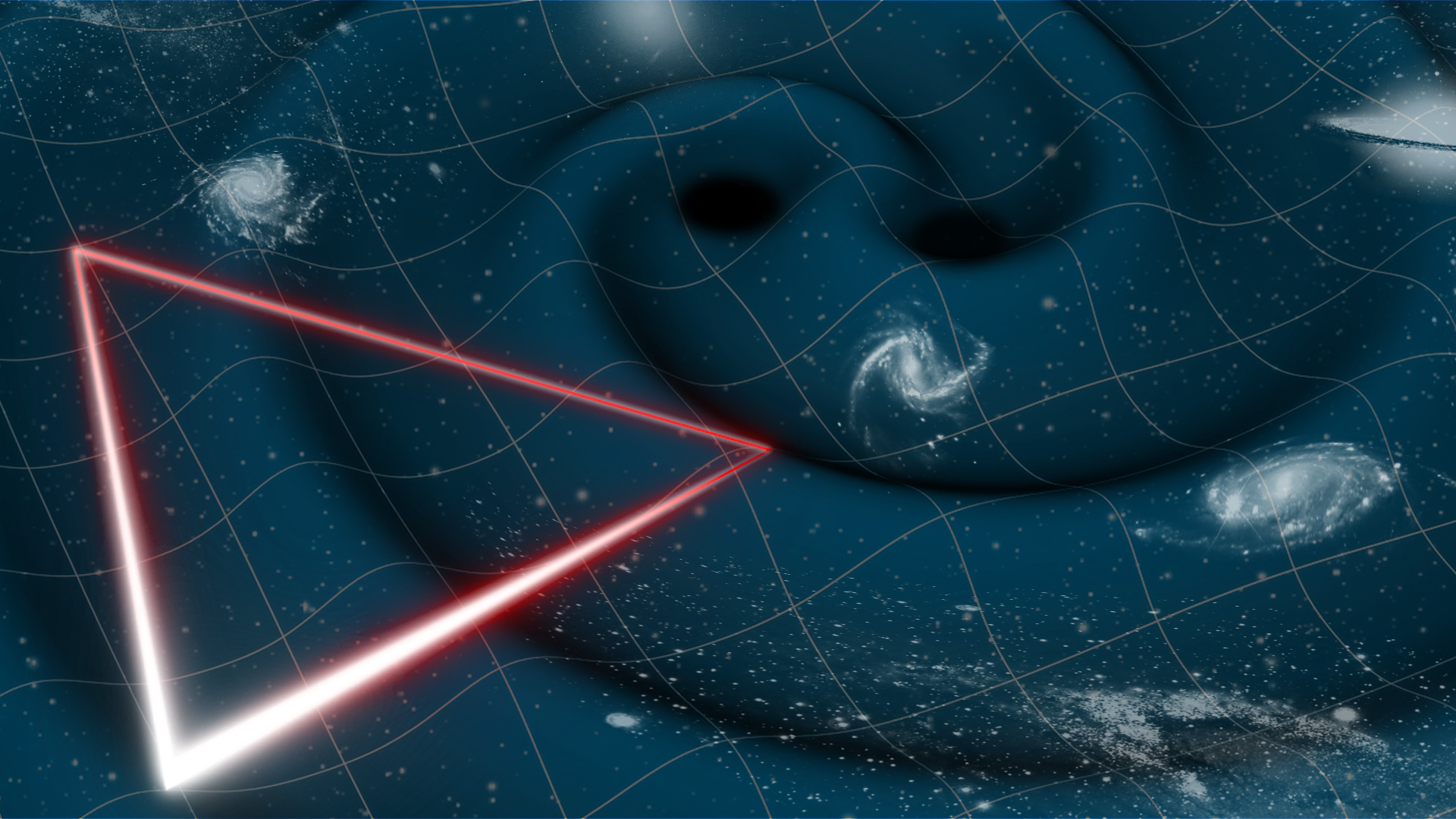
Fraser discusses LISA - humanity’s biggest telescope.LISA, which is planned to launch in July 2035, is designed as a gravitational wave detector. It will consist of three separate spacecraft flying in triangular formation, and will mainly be looking for the ripples in the fabric of spacetime caused by cataclysmic events like merging black holes. But its exquisitely sensitive instruments would also make it very susceptible to regular Newtonian dynamics.
Inside each of LISA’s spacecraft, there is a free-falling test mass, and the instrumentation to measure picometer-level changes to those masses. If an NEA happens to get close enough to one of them - specifically inside what is called the Minimum Orbital Intersection Distance (MOID) - the asteroid’s pull will tug on those masses, inducing a tiny velocity change that LISA’s instrumentation will then be able to measure.
Originally, the designers of the mission thought this would be a bug rather than a feature - they saw any gravitational pull not caused by the waves they were looking for as an irritant rather than a useful datapoint for a planetary scientist. To prove the signal could be separated from the “noise”, Sara Marques of the University of Bern and Oliver Jennrich of ESA modeled what this “noise” would look like by using Time-Delay Interferometry (TDI), which synthesizes an equal-arm interferometer to cancel out the laser frequency noise. This necessitated the use of Time-Delay Interferometry (TDI), which synthesizes an equal-arm interferometer to cancel out laser frequency noise, essentially allowing researchers to "clean" the signal of these gravitational disturbances.
Fraser discusses LISA receiving the green light for development.Their simulations showed that, if an asteroid passed by closely enough, LISA could determine its mass within a maximum uncertainty of 20% - much better than the data we have for the vast majority of asteroids. However - there’s one aspect of this plan that can’t really be controlled - serendipity.
The authors estimate that, over its 10-year operational lifespan, LISA would be able to calculate the gravity of approximately 3 asteroids. That might not seem like a lot, but it’s also based on our current understanding of the asteroid population - which to put it bluntly is not great. Calculations suggest we only know about 38% of the population of NEAs greater than 140m in diameter have been discovered. So there’s a decent chance LISA, which will be located about 50 million km behind the Earth on a heliocentric orbit, could run into some asteroids that we aren’t currently aware of.
It will still be over a decade before it happens though - LISA isn’t planned to launch until 2035, and its commissioning process won’t be a short one, as aligning three distinct spacecraft in deep space using lasers is no easy task. And even when it is online, its primary mission will still be to seek out gravitational waves. It’s just nice to know that it also has this other capability too, even if it was originally thought of as a nuisance.
Learn More:
S. Marques & O Jennrich - Parameter resolution of near-Earth asteroids using LISA
UT - Could the Milky Way’s Missing Mass Be Hiding in a Swarm of Interstellar Comets?

