 Universe Today
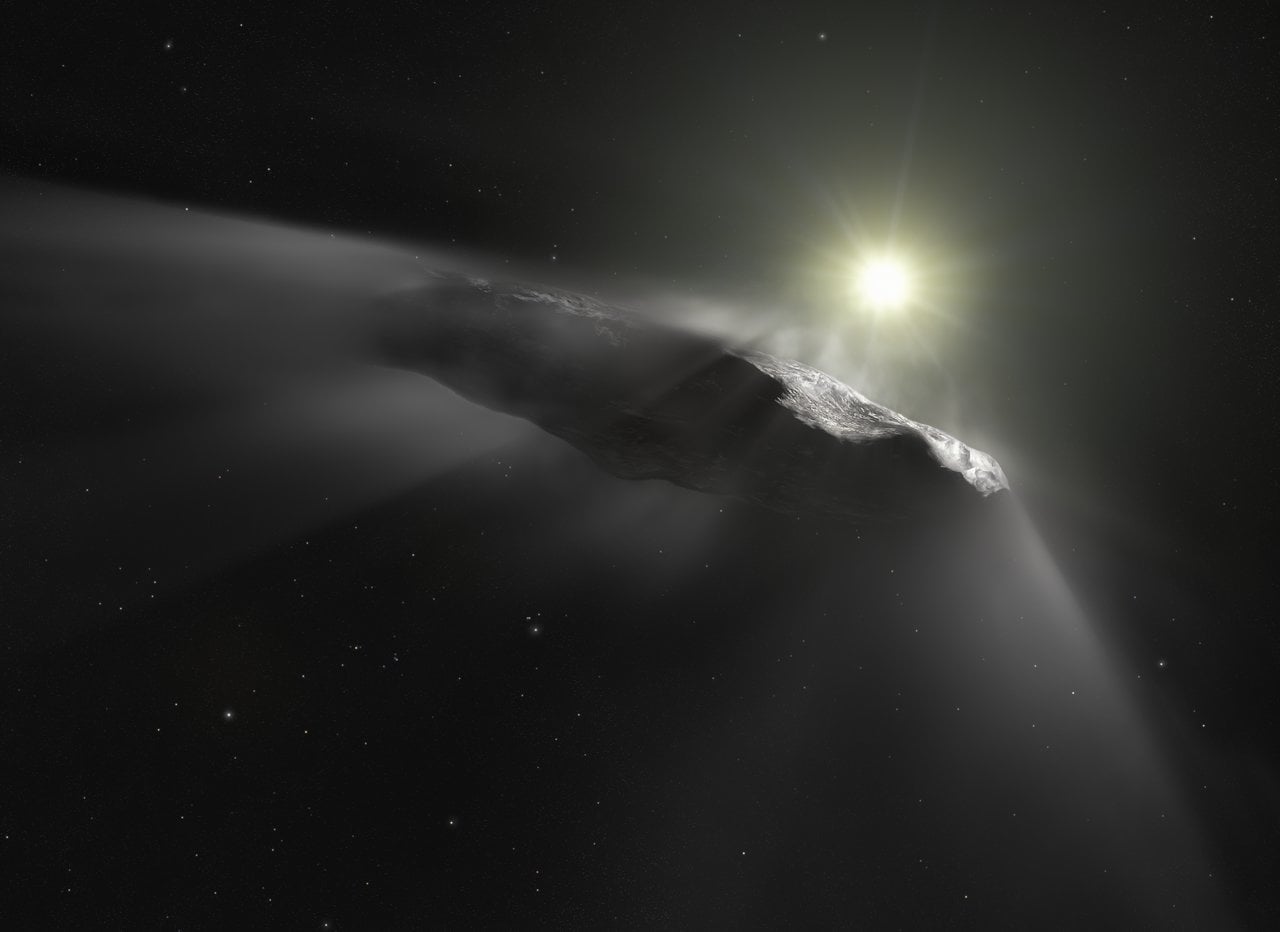
3I/ATLAS has caused quite a stir over the last year, inviting astronomers to update what they know about other solar systems as well as our own. However, this third interstellar visitor may have an unexpected impact on our understanding of dark matter. A new paper, available in pre-print on arXiv from researchers at the University of Hamburg, attempts to calculate the impact that the presence of large amounts of interstellar objects (ISOs) would have on our calculation of dark matter in our galaxy.
Part of our calculation of dark matter is based on what’s known as “missing mass”. This value is based on a property known as the Galactic rotation curve - basically the speed at which stars orbit the center of the Milky Way. The actual value for the curve is much higher than would be expected just from the amount of stars that we can see, so something else must be contributing to the mass that can account for that increased rotational speed.
Scientists have long held that dark matter is the contributing factor of this mass. But since it doesn’t (or very rarely) interact with anything other than gravity, it's not like we can actually “see” it, making it hard to study. Current estimates of the value of dark matter in the galaxy from the Gaia mission put its concentration at roughly 0.44 gigaelectron volts per cubic centimeter. But what if there was another explanation for some of that missing mass?
Fraser discusses how to find interstellar objects.ISOs themselves have mass - and are also visible via other means. So far we’ve only seen three of them - 1I/’Oumuamua, 2I/Borisov, and 3I/ATLAS, the largest of the bunch clocking in at a radius of somewhere between 0.16 and 2.8 km. Since mass increases with the cube of radius, that difference in value has a massive impact on the estimated weight of this largest interstellar visitor. But we also know that there are likely billions if not trillions of other interstellar objects floating out in the galaxy right now.
The question the researchers were attempting to answer was simple - what percentage of the “missing mass” of the galaxy could be floating interstellar objects that we just can’t see using our normal observational techniques. To determine this value, they ran a statistical process known as a Poisson distribution to calculate the local density of wandering rocks similar in size to 3I/ATLAS. And they found there could be a fair number of them floating in our general area of the galaxy.
Taking that process a step further, they then calculated the percentage of the “missing mass” in the galaxy that could be attributed to these ISO. Turns out, they could account for approximately 13% to 45% of the mass of the galaxy currently attributed to dark matter.
Fraser answers questions about 3I/ATLAS, our third interstellar visitorAdmittedly, there are some weaknesses in this extrapolation process. The main one is that they are literally extrapolating a sample size of 1 (3I/ATLAS) into an entire galactic population of ISOs. The authors themselves even admit that the upper bound on the calculation (where ISOs would account for up to half the missing mass) requires an “overly optimistic” amount of matter to be thrown into interstellar space.
However, the underlying math is sound, and it has implications for some existing and upcoming surveys. Direct dark matter detection experiments, such as LZ and XENONnT rely on the local dark matter density to calculate the expected flux of Weakly Interacting Massive Particles (WIMPs) passing through their vats of xenon. If that number is even just 18% lower than originally expected by the experiment designers, the sensitivities of the instruments might have to be readjusted.
Luckily, we won’t have to wait for long to get some more evidence to prove or disprove this theory. Next-generation sky surveys are coming online that are expected to find dozens, or potentially even hundreds, of new interstellar objects. Once we have a better grasp of the size and shape of ISOs, we’ll have a better sense of what, if any, contribution they make to the missing mass of our galaxy - and whether our understanding of dark matter is correct or not.
Learn More:
D. Horns, N. Knop, & M. Mohammadidoust - Contribution of interstellar objects to local dark matter density
UT - A New Way to Measure Where the Milky Way's Dark Matter Is
UT - There's Less Dark Matter at the Core of the Milky Way
UT - Interstellar Comet 3I/ATLAS Left a Trail of Methane in its Wake

