 Universe Today
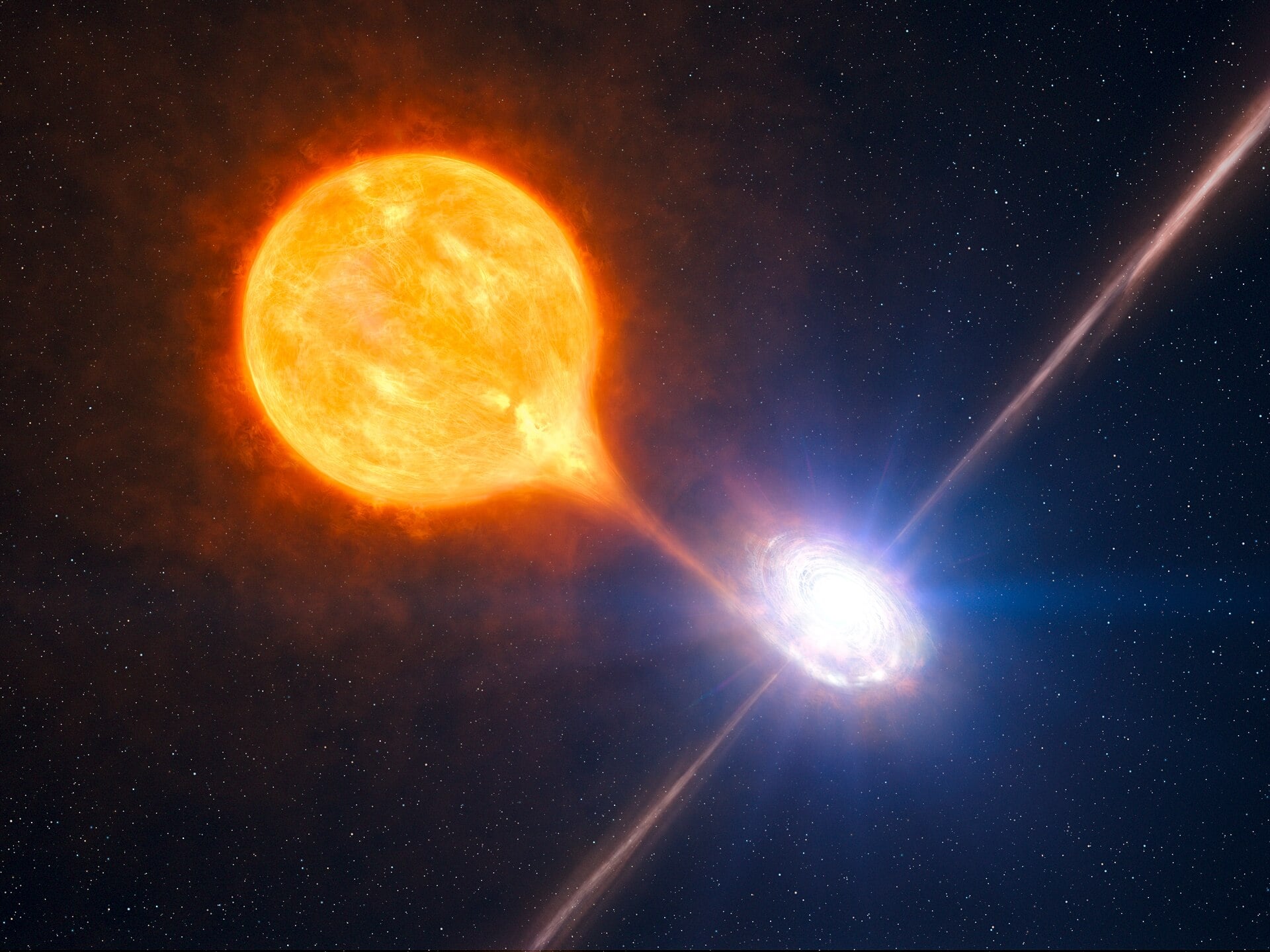
Black holes represent some of the most extreme environments in the universe. They’re the sources of the strongest consistent gravitational fields, which allows us to test Einstein’s Theory of General Relativity to an extent that’s impossible with small objects. But we’re also reaching our limit of what we can learn about one remotely. So various authors have put forward ideas for how we might eventually send a probe directly to a black hole to observe it up close. One of the most vocal of those authors is Cosimo Bambi of Fudan University in Shanghai - and he recently released a paper, available in pre-print on arXiv, about what it would take for us to send a gram-size probe to a nearby black hole.
Unfortunately, we don’t know of any “nearby” ones - at least not yet. The closest black hole that we know of is Gaia BH1, which is roughly 1,560 light years away in the constellation Ophiuchus. However, we only know of Gaia BH1’s position because it has a slight gravitational pull on a nearby companion star. There’s likely many more, invisible black holes in our galactic neighborhood that don’t have such tell-tale signs.
According to the paper, the Milky Way likely contains about 100 million stellar-mass black holes. That is not a typo - there are most likely hundreds of millions of black holes the size of a star floating around our galaxy. Crucially. 92% of them are isolated, without a companion star to illuminate them - meaning they would be essentially invisible since they suck up all the light that is directed their way. But, according to Bambi’s paper, there should be one stellar-mass black hole for roughly every 1,500 cubic parsecs (about 52,000 cubic light years) - keep in mind that the Milky Way has an estimated volume of around 150 cubic kiloparsecs.
Fraser talks about a bigger example of a black hole foundin our galaxy.From a statistical standpoint, this offers a tantalizing possibility - there could be an unseen black hole within 20-25 light years of Earth. To be clear, it would pose no threat to our solar system at that distance - but it would offer us the opportunity to send a specially designed probe to visit it within a human lifetime. We would just have to find it first, and Bambi suggests we could do so by watching the radiation the black hole would emit as it swallowed up gas while traveling through Local Interstellar Clouds. Our current multi-wavelength astronomical surveys could likely pick up that signal.
So let’s say we do find one nearby - and we decide we want to send a probe to it. What would that look like? Rockets are out of the question - due to the “tyranny of the rocket equation”, they would take thousands of years to reach a black hole that is even a few light years away. The best option, at least from a theoretical standpoint, is a laser-pushed solar sail.
Lasers don’t transmit much force, so the design of such a system is critical. It would compose two major parts - the “chip” which consists of a gram-sized microchip which houses the navigation, scientific, and communication instruments, and the sail, which, in the paper’s telling, would be a 10m2 dielectric metamaterial light sail. That sail would be pushed by a massive laser, intending to accelerate the entire assembly to one third the speed of light in just 17 minutes.
Fraser talks about whether a black hole will "eat" our galaxy.At that speed, it would take between 60 and 70 years to reach a black hole 20 to 25 light years away. Unfortunately, there’s no way to slow down upon entering the system, so the probe would have to do a flyby of the black hole, collect as much data as possible as quickly as it can, and then send that complex data back to Earth, which would take another 20 to 25 years. Ultimately, the entire mission would last 80 to 100 years, most likely outlasting the engineers and scientists who originally began work on it.
To put it bluntly, we don’t have the technology for such a mission - yet. A gram-sized chip that is able to withstand a decades-long trip at interstellar speeds yet can still send back coherent scientific data over a 20 light year gap is beyond our current engineering capability. So is a space-based laser that would be able to push such a system to those speeds. Not to mention the fact that we don’t even have a known black hole that we can aim at at this point. And, unfortunately, one of our best shots at developing such technology, Breakthrough Starshot, was discontinued in September 2025.
In theory, though, none of these challenges are insurmountable. They just require better engineering. And there are already working groups being formed to develop systems for the science, instrumentation, and communications systems, with a planned international conference to take place on the subject in the summer of 2027. We certainly won’t have a fully functional system design by then, but every step towards tackling some of those challenges brings us one step closer to actually sending a mission to a black hole. We just have to find one nearby first.
Learn More:
C. Bambi - A Space Mission to Earth's Nearest Black Hole: Reality or Science Fiction?
UT - Planning for the Ultimate Space Mission
UT - New Images Reveal the Stunning Properties of the Black Hole at the Center of M87
UT - To Measure a Black Hole’s Ultimate Spin, We Have to Go to Space

