 Universe Today
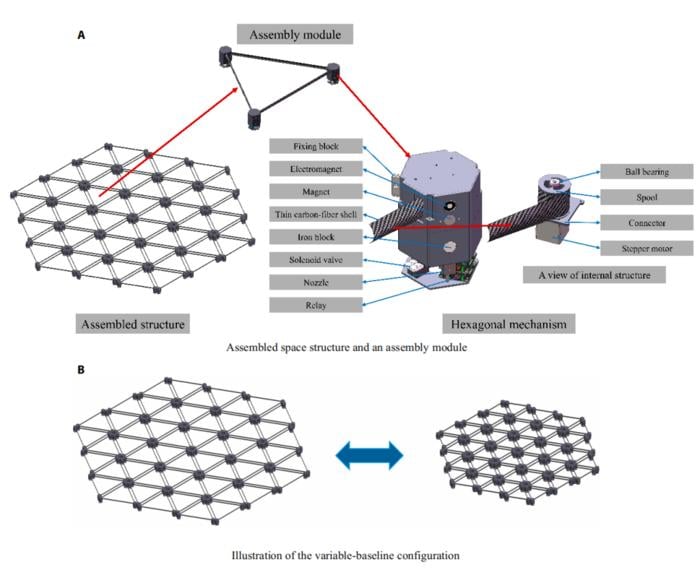
Private companies are getting better and better at launching more and more mass into space with larger and larger rockets. But, there is still a major constraint on the size of objects we can get into orbit - fairing size. This places physical constraints on the overall shape of what we can launch, and severely limits the sizes of, say, a communications array or a power satellite. But a new paper from researchers at Nanjing University of Aeronautics and Astronautics and the Beijing Institute of Technology offers a solution - a self-shaping, deployable module that can fine-tune both its positioning and its own dimensions.
To understand how that offers an advantage, it’s best to look at how engineers currently solve this problem. Typically they use a rollable deployable boom - a stiff, thin strip of carbon fiber that can coil up like a tape measure, then unwind to snap straight once deployed in microgravity. The problem is, these systems almost never deploy perfectly in real environments, and when talking about snapping together multiple modules, even a few millimeters of error can cause the entire mission to fail.
Fixing this requires taking steps after that initial unfolding to correct whatever errors might have been introduced. The researchers built the system as a set of three hexagonal corner pods connected by carbon-fiber rods. Crucially, each corner pod has two features - a spool and thrusters - that allow the whole assembly to adjust its sizing in real time.
Fraser describes a NIAC project to fit rollable composite booms into a rocket fairingUsing a stepper motor to drive the spool, each module can shorten or lengthen its carbon fiber rods on command. This not only allows it to adjust its size to the structure it intends to join, but also allows for slight adjustments, provided from a control feedback loop, to ensure that each module fits neatly into the planned structural pattern.
Maneuvering the modular assembly into place is where the thrusters come in. Each corner pod is equipped with a cold gas thruster, all connected to a central control system that uses them to nudge the module forward, backward, or spin it to match the rotational speed of its intended target. Once the modules are maneuvered close enough via the thruster, magnetic force takes over, with permanent magnets embedded in each pod as well that pull the modules together over the final few centimeters.
This all sounds good in theory, but to prove that it is actually good in theory, the researchers had to develop a type of mathematical framework to combine rigid corners with bendable carbon fiber arms, and combine that with changing masses as the module expended propellant. In other words, there was a lot of complicated math involved, and the researchers used a few different techniques to formulate the dynamic control equations needed to actively control the modules in flight.
Metamaterials are another potential solution to the fairing problem, as Fraser describes.But what about in practice? It’d be too expensive to launch a series of these modules this early in their development. So instead, the researchers turned to an air hockey table. Or more specifically, they used precision air bearings gliding overtop of a granite slab - which is close enough to air hockey to warrant an analogy. They also set up a tracking system above the table, watching the positioning of the pods with a set of cameras from above as the thrusters maneuvered them towards each other. Those same cameras also fed those real time coordinates into the control algorithm, allowing the modules to adjust their positioning on the fly.
Such adjustment was critical to the modules actually connecting, according to the paper. If that real-time adjustment was turned off, the manufacturing defects and deflections from bending carbon fiber made the magnetic latches miss, causing the assembly to fail. With “active morphing control” enabled, the controllers were able to adjust the boom lengths and positioning errors by over 98%, enabling the magnet to lock into place.
This work represents a first step towards the rollout of autonomous assembly of large structures in orbit - and specifically a type of modular space infrastructure that could prove critical as we take our first major infrastructure steps out of our planet’s gravity well. Eventually there could be entire autonomous swarms of modules assembling everything from power platforms to deep-space observatories. But for now, this step of two pieces combining together over an expensive air hockey table is another achievement on the way to that long-term dream.
Learn More:
EurekAlert / Beijing Institute of Technology - Dynamic analysis and experiments on the assembly control of planar deployable modules
Q. Duan, J. Sun, & H. Hu - Dynamic Analysis and Experiments on the Assembly Control of Planar Deployable Modules
UT - A "Smart Ruler" Could Help Swarms of Space Telescopes Image Exoplanets
UT - Robots Could Build Massive Metamaterial Radars in Orbit
