Universe Today
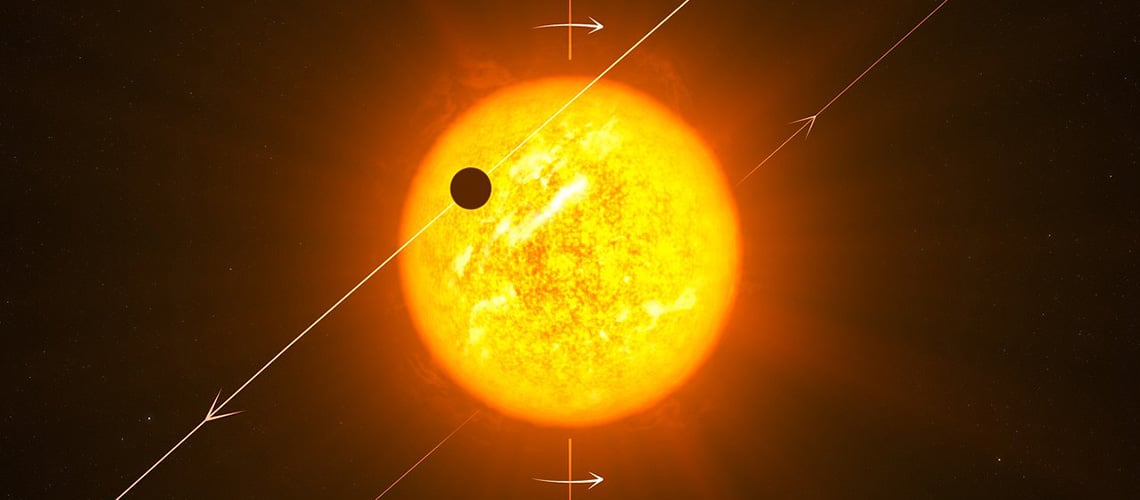
In our own solar system, all eight planets orbit our Sun in a nice, orderly fashion. None are more than 7° or so out of alignment with the equator, and all of them rotate in the same direction as the Sun itself. But that’s not the case for all solar systems, and a new paper published in Astronomy & Astrophysics from a team of researchers led by Yann Carteret, a PhD student at the University of Geneva (UNIGE), describes the first time we’ve ever found an exoplanet orbiting the opposite direction of its red dwarf parent star - and it has major implications for our understanding of planet formation theory.
The planet, known as GJ 3090 b, is a “sub-Neptune”, roughly 2.2 times the width of Earth with 4.5 times the mass. It orbits a cool, dim red dwarf located 73 light-years away in the southern constellation Phoenix about once every 2.9 days. The researchers were trying to resolve that orbit using the 3.6m telescope at the European Southern Observatory in Chile.
An obvious way to find details of that orbit is to closely watch a planet’s “transit” when it passes in front of its star. In particular, the researchers were looking for something called the Rossiter-McLaughlin (RM) effect. As a star rotates, the side that is spinning towards the observing telescope is slightly blueshifted due to the motion of that part of the star towards the observer. That also means that the other side, which is turning away from the observer, would appear slightly redshifted. This is the RM effect.
Fraser talks about the future of exoplanet observations.In a regular system, such as our own, the planet would cross the “blue” side first, temporarily blocking the blue light and making the star appear redder. It would then cross into the “red” hemisphere, and make the star appear slightly bluer. As the researchers watched GJ 3090 b transit its star 5 separate times, they noted that every time the exact opposite happened - it first crossed over the “red” hemisphere then the “blue” hemisphere. In other words, it’s moving backwards compared to its star.
Further calculations put the planet’s orbital obliquity at around 136 degrees - with anything over 90 meaning it's moving in retrograde. That is huge compared to the ~7 degrees or so for planets in our own system, but it’s not the first time we’ve found an exoplanet with that high of an obliquity. With those other exoplanets, we know what caused it - and GJ 3090 b seems to lack all of those causes.
Typically, planets end up in weird orbits because of some gravitational drama that happened long after the planet itself formed. This is usually caused by a massive planet elsewhere in the solar system, or a companion star. While GJ 3090 b does have another planet in the system (which the researchers also suspect might be moving in retrograde, but without enough data to support that claim), it doesn’t have anything near the size required to move GJ 3090 b into the type of retrograde motion it appears to have.
Fraser talks about the technology needed to find more exoplanets - including those in retrograde orbits.Without that lurking companion, classical dynamic models of what might have caused the planet’s orbit go out the window. So what might have caused it? The authors posit that what they call a “primordial disk flip” might have happened.
After the star formed and its original disk was dissipated, a fresh stream of gas and dust was introduced from the surrounding interstellar medium. Some of that material fell into the star, but some would have potentially created a second protoplanetary disk, and if it came in at the right angle, it would keep its own angular momentum, which could be the opposite of the star’s.
There’s some evidence for this in other star systems. Astronomers have observed what they call “Peter Pan disks”, which stick around tens of millions of years longer than most stellar evolution models predict they should. So, GJ 3090 b might be an example of what happens when a Peter Pan disk does decide to finally grow up and become a planet.
That’s an intriguing theory, but one that will have to wait for more evidence to prove. That evidence might be forthcoming though, as this paper represents a technical milestone for exoplanet observation - GJ 3090 b is the smallest exoplanet to ever have its orbital obliquity around a red dwarf mapped. There’s sure to be more where that came from, and there are plenty of other multi-planetary systems around red dwarfs to observe. It may be only a matter of time before we unlock the secrets of the backwards traveling planet(s).
Learn More:
UNIGE - A “rebellious” exoplanet orbits in the opposite direction of its star
Y. Carteret et al - Upside down: GJ 3090 b the first retrograde exoplanet around an M dwarf detected with NIRPS