 Universe Today
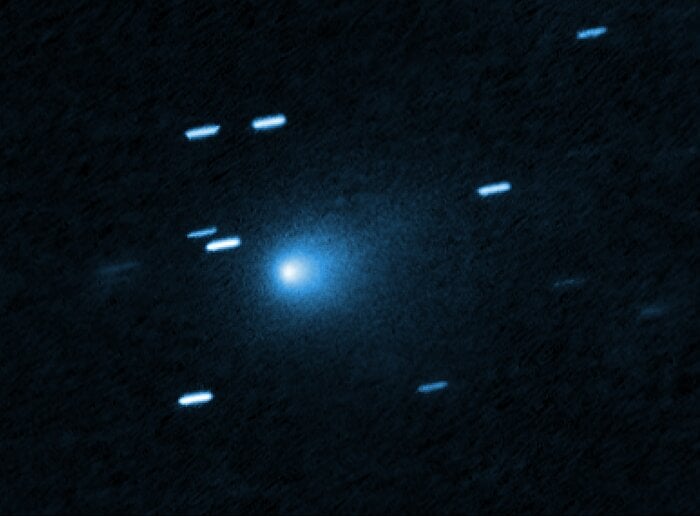
More and more details about 3I/ATLAS are filtering through the scientific process as time goes on. Our third known interstellar visitor attracted the attention of some of the most powerful observatories in the world when it was discovered in July 2025, and some of those telescopes found something peculiar - the isotopes it contained appeared different. A new paper submitted to The Astrophysical Journal Letters (and available in pre-print on arXiv) by Kenji Furuya of the RIKEN Pioneering Research Institute in Japan and his co-authors, shows how that isotopic discrepancy is likely due to the “low-metallicity” of the stellar nursery 3I/ATLAS was born in.
In everyday language, we think of metals as having certain properties. But to astronomers, “metals” would include anything that has an atomic number higher than helium, and which were only created in supernovae after the first generation of stars died. Hence, the universe has slowly become more metallic over time, at least according to astronomical standards, as more and more stars explode in supernovae and create “crazier space dust” as a famous YouTube video once put it.
Some of that crazier space dust takes the form of carbon, which is crucial in organic chemistry, but also present in 3I/ATLAS. Critically, it was present in an isotope ratio that didn’t match anything we saw in our own solar system. The ratio of C-12 (i.e. a carbon atom with 12 protons and neutrons) and C-13 (a carbon atom with one more neutron) for objects in our solar system hovers right around 90. The ratio for the interstellar medium is around 68 on average. In 3I/ATLAS, that ratio was between 123 and 191 - much higher than anywhere the interstellar object has been traveling in the last few billion years.
Fraser talks about much of the science behind 3I/ATLASAnother strange isotope signature scientists have found in 3I/ATLAS was that of water. Hydrogen has a “heavy” form, known as deuterium, which carries around a neutron in addition to the single proton that makes up hydrogen itself. When astronomers measured this deuterium/hydrogen ratio in 3I/ATLAS’s water, they found a ratio of around 1%. Compare that to 0.015% to 0.03% for a typical comet in the solar system and it becomes clear that our interstellar visitor carries a lot more “heavy water” than is typical in any object in our own solar system.
So what caused these isotopic discrepancies? Scientists have long thought that a high C-12 to C-13 ratio was caused by being formed in a low-metal environment. However, according to the paper, the D/H ratio would also be explained by that origin story. To prove their point, the researchers simulated a complete life cycle of water ice - where it forms from an interstellar cloud to where it collapses into a bunch of gas and dust that will eventually form a star. Most importantly, it modeled a specific step in that life cycle that happens in the depths of interstellar space.
Out in the void, interstellar gas is only heated to around 10 Kelvin (-263℃) - far too cold for typical chemical reactions to take place. One of those typical chemical reactions is called deuterium enrichment - or “deuterium fractionation” as the paper calls it, which, in the depths of interstellar space, will only take place based on energy differences.
Fraser talks about the presence of water on 3I/ATLASDeuterium fractionation is driven by cosmic rays hitting the gas and forming triatomic hydrogen atoms (H3+). These then occasionally collide with a deuterated hydrogen molecule (HD) to create H2D+, regular H2, and a little bit of excess energy. At such cold temperatures, this reaction, which is normally bidirectional, doesn’t have enough energy to kick the H2D+ back into the neutral, inert HD form - essentially trapping the deuterium in a much more unstable form.
Eventually the H2D+ molecules get hit with an electron, breaking it apart and creating atomic deuterium. Those atomic deuterium atoms eventually meet up with oxygen atoms, creating “heavy” water at ratios that were much higher than expected in our own solar system.
There are three main reasons for this deuterium boom, according to the paper, all of which have to do with the low metallicity of its formative environment. First is that there’s fewer carbon monoxide molecules in the area. CO destroys H2D+, so having less of it around means that H2D+ itself can survive for longer to create atomic deuterium.
Fraser holds a Q&A session on 3I/ATLASSecond is a lack of a “hydrogen deluge”. In metal-rich environments, UV photons break apart water into OH and H, creating a flood of atomic hydrogen atoms, and thereby diluting the D/H ratio. In metal-poor environments, there isn’t as much water breaking apart, meaning the area is flushed with less atomic hydrogen, keeping the ratio relatively high.
Third is a relatively low cosmic ray ionization rate. In gas clouds with lots of high energy cosmic rays, there is enough excess energy to kick the chemical process that creates the H2D+ back into the more stable form of regular HD, thereby lowering the amount of H2D+ available to be split into atomic deuterium. Lower cosmic ray energies mean less energy feeding that chemical reversal reaction, thereby keeping the levels of deuterium higher than expected.
To validate these processes, the authors ran a validation check using another common cometary material - methane. Previous studies had found that the D/H ratio in the methane in 3I/ATLAS was around 3% - which is still an order of magnitude above the 0.2% found in other solar system comets such as 67P/Churyumov-Gerasimenko. However, the relative ratio between the D/H ratio in methane and that in water is remarkably similar (3.4 in 3I/ATLAS and 4.8 in comet 67P). So while the absolute deuteration of a comet skyrockets in low metallicity conditions, the ratio of methane deuteration to water deuteration remains constant no matter the environment the comet was formed in.
As more and more scientific papers come out discussing the various nuances of 3I/ATLAS, it seems more clear that this visitor offered an up-close look at the environment of a very early part of the solar system. And while it’s great that we got to study it while we did, it’s now moved on from our observational capabilities. Maybe the next interstellar visitor will have the same deuteration and carbon isotopic features, or maybe not, but either way, we should continue to take every chance we get to study these unique windows into our galaxy’s history.
Learn More:
K. Furuya et al - High water D/H ratio of the interstellar object 3I/ATLAS is consistent with a low-metallicity origin
UT - New Research Reveals That Interstellar Comet 3I/ATLAS Formed in a System Far Colder Than Our Own

