 Universe Today
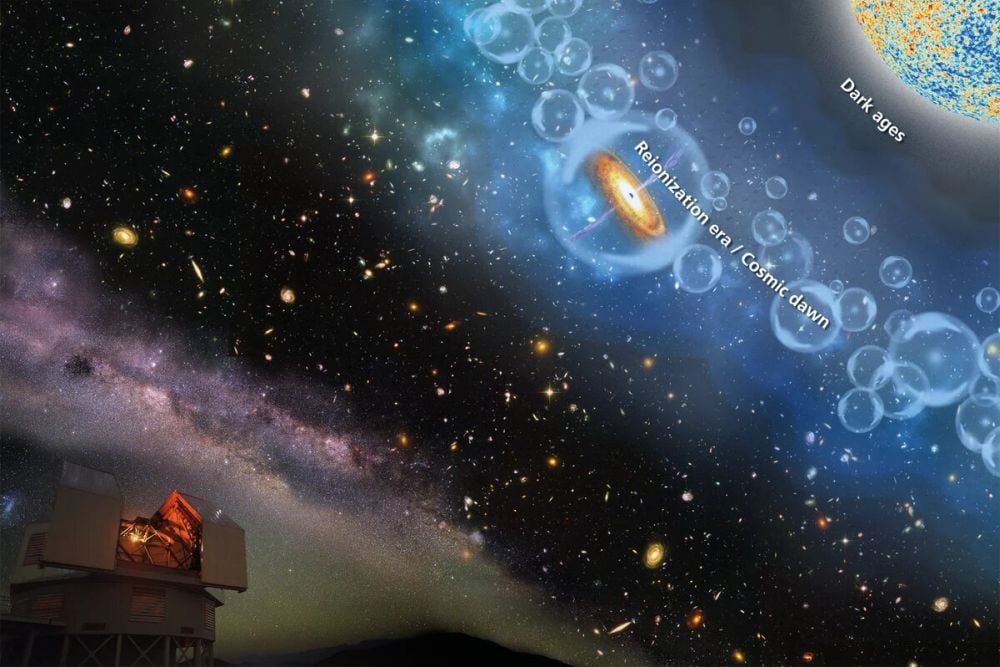
The Universe has gone through many defining changes over its 13+ billion year history. One of its phases was the Dark Ages, which started after Recombination and lasted until somewhere between about 150,000 and one billion years after the Big Bang. It ended with the Epoch of Reionization (EoR), when neutral hydrogen atoms in the early cosmos were reionized. At that time, light was able to travel freely through the Universe, and the Dark Ages came to an end.
Standard thinking says that the Dark Ages ended because stars, galaxies, and quasars/active galactic nuclei formed. They were responsible for reionizing the hydrogen with their UV radiation. But there's a lack of clarity when it comes to the details. Early supernovae explosions likely contributed to the EoR, but the details of their contribution aren't clear.
How it all worked in the EoR is a subject of deep study in cosmology. Cosmologists know it happened, but the relative roles that different ionizing sources played is not clear. A supernova explosion is an extremely energetic event, but its light is largely optical, not ionizing. What role did they play in the EoR?
New research in Nature Astronomy examines the role of supernovae in Reionization. It's titled "Lyman continuum escape during the onset of galactic winds in compact starbursts," and the lead author is Dr. Cody Carr. Carr is a postdoctoral researcher in the Department of Astronomy and an Extremely Large Telescope Fellow at the University of Michigan, formerly from Zhejiang University in China.
We know that high-energy ionizing radiation caused the EoR, and that it was a significant transition. "Eventually, when it ionized the majority of hydrogen filling intergalactic space, that was the end of reionization and we see the universe today,” lead author Carr said. “We call reionization the last major phase transition of the universe.”
We also know that the population of galaxies in the early galaxy was different than today, and that they provided enough energy for reionization, because the Universe is no longer opaque.
"The abundance of UV-bright, compact star-forming galaxies in the early Universe indicates that high-energy (Lyman continuum (LyC); λ < 912 Å) photons from massive stars alone could have re-ionized the intergalactic medium," the authors write. "However, the efficiency with which LyC photons escape these systems—and the relative roles of radiation, stellar winds and supernovae in regulating that escape—remain uncertain."
That's a critical point. The early galaxies produced the radiation. But were there barriers to it escaping its source galaxy? How did all the moving pieces fit together?
“We don’t know exactly what objects caused reionization or how it evolved,” said Carr, who led and carried out the study as a postdoctoral scholar at Zhejiang University in China before joining U-M. “We know that it took place, but we don’t have complete answers to those questions.”
Galaxies are collections of stars and gas, and one theory says that supernova explosions and the winds they drive can carve lower-density channels in a galaxy's gas. So instead of being absorbed by the neutral hydrogen in galaxies, ionizing photons from the galaxy can escape into the IGM. Supernovae basically open channels for reionization.
The researchers tested that theory against Hubble observations. There are local star-forming galaxies that are very similar to the ones present in the EoR, and they can be used as proxies.
"Here, using medium-resolution spectra of six otherwise similar local star-forming galaxies spanning a range of starburst ages, we directly trace the launch of a multiphase galactic wind through individual spectral lines alongside measurements of the LyC escape fraction," the authors explain. A multiphase wind has gas with different temperatures and ionization states at once.
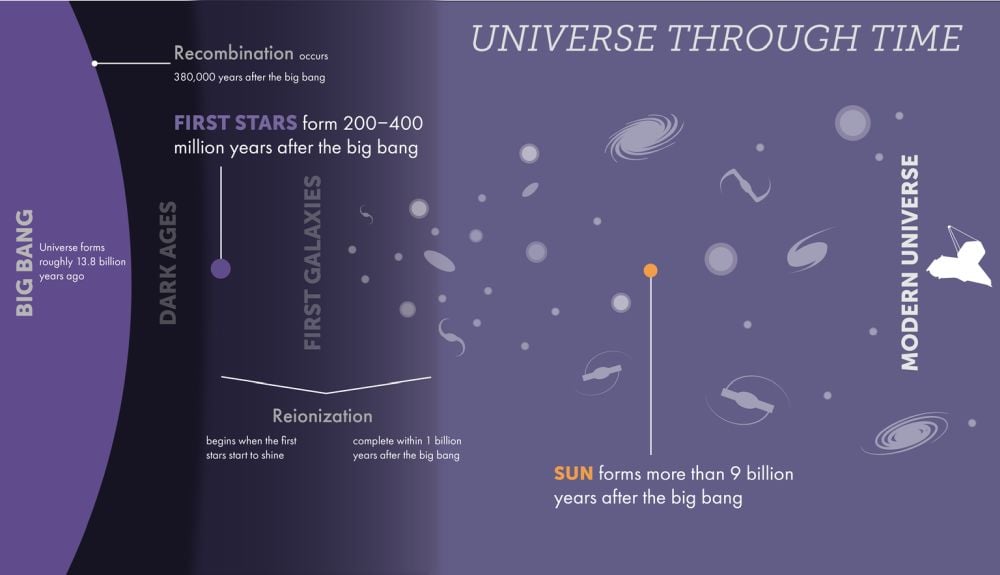 Reionization brought an end to the Dark Ages and eventually made the Universe transparent. The authors call reionization the last major phase transition in the Universe. Image Credit: NASA, ESA, CSA, STScI
Their results show that at first, galactic winds—driven in part by supernovae—do carve low-density pathways that aid LyC escape. "Together, these results favour a scenario in which a volume-filling wind—driven by radiation and stellar winds and possibly aided by a few early supernovae from the most massive stars—expels the first material from the ISM in compact starbursts," the authors write in their research. "Early feedback and clumping open low-density pathways with little dust or neutral gas, creating optimal conditions for LyC escape."
But that doesn't last. Eventually, supernovae create neutral dust in the galactic outflow that absorbs LyC, creating a barrier to its escape.
"As more supernovae occur, they drive additional neutral mass into the outflow. These supernovae likely destroy dense clouds and carve out lower channels, but the accompanying mass loading, dust creation and increased lateral volume filling of the wind reduce Lyman escape fractions on average."
"It appears that energy input from supernovae has stirred up the surroundings and increased, rather than decreased, the coverage of neutral gas and dust that suppresses ionizing radiation escape,” said Stephan McCandliss, senior author of the new study and director of the Center for Astrophysical Sciences at Johns Hopkins University.
Eventually, as gas and dust columns became denser, they suppressed LyC escape completely.
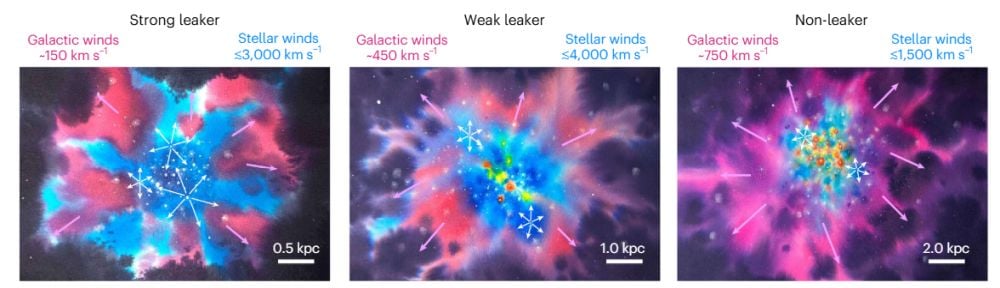 These panels show an artist's illustration of the evolution of stellar feedback in compact, star-forming galaxies. Red regions show the multiphase wind, where the gas spans several temperatures and ionization states; the lighter shades show less dense gas. At first, intense radiation and rapid stellar winds drive a slow galactic outflow that clears gas and dust. Gas clumping and strong ionizing feedback drive rapid LyC escape. As supernovae begin exploding, they drive neutral mass and dust into the galaxy's ISM, which lowers average LyC escape, despite carving out low density channels for LyC to escape. Later, large-scale winds driven by supernovae inhibit LyC escape. Image Credit: Carr, C., Cen, R., McCandliss, S. et al. Lyman continuum escape during the onset of galactic winds in compact starbursts. Nat Astron (2026).
"Basically, how these galaxies were leaking ionizing radiation isn’t what we thought,” Carr said.
The results pour cold water on the idea that supernovae were important contributors to the EoR. In fact, they support an alternate theory. The results show that young stars drove ionizing radiation out of their galaxies before there was enough time for many supernovae to even explode.
The problem is that cosmological simulations show that supernovae did play an important role in reionization. But simulations take a backseat to observations.
“Supernovae play a central role in cosmological hydrodynamic simulations that explain how ionizing radiation escapes from galaxies,” said Renyue Cen, a senior author of the study and professor and director of the Center for Cosmology and Computational Astrophysics at Zhejiang University. “Our findings highlight the need to examine how radiation and winds from young stars shape the surrounding gas before the first supernovae explode.”
