 Universe Today
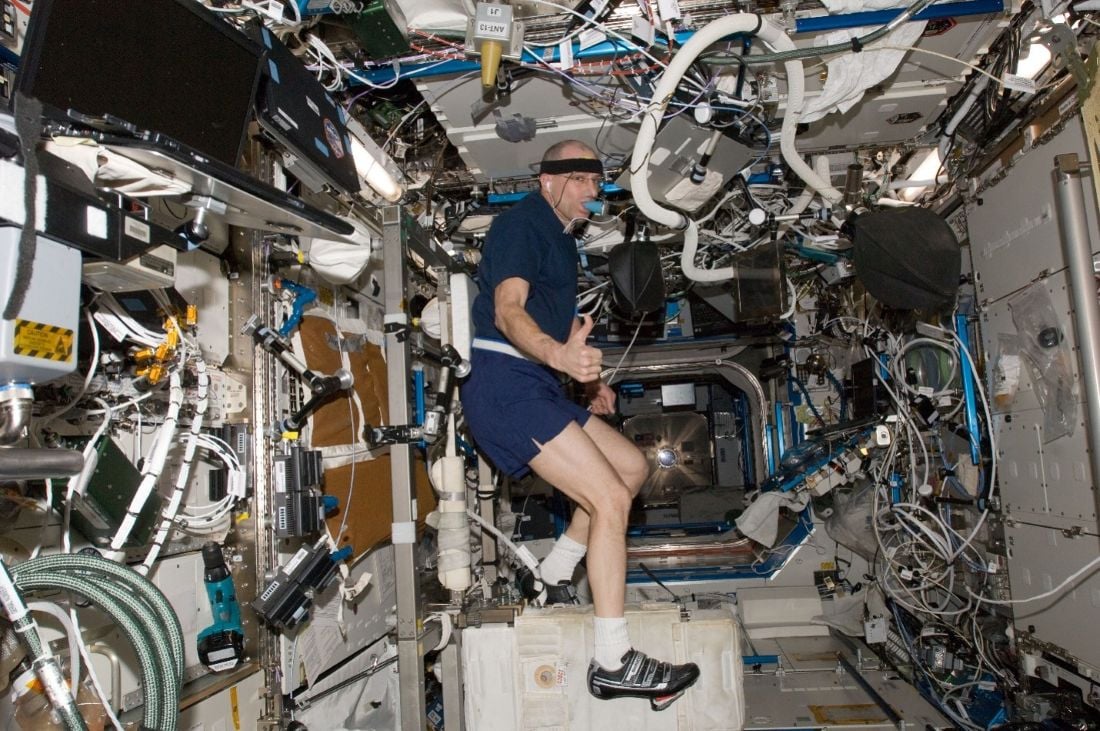
Getting a human body to Mars will take a toll on it. NASA and other space agencies have been concerned for years that the 6-9 month travel time to get to the Red Planet could have such a deleterious impact on human anatomy that any crewed mission would fail before it even began. But a new study, co-led by Dr. Benjamin Levine of the University of Texas Southwestern Medical Center and published in the journal Circulation, eases some of that concern by claiming that, given a sufficient exercise regimen in low gravity, astronauts should be able to operate on Mars upon arrival without any major cardiac issues.
The zero gravity astronauts experience in spaceflight forces the heart to act very differently than it does on Earth. In weightlessness, instead of having to work against gravity to pump blood to your brain and upper extremities, the blood itself will migrate there. Over an extended period of time, an astronaut’s heart will adapt to this new, easier environment, and begin to not pump as hard, leading to physical changes in its structure - primarily it getting smaller.
A smaller heart can leave astronauts vulnerable once they set foot back on a planetary surface. Left to its own devices, the heart will shrink small enough to cause low blood pressure, reduced stamina, and in some cases fainting - or what cardiologists call “orthostatic intolerance”. If that happened to Martian astronauts when they first step foot on the Red Planet, the mission could be over before they get to do any actual science.
Fraser talks about how we can use "artificial" gravity to fight some of the health effects microgravity introduces.Scientists have known about this problem for a long time though, and exercise scientists specifically have developed a rigorous protocol that astronauts abide by to keep their heart functioning as expected over long-duration weightlessness. The study published in Circulation was intended to monitor physical adaptations the heart made during an astronaut’s time in space, to see if the cardiovascular changes they undergo with the exercise regimen in place are severe enough to affect a crewed Mars mission.
To monitor their heart health, the researchers didn’t rely solely on pre- and post-flight checkups. They had the astronauts use specialized echocardiography ultrasound equipment on themselves, tracking changes in cardiac volume, blood flow, and muscle strain. And they did so with 13 different astronauts - nine male and four female (though a press release accompanying the paper says they monitored 14).
Each astronaut was in space for at least six months, and were monitored five times during their mission. First was at 14 days, then at 30, 75, 135, and finally around 15 days near the end of their time on the International Space Station (ISS). Each spent around two hours every day performing vigorous physical exercise - both cardiovascular and resistance training - during their time onboard the station.
Fraser talks about some of the dangers of microgravity for humans.The researchers also checked the astronauts by “simulating” Martian gravity by having the astronauts lay on a 22-degree tilt table and monitoring their heart strength in a gravitational state comparable to Mars. What emerged was a clear pattern of adaptation and adjustment that showed the astronauts should be ready for their encounter with the Red Planet, assuming they stick to their exercise regime.
During the early stages of the astronauts’ flight, there was a noticeable drop in the volume of both the blood their heart pumped and also the volume of the heart itself. The researchers attributed this to a combination of the novel microgravity environment and relatively lax exercise due to the astronauts themselves getting up to speed on their mission requirements.
But over time, they got into a more regular exercise routine, and their heart began to get back to normal. By the end of their time on the ISS, the astronauts themselves were back to essentially their pre-flight baseline cardiac health. They were also capable of withstanding Earth’s own gravity, which is much more stressful on a cardiac system than the lower gravity of Mars.
For mission planners working on crewed Mars landings in the 2030s, this paper removes a major question mark. There are still plenty of other medical issues to worry about though, ranging from deep space radiation to blindness. But at the very least, astronauts can be sure they won’t collapse from cardiac failure once they land on the Red Planet - as long as they keep up with their exercise anyway.
Learn More:
UT Southwestern Medical Center - Exercise keeps astronauts’ hearts strong enough for flight to Mars
V. Appadurai et al. - Impact of Prolonged Spaceflight on Cardiac Structure and Function: An Exploratory Longitudinal Observational Study

