 Universe Today
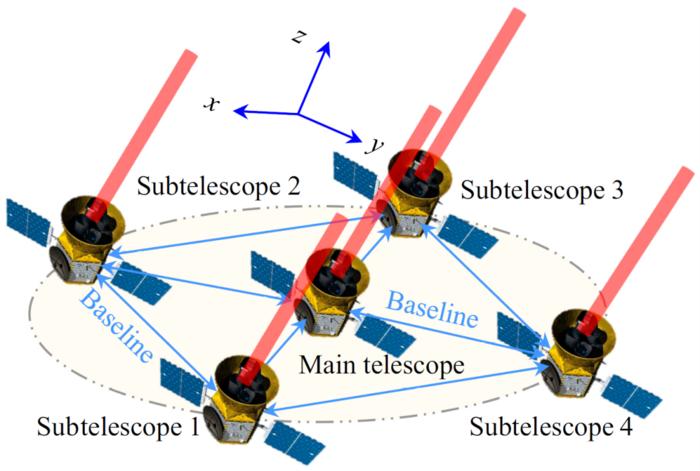
We’ve talked plenty of times here about the infeasibility of launching a mirror big enough to directly image exoplanets using current rocket fairings - at least as long as we’re not sending them 500+ AU away to a gravitational lensing point. We’ve also talked at length about the potential solution to that problem - interferometry, where multiple smaller satellites link up precisely, but are spaced far enough apart to act as one gigantic mirror. The problem is, from a technical standpoint, it’s really hard to build these kinds of systems. But the field has taken another step forward with a new paper from researchers at Xidian University and the Beijing Institute of Control Engineering, published in Space: Science & Technology, which describes a system to both control and calibrate a free-floating interferometer.
It wouldn’t be an article on a new interferometry technology without talking about lasers. They are the fundamental tool engineers use to accurately measure the distance between two satellites floating in space. Specifically, they like to use a technique called frequency-sweeping interferometry (FSI) as the equipment for it is compact, and it’s extremely accurate. It works by firing a laser that constantly changes frequency (up or down) at a target, then measuring the frequency of the light that bounces back.
So far so normal, but FSI struggles with two major hurdles in space - the Doppler effect, where the movement and vibration of the target satellite amplifies the measurement error, and inaccuracy in the lasers themselves, which can throw off the math used to calculate the distance. Engineers have solved the first of those issues using a technique called Double-Sideband FSI (DSB-FSI), which uses a tool called a Mach-Zehnder modulator (which sounds like something out of Star Trek) to simultaneously fire two separate laser frequencies, one sweeping up and one sweeping down. These results are averaged and the movement errors introduced by the target satellite cancel each other out.
Fraser talks to Dr. Lee Feinberg about the LIFE telescope, which is also an interferometerThat leaves the problem of laser inaccuracy. To solve this the research team, led by Wenjun Chen, turned to another Star Trek-sounding technology - a Fabry-Pérot etalon. Essentially, an etalon is a tiny optical cavity with two parallel reflecting mirrors. A small part of the laser is siphoned off into this cavity, and since the light only passes through at specific frequencies, a sensor can tell exactly when the frequency sweeping process passes through the exact frequency it's looking for, allowing the whole system to understand what, if any, offset there is in the frequency sweeping algorithm, and also allowing it to be corrected.
To prove these Star Trek-sounding technologies solve this problem, the researchers built a physical prototype. Over the course of a one hour test and a 5.7m distance between the two mock “satellites”, the addition of the etalon brought the baseline drift error down from 20.11um to just 13.38um. While that may not be much in absolute terms, it’s a 33.47% decrease - significant enough to make a huge difference over the lifetime of such a system in space.
The researchers also compared the system to a commercially verified laser interferometer (a Renishaw XL-80), and found their “homemade” system only differed by about 44.3um from that “gold standard” measurement. They also found that the system successfully tracked targets moving away from it at a speed of up to 20mm/s, showcasing its ability to track dynamically moving spacecraft.
Fraser talks about why we need an interferometer in space.Now, that being said, the system isn’t perfect. Space is harsh, and the realities of spaceflight itself, such as extreme temperature fluctuations, high radiation, and microgravity, could affect this system in ways that are hard to reproduce on the ground. And obviously 10m is at least an order of magnitude closer than any such system would need to be in space if it's to be actually useful, so scaling all these optical distance measurement systems to that level of precision will require some additional engineering.
But it seems the researchers are on the right track, and proved, at least in theory, that the fundamental physics of using these optical systems are sound. China’s space agency plans to launch the Multiple-Spacecraft Exoplanet Aperture Synthetic Interferometer (MEAYIN) to the L2 Lagrange point. At this point MEAYIN is still early enough in its development phase that no launch date has been announced yet, but similar interferometer systems, such as the LIFE telescope could also benefit from the optical wizardry described in the paper. While there’s still a lot of work to do before it’s ready for flight time, every little bit of research brings us a little closer to capturing our first high-resolution image of an exoplanet.
Learn More:
Beijing Institute of Technology - Frequency-sweeping interferometry for intersatellite baseline metrology in array telescope formation
W. Chen et al. - Frequency-Sweeping Interferometry for Intersatellite Baseline Metrology in Array Telescope Formation
UT - Interferometry Will Be the Key to Resolving Exoplanets
UT - It's Time to Build a Space Telescope Interferometer. This Could be the First Step
