 Universe Today
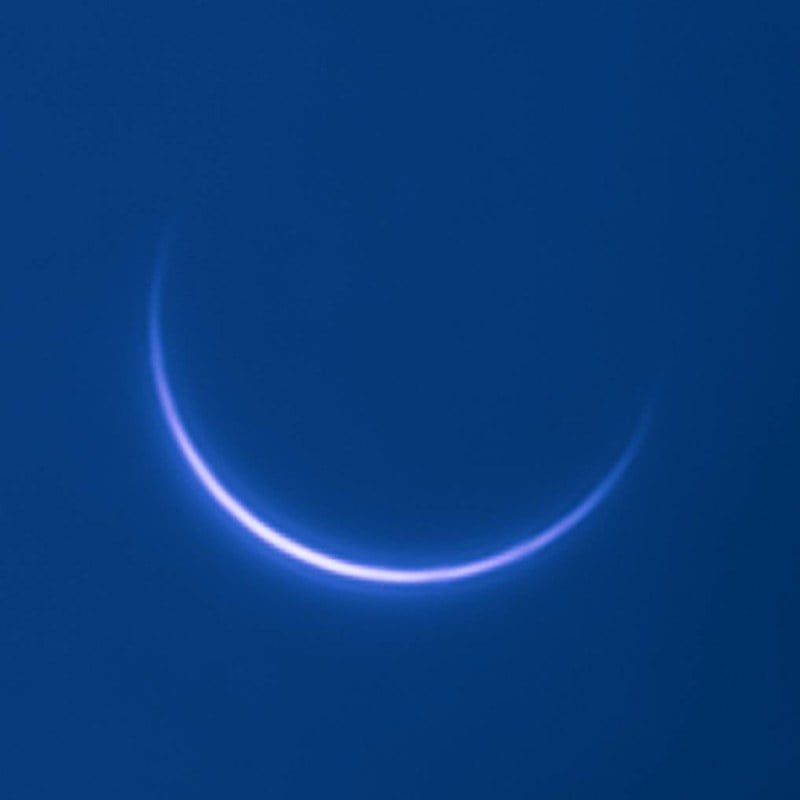
Inferior conjunction offers a rare chance to spy Venus at its closest approach.
Where have all the planets gone? Late October 2026 sees a decided dearth of planets in the dusk sky, with only bashful Mercury receding from view, and Saturn fresh off of opposition. Venus, the former lucida of the evening is now lost from view, taking the plunge sunward. But this vanishing act allows for a dramatic transformation this weekend, as our nearest planetary neighbor brushes past the Sun and transitions into the dawn sky.
We call this passage of an innermost planet versus the Earth inferior conjunction, as it crosses between our planet and the Sun. Venus crosses this point on Saturday, October 24th at 4:00 Universal Time (UT). Venus will be 0.27 Astronomical Units (AU) or 40 million kilometers from the Earth at that point.
Fun fact: although Venus is often touted as the closest planet to Earth (barely nudging out Mars at a favorable perihelion for the title), Mercury actually spends more time nearest to Earth than any other world.
Orbiting the Sun once every 224 days, Venus makes 13 loops around the Sun, versus Earth’s 8. This means that, from an Earthbound skywatcher’s perspective, apparitions of Venus follow an apparent 8-year cycle, making 5 complete circuits of the sky minus just 2.4 days. In 2026, We’re seeing a path for Venus nearly identical to its 2018 trek.
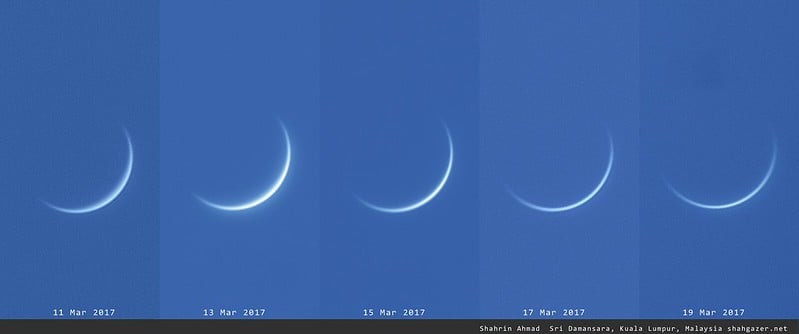 The rotating horns of Venus as seen during the 2017 apparition. Credit: Shahrin Ahmad.
These passages also alternate from north to south. The March 22nd 2025 inferior conjunction passage was north of the Sun, while this year’s is southward.
The 3.4 degree tip of Venus’ orbit versus the ecliptic plane also means that the planet generally misses transiting in front of the Sun, as it last did on June 5-6, 2012. These rare events occur in pairs eight years apart, followed by alternating 105.5/121.5 year gaps. The last transit of Venus isn’t until December 10-11, 2117.
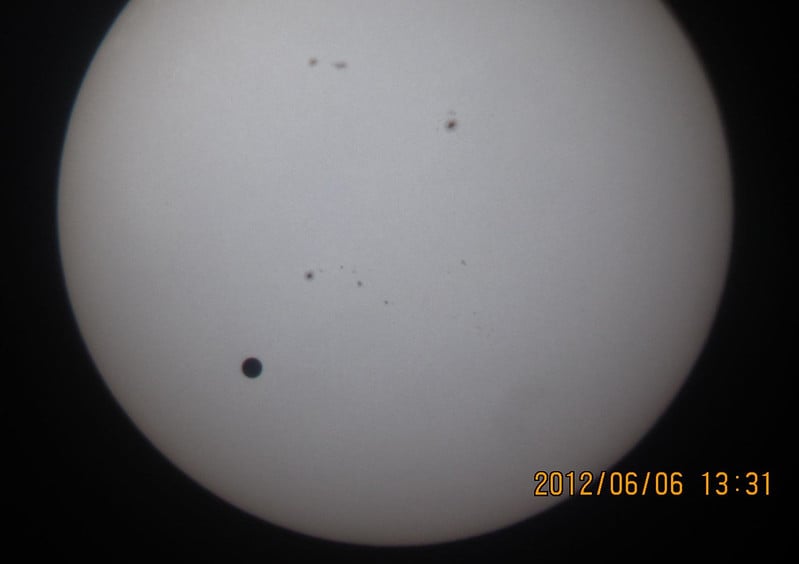 The 2012 transit of Venus across the face of the Sun. Credit: Filipp Romanov
Following Venus right through inferior conjunction is difficult, though not impossible. You’ll need to take proper safety precautions to block the dazzling Sun from view. On the 24th, Venus passes just 6 degrees from the Sun. Shining at magnitude -4, the slim 0.75% illuminated disk is a full arcminute wide, the largest that any other planet can appear from Earth. This offers properly equipped viewers a glimpse of the ‘ring of fire,’ as the delicate gossamer thread of an illuminated Venus seems to extend all the way around its disk, proof of its atmosphere.
Unfortunately, such an observation is best left to well-equipped amateurs. You’ll need to block the Sun physically out of view, while also working to acquire Venus. Astrophotographers have had better luck imaging Venus in the infrared. You can also follow Venus near inferior conjunction before sunrise or sunset with the Sun safely below the horizon, though 2026 favors viewers in the far southern hemisphere.
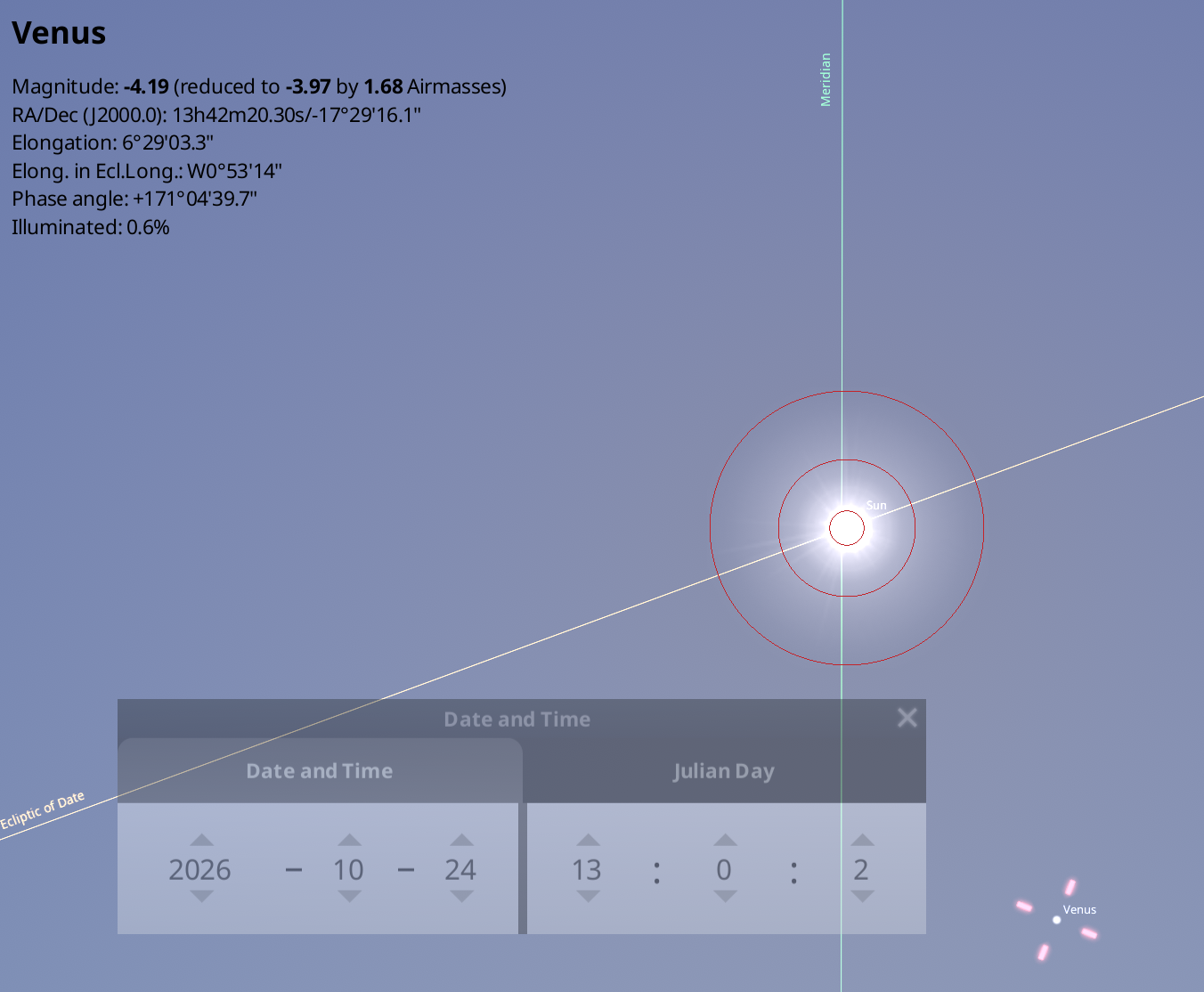 Venus versus the Sun on Saturday, October 24th at solar noon. Credit: Stellarium
We once spied Venus with the naked eye on the day of inferior conjunction from the Chena Flood Channel outside of Fairbanks, Alaska.
Though Venus is only slightly smaller than the Earth, the two worlds couldn't be more different. Modern observations has revealed that Venus is a hellish landscape, bone dry with surface temperatures topping 464 degrees Celsius and pressures reaching over 90 atmospheres. Russian Venera probes lasted up to a couple of hours on the surface of Venus before succumbing to the harsh environment.
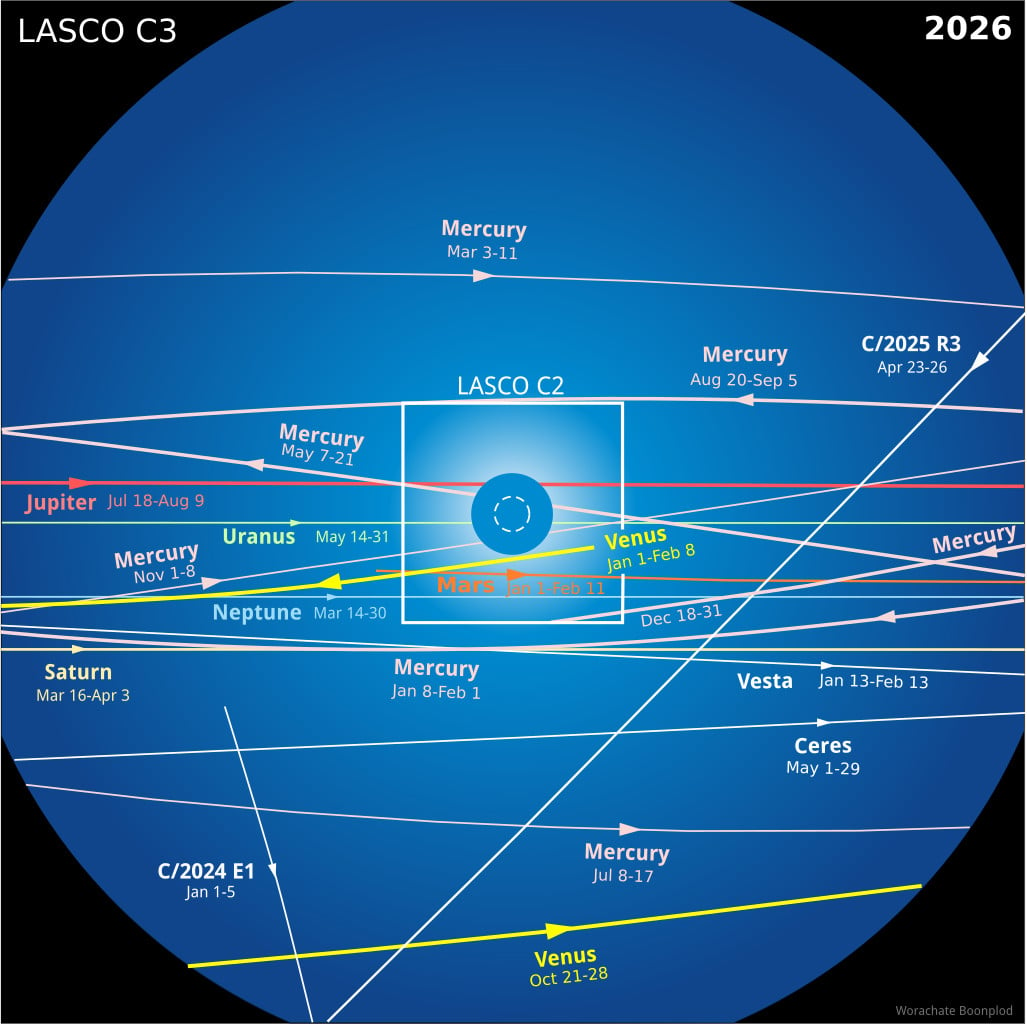 SOHO LASCO transits for 2026. Credit: SOHO/Worachate Boonplod.
There is, however, one place you can follow Venus right through inferior conjunction. The Sun-staring Solar Heliospheric Observatory (SOHO) sees Venus crossing its wide field of view LASCO C3 imager from October 21st until October 28th. A sun-diving Kreutz comet on October 19th added to the view.
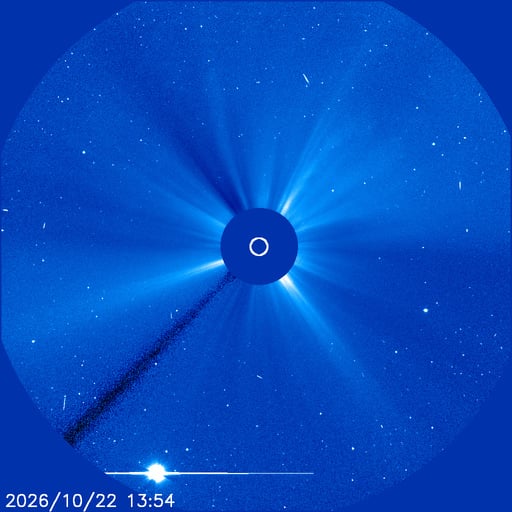 Venus in the October 22nd SOHO LASCO C3 view. NASA/ESA/SOHO
After this weekend, the hunt is on to recover Venus low in the dawn sky. In November, Venus joins Jupiter currently located high in the sky, and Mars headed towards opposition in early 2027. Mercury makes one more dawn apparition in late November.
Don’t miss a rare chance to track Venus through its inferior conjunction passage this coming weekend, either in person or online.