 Universe Today
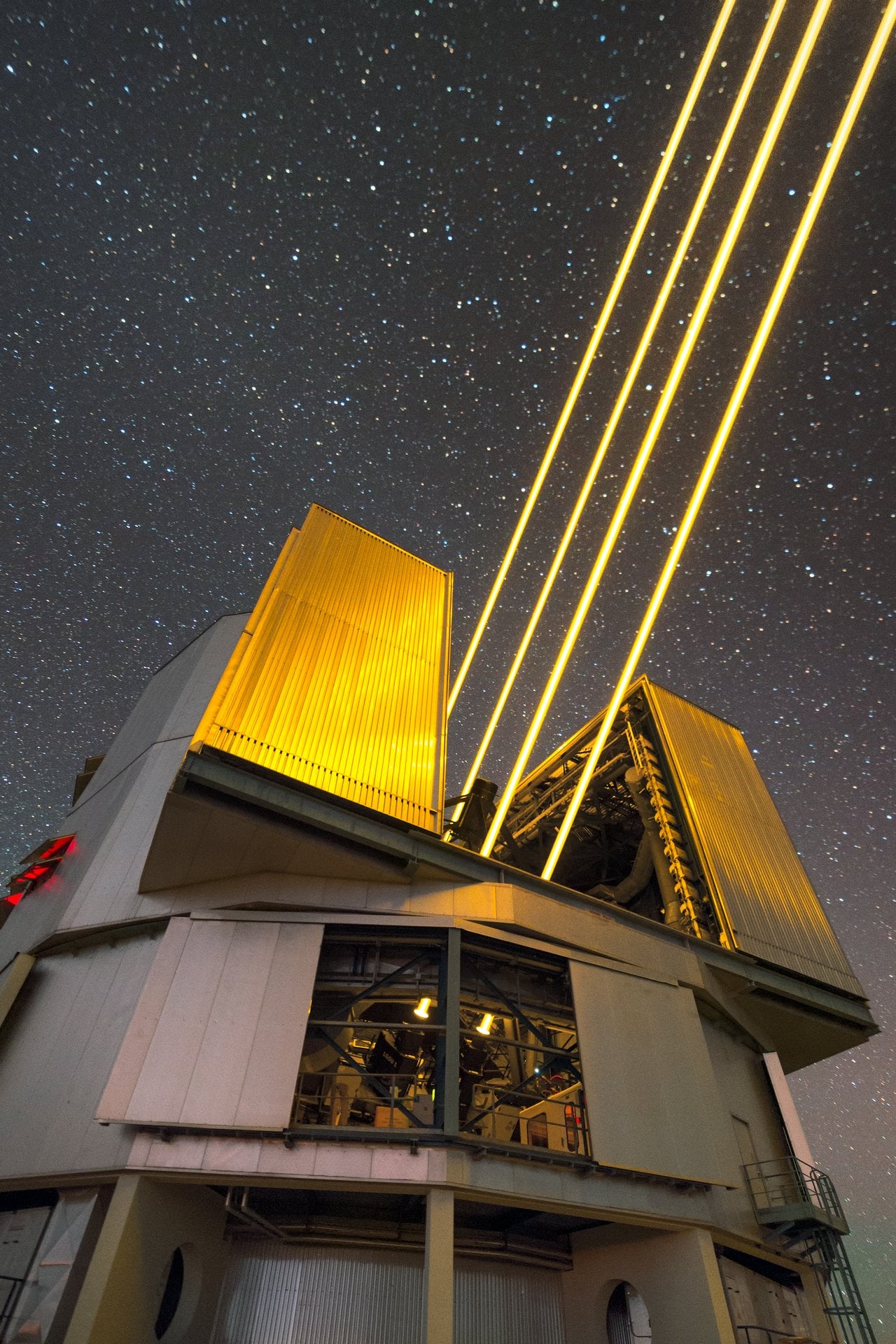
Searching for extraterrestrial intelligence has so far meant primarily focusing on one particular type of signal - and that signal has normally been based on what our own current cutting edge technology is. But what if that’s the wrong way to look for signs of an alien intelligence? What if a resource-conscious civilization decided it was too complicated to send femto-second lasers in high energy bursts out across the universe. A new paper, available in pre-print on arXiv, from researchers Dániel Apai, Chia-Lung Lin, and Kevin Wagner, suggest that might actually be what happens, and that we should start looking for long-duration pulsing interstellar beacons.
Interstellar communication, such as what an advanced civilization would use in between different stellar colonies, is heavily affected by both resources and time. In the paper, the authors handle this by making a simple assumption: an alien civilization that is trying to send interstellar messages wants to keep its costs down. To be honest, there’s some debate about that idea in the SETI community, with some arguing that “cost” is a relative term based on our own understanding of the world, and might be a completely foreign concept to an alien civilization.
A key feature, though, is that a signal must be “detectable”, and therefore must be close to continuous, making that the biggest cost factor of maintaining an interstellar communications network. Currently, we are capable of making lasers that last only a femtosecond, and can outshine a star for brief periods. But these types of highly advanced systems are incredibly complex, and, therefore, extremely expensive. The authors argue that aliens wouldn’t use that type of finicky system for their interstellar communication efforts.
Fraser talks about Technosignatures - signs that intelligent life may be out there.Instead, they would rely on robust, mass producible lasers firing longer pulses. Typically, they envision them being in the micro- to milli-second range, simply to keep data transfer at a reasonable pace across the light years. However, there is a major bottleneck for that type of transmission technology - interference from the local star.
It would be nigh impossible to be able to pick out an intentional slow-pulse beacon from the background of the star it is orbiting. So, the authors suggest, the civilization would probably put such a beacon in some sort of interstellar orbit - or at least very far on the outskirts of a solar system itself. That way it wouldn’t need to compete with the light coming from the star itself.
Crucially, our current astronomical surveys are effectively blind to that exact type of laser communications relay. Traditional optical Search for Extraterrestrial Intelligence (SETI) focuses on individual stars, and looks for nanosecond bursts of light. Any beacon far away from a parent star, or broadcasting at a slower wavelength would be completely missed by our current crop of SETI surveys - with one particular exception. The Pulsed All-sky Near-infrared Optical SETI (PANOSETI) project was designed to monitor large swathes of the sky for nanosecond to second period optical transient signals. However, the authors argue that PANOSETI’s resolution is too low to capture the type of “cosmic lighthouses” they are looking for.
Isaac Arthur talks about interstellar relays - the exact kind of technology this project would catch. Credit - Isaac Arthur YouTube ChannelTo fix this blind spot, the authors propose the “Cosmic Lighthouses Project”. This would use the three key technologies to analyze our stellar neighborhood for any such beacon. Off-the-shelf GPUs would be able to handle the massive amount of image processing to capture microsecond pulses (though actually getting their hands on these supply constrained chipsets might prove a challenge). qCMOS detectors can help improve contrast and resolution of large-scale sky surveys. And finally, mass-producible diffractive-refractive lenses can dramatically improve image quality over a massive field of view.
Combining all of those technologies, the authors calculate that a simple 1m telescope would be able to detect a 100 MW laser with a 10 microsecond pulse within 20 parsec (about 65 light years). That might seem likely an absurdly large laser, but realistically that’s on the lower end of what would be expected for an intentional stellar beacon. And that 20 parsec bubble contains around 3,000 stars, allowing for a very detailed SETI survey of our nearest stellar neighborhood.
If there is such a cosmic lighthouse blinking in the dark, this survey would be our best chance to see it. But so far, it has only just been proposed, and doesn’t have a clear path to funding or implementation. But given the relatively inexpensive price tag, there’s a possibility such a project would be picked up by a philanthropist with a particular interest in SETI. Maybe the Schmidt Observatory System has space for one more telescope.
Learn More:
D. Apai, C-L Lin, & K Wagner - The Interstellar Laser Beacons Hypothesis and the Cosmic Lighthouses Project
UT - What Technosignatures Would Interstellar Objects Have?
UT - How Hidden Stars Shape Our Search for Technosignatures
UT - The Best Place to Look for Alien Megastructures Might Be Moon Dust

