 Universe Today
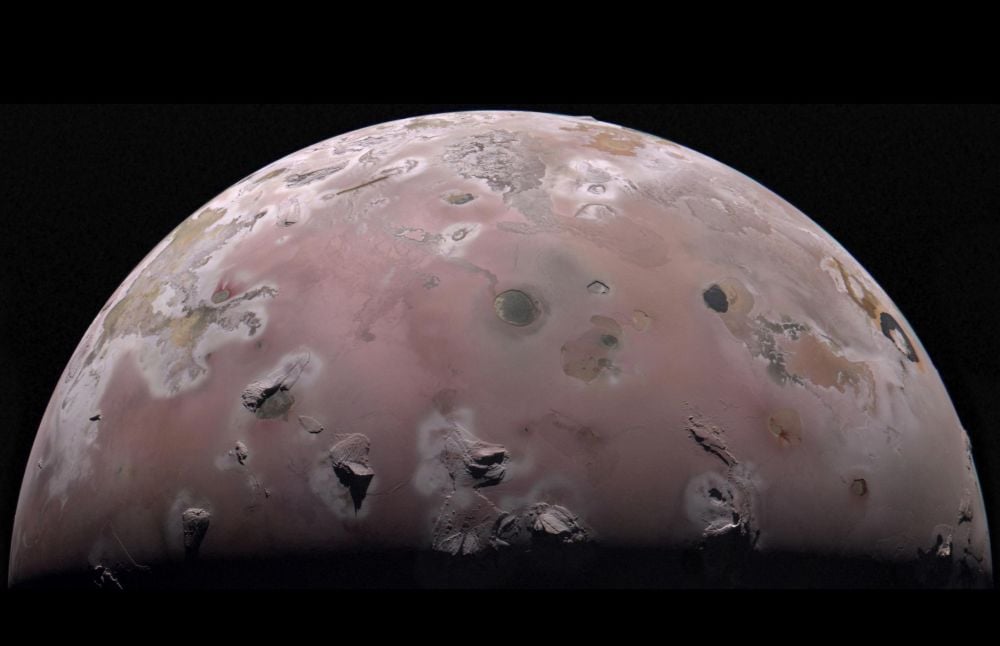
Jupiter's moon Io is a strange one. It's the driest object in the Solar System, has the strongest surface gravity in the Solar System, and the highest density. It's also the most volcanic object, with more than 400 known volcanoes.
Its abundant volcanic activity comes from tidal heating, as the moon is pulled between massive Jupiter and two of the gas giant's other Galilean moons, Ganymede and Europa. Volcanic plumes rise as high as 500 km, and some of its more than 100 mountains are taller than Mt. Everest.
When the Galileo spacecraft visited the Jovian system, it made multiple flybys of Io, coming as close as 100 km above the moon's surface. It found extremely hot lava, active plumes, rapid resurfacing, a differentiated metal core, and also made other discoveries.
NASA's Juno spacecraft has been in the Jovian system since 2016 and has also performed multiple flybys of Io. Though it only came to within 1,500 km of the surface, it gathered data that Galileo was unequipped to obtain. Galileo focused on the moon's surface infrared, while Juno used its Microwave Radiometer (MWR) to probe down to 6 meters below the surface. That might not sound very deep, but it's enough to measure a heat gradient.
The MWR was made to probe deeply into Jupiter's atmosphere. It was never intended to be used to probe Io's subsurface, but when Juno's mission was extended, Juno scientists realized they could use it to study Io. If the MWR could penetrate hundreds of miles of Jupiter's atmosphere, then it could penetrate several meters into Io's rocky surface.
The MWR has six separate antennae that together cover the frequency range from 600 MHz to 22 GHz (1.37 to 50 cm in wavelength.) Each antenna covers a specific frequency.
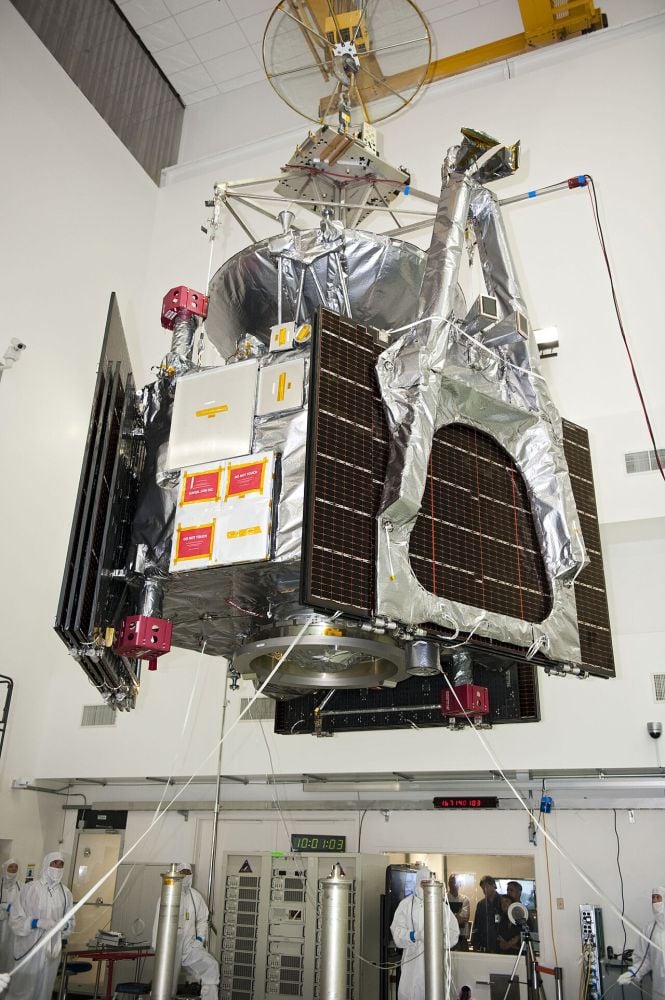 This image shows Juno in a pre-launch facility. The white squares of different sizes are MWR antennae of different wavelengths. Image Credit: By Kim Shiflett - http://mediaarchive.ksc.nasa.gov/detail.cfm?mediaid=53916, Public Domain, https://commons.wikimedia.org/w/index.php?curid=15790416
Juno used the MWR to study Io's subsurface during flybys in December 2023 and February 2024. The results of those measurements are in new research in Journal of Geophysical Research: Planets titled "Io Sub-Surface Temperature Profile Observed by the Juno Microwave Radiometer." The lead author is Shannon Brown, from NASA’s Jet Propulsion Laboratory in Southern California.
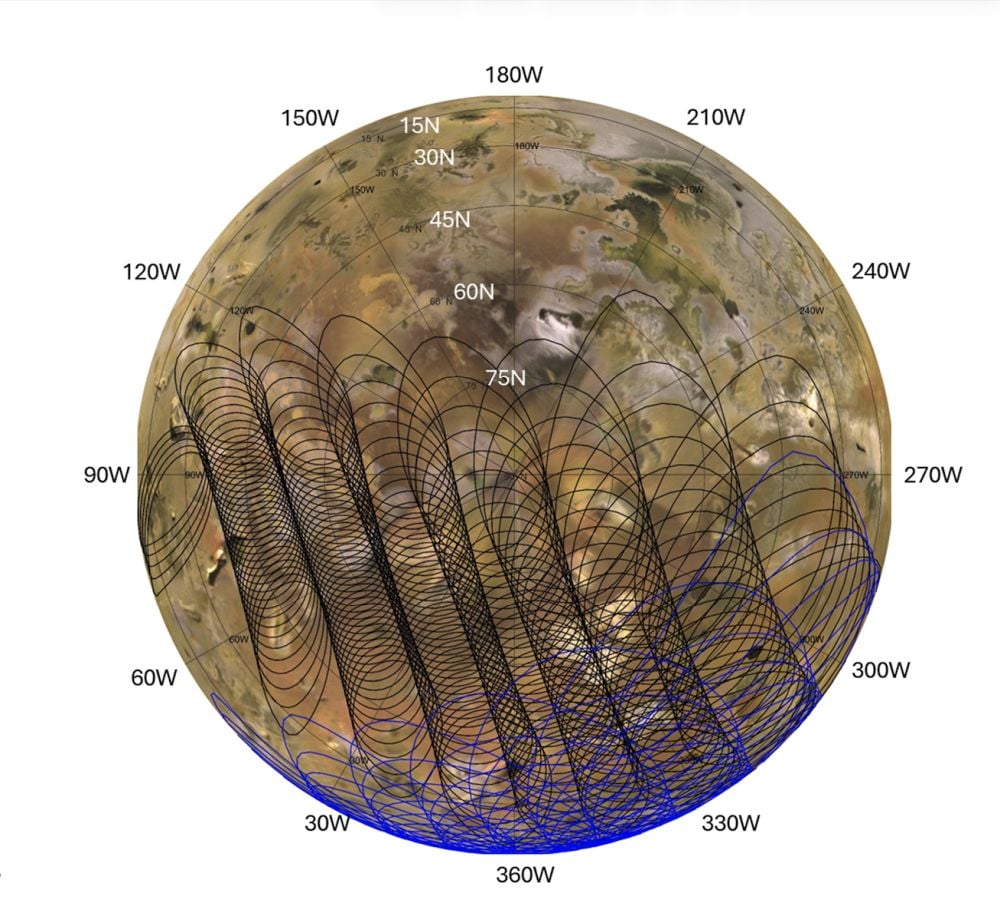 This figure shows the portion of Io's surface covered by Juno's MWR. The data was gathered during two flybys and doesn't cover the entire surface. But it covers enough to reach some reasonable conclusions about Io's heat flow. Image Credit: NASA/JPL-Caltech/SwRI/USGS
“The instrument measured Io’s thermal emission at depths ranging from a few inches down to tens of feet," lead author Brown said in a press release. "Everywhere we looked, we found the temperature rising by more than 40 degrees Fahrenheit just several feet into the surface — a gradient far steeper than solar heating alone can explain.”
Tidal heating is a common mechanism, and it just happens that in our Solar System, Io's situation is extreme. But the results extend beyond Io itself. Understanding extreme tidal heating on Io is a way to understand it on other moons, like the ocean moons Europa, Enceladus, and others. It's applicable to exoplanets, exomoons, and potential habitability.
“Io provides a unique window into learning how tidal heating works throughout the cosmos, a fundamental process that provides energy and heat to worlds that are far from their parent star,” said co-author Scott Bolton from SwRI, who is also the Juno mission's principal investigator. “This process can not only create the most volcanic body in the solar system, in the case of Io, but also fuels the subsurface oceans on the moons of giant planets, such as Europa and Ganymede. Up until this point we could only observe the heat escaping at the surface or through eruptions. Now we can characterize how the heat is moving from the interior toward the surface.”
Juno's MWR was designed so that each of its six antennae can see to a different depth in Jupiter's atmosphere. It worked great at Jupiter, delivering new data and new insights into the gas giant's massive atmosphere. When Juno's mission was extended, the instrument paid dividends when studying the Galilean ice moons. But the ability to peer below Io's rocky surface was unexpected.
“The technique is novel in that each wavelength explores different depths, providing a new way to characterize the deep atmosphere of giant planets and the subsurface crusts of icy and rocky moons,” said Bolton. “At Ganymede and Europa, we explored tens of miles below the surface, assuming their ice shells were mostly pure water, but the ability to probe into the volcanic rock at Io was an unexpected discovery.”
The MWR found that Io's temperature rises by about 22 degrees C (40 degrees F) only several feet below the surface. This isn't due to hotspots. The volcanic moon is leaking heat all over.
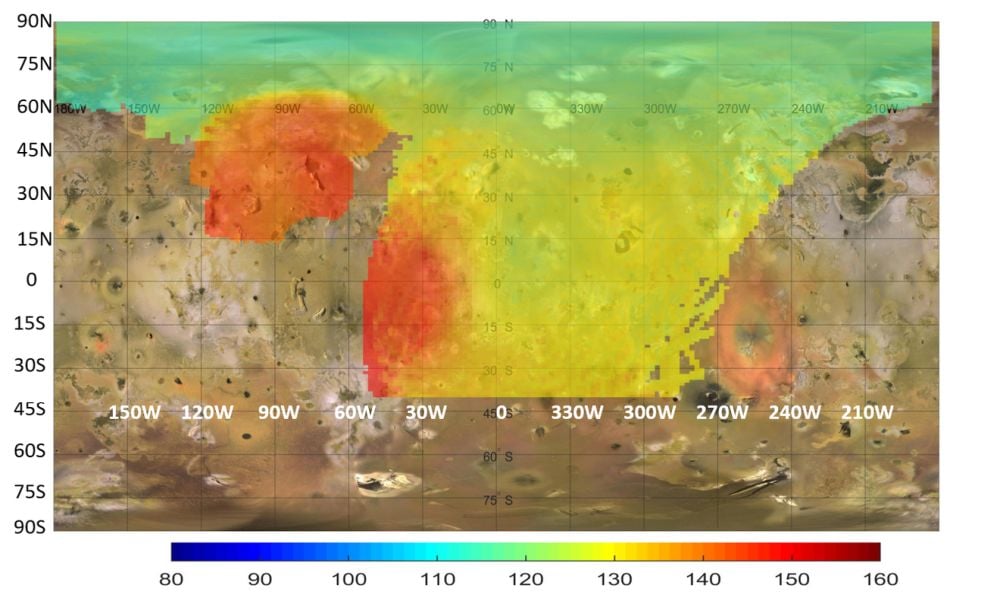 This figure shows heat data captured by Juno's MWR. It represents heat rising from deeper inside the moon to the surface. Red represents the hottest regions. Image Credit: NASA/JPL-Caltech/SwRI/USGS
“The instrument measured Io’s thermal emission at depths ranging from a few inches down to tens of feet. Everywhere we looked, we found the temperature rising by more than 40 degrees Fahrenheit just several feet into the surface — a gradient far steeper than solar heating alone can explain,” said lead author Brown.
Since these are the first results for studying Io's heat flow, the researchers don't have a definitive explanation, beyond the obvious fact that Io is volcanic. But they do present a couple potential explanations for the MWR's measurements.
The crust itself could be very conductive, meaning that it spreads the heat from internal hot spots or magma flows and releases it more uniformly. In this scenario, the background heat flow isn't powerful locally, only about 1 to 3 watts per square meter. But across the entire moon, that's about 30 times Earth's average.
The other explanation involves local fresh lava from within the last five years or so. In this scenario, the lava flows are capped with about 10 meters of thin, cooling crust that covers only about 10% of the moon. This could produce the same heat signal.
Juno's MWR also revealed the nature of Io's surface like never before. Though known for its lava lakes, like Loki Patera, the largest lava lake in the Solar System, and for tall mountains, some of which are taller than Mt. Everest, its surface topography wasn't well understood. "The surface appears to exhibit specular reflection in the microwave, suggesting a relatively smooth surface on 100 km spatial scales (apart from visible topography), like Earth's land and ocean surfaces," the authors write in their research. That means that smooth patches can extend for up to at least 100 km.
“Away from its mountains, the surface is more like the Great Plains of North America, and even though Io is a rocky body, the surface material has a very low density — more like pumice or a fluffy volcanic ash than solid rock,” said Brown.
All in all, this work shows how MWR instruments can be used to probe solid surfaces. In the future, these instruments can be designed for more specific targets and results.
"The findings presented here demonstrate that multi‐frequency microwave radiometry is a powerful diagnostic of Io's sub‐surface thermal and physical state, capable of constraining both heat flow and surface composition," the authors write.
"Future work combining MWR data with infrared, ALMA, geophysical models will allow for refined mapping of spatial heat flux variations and the role of small‐scale volcanic resurfacing in Io's global heat budget. Future versions of an MWR can be tailored to specific targets and associated science objectives," the authors conclude.

