 Universe Today
Stars form by direct collapse of gas in giant molecular clouds, creating molecular cloud cores. It's not a solitary act; multiple stars form in these cores. A good number of these stars, at least in our Milky Way, end up bound together gravitationally as binary stars.
Some binary stars are very close together, orbiting one another in a matter of hours. Observations show, and theory agrees, that these stars can't have formed this close together and must have migrated toward each other. But how they manage to get so close hasn't been clear to astrophysicists.
New research in the Monthly Notices of the Royal Astronomical Society has an explanation, and the explanation also extends to binary black holes. It's titled "Magnetic-field-induced inspiral of binaries with circumbinary disc: black hole and protostellar systems," and the lead author is Tomoaki Matsumoto. Matsumoto is from the Faculty of Sustainability Studies at Hosei University in Tokyo.
"The orbital decay of binary systems is a critical process for understanding the evolution of massive binary black holes (MBBHs) and binary star formation," the researchers write. In this work, the researchers used 3D hydrodynamical simulations to model how a binary system accretes gas from the surrounding envelope. They describe it as "analogous to the collapse of molecular cloud cores in the context of binary star formation."
The simulations also extend to the biggest problem in our understanding of black hole mergers. It concerns orbital decay, and how those mergers are plagued by what's known as the "final parsec problem." Even though we know black holes merge, astrophysicists can't account for how they get close enough to do so. They understand how inspiralling works, but not how the black holes overcome the final parsec and merge.
Angular momentum is the barrier that creates the final parsec problem. In a binary system, the bodies must shed that momentum to reach close proximity to one another. On wider orbits, friction with the stellar background sheds the momentum, letting the bodies approach one another. As the bodies get closer, individual stars or gas lets the binaries shed momentum. But once the bodies are close together, those aren't enough. Without a way to get rid of more angular momentum, the bodies overshoot inward and then follow an elliptical trajectory outward. They can never reach the tight orbits observed in some binary stars, or merge as in the case of black holes.
How a pair of black holes shed enough angular momentum to overcome the final parsec that separates them has been difficult to understand.
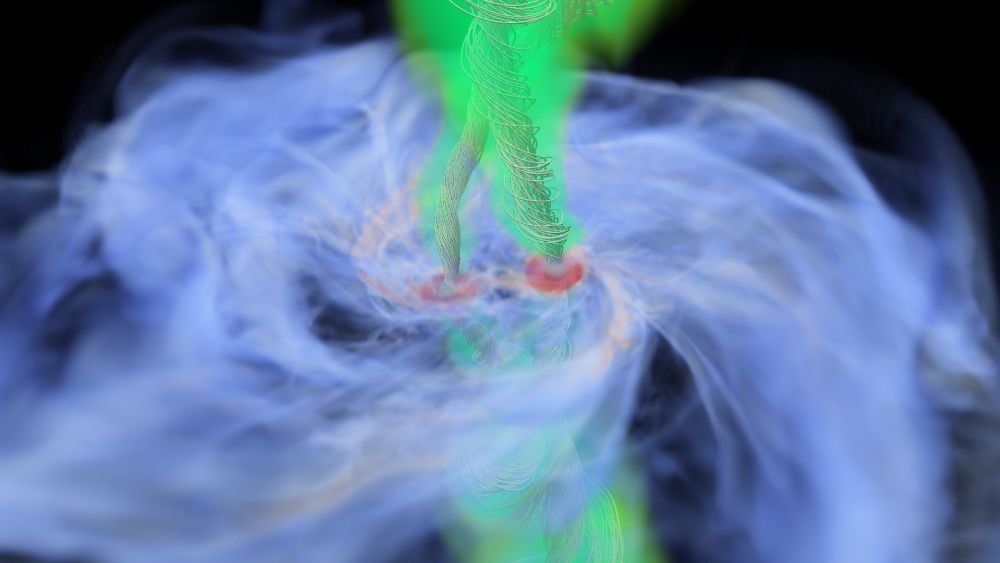
These simulations, though also aimed at binary stars, have an answer. They show that the binary system emits two types of outflows or jets. One type comes from each of the circumstellar disks, and one comes from the circumbinary disk (CBD). The simulations also show that within the CBD, magneto-rotational instability is excited.
Overall, the simulations show that outflows/jets, when combined with magneto-rotational instability, subtract angular momentum from the binary pair. This loss of angular momentum allows a pair of objects to move very close together, and in the case of black holes, eventually merge.
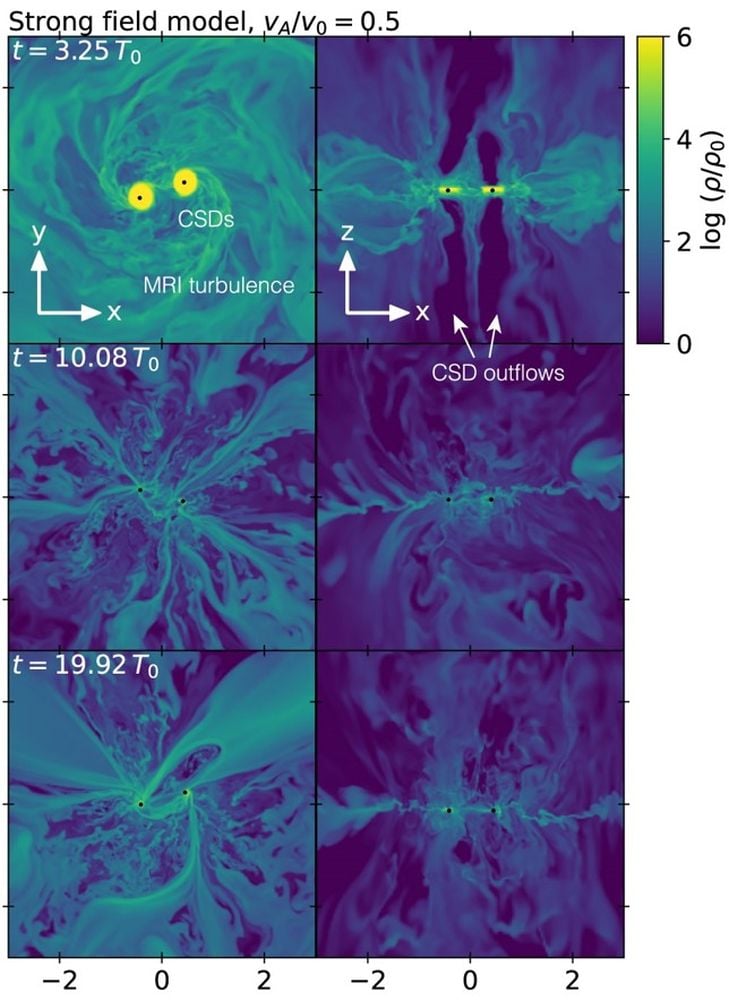 This figure shows the binary pair simulation from the top down (left column) and from the side (right column.) The magneto-rotational instability occurs in the cirucmbinary disk, showing turbulent density structure in the CBD. This redistributes angular momentum, leading to the CBD expansion. As a result, these magnetic phenomena extract angular momentum from the system in both the radial and vertical directions, letting the bodies get close together. Image Credit: Matsumoto et al. 2026. MNRAS https://doi.org/10.1093/mnras/stag669
The magnetic fields play a powerful role in allowing this to happen, and that alone isn't a new insight. "One of the key processes promoting orbital decay is angular momentum transport, for which magnetic fields serve as a powerful agent," the authors write. But previous research showed that these magnetic fields were confined to within the circumbinary disk.
This paper proposes a new scenario. The simulations include not just magnetic fields inside the disk, but interstellar magnetic fields from the gas cloud, too.
"These magnetic processes efficiently transport angular momentum in the gas surrounding the binary and thereby drive orbital decay, while a purely hydrodynamical model exhibits orbital expansion," the authors write.
Notably, they also simulated systems with a zero magnetic field, and in those simulations, the binary objects were pushed farther apart. Without magnetic fields, the system couldn't shed enough angular momentum.
The results extend to galaxy mergers, where two black holes also merge into one. By including magnetic fields, the pair of black holes overcame the final parsec problem. "By appropriately scaling these numerical results, we propose a new mechanism for MBBH (Massive Binary Black Hole) mergers within a Hubble time, overcoming the bottlenecks encountered at separations near the final parsec scales," the authors write.
One caveat concerns the run-time of the simulations. It would take an enormous amount of computing power to complete the simulations, and though these were run on supercomputers, even they have their limits. "Although the simulations do not reach a long-term steady state, the qualitative difference between the magnetized and non-magnetized models persists over multiple orbital periods," the researchers write.
"This suggests that magnetic effects play a robust role in the orbital evolution," the authors explain.
