Mimas and Saturn

By Fraser Cain - February 28, 2006 04:19 AM UTC | Planetary Science
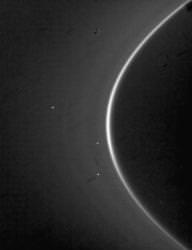
This is a photograph of Saturn's icy moon Mimas, perched in front of the ringed planet. Mimas is only 397 kilometers (247 miles) across, so it's absolutely dwarfed by Saturn in the background. NASA's Cassini spacecraft took this photograph on January 20, when it was approximately 1.4 million kilometers (900,000 miles) from Mimas.
Continue reading

Block Starlight to See Planets

By Fraser Cain - February 28, 2006 04:09 AM UTC | Exoplanets
University of Arizona researchers have developed an "optical vortex mask" that will block the starlight from a bright star, so that dim objects nearby the star can be observed. This mask could theoretically be attached to a powerful observatory, to completely mask the light from the star, and allow astronomers to see planets 10 billion times less bright. Future space missions, like the Terrestrial Planet Finder might use a similar technique as well.
Continue reading

CryoSat-2 Will be Constructed

By Fraser Cain - February 28, 2006 03:47 AM UTC | Missions
Officials at the European Space Agency have approved a plan to build and launch a replacement spacecraft for destroyed CryoSat satellite. CryoSat 1 was lost when its Rockot launcher malfunctioned on October 8, 2005. CryoSat-2 will have the same mission objectives as its predecessor, to monitor the thickness of land and sea ice, and to help scientists predict future climates as this ice melts and the planet warms up. It will probably be launched in March, 2009.
Continue reading

What's Inside a Gas Giant?

By Fraser Cain - February 28, 2006 03:38 AM UTC | Planetary Science
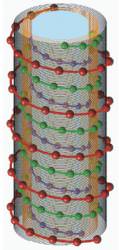
If you could strip away all the gas from Jupiter and Saturn, what would you find inside? Inside gas giant planets, the pressures and temperatures are enormous, and not much can survive those conditions. Researchers at the University of Minnesota have calculated that crystals would dissolve, and would actually work like metals, facilitating the flow of electrons. This could help to explain the tremendous magnetic fields detected around gas giant planets.
Continue reading

FUSE Satellite is Working Again

By Fraser Cain - February 28, 2006 03:18 AM UTC | Missions
NASA's Far Ultraviolet Spectroscopic Explorer (FUSE) astronomy satellite has returned to service after being offline for about 10 months. 3 of the spacecraft's 4 reaction wheels had failed; these allow it to point at precise locations in the sky. Even though it only has a single reaction wheel, engineers were able to create a technique which allows it to orient itself. FUSE has already had its original 3-year mission extended twice, so any further science it can gather is a bonus.
Continue reading

Astrophoto: A New Star in Ophiucus by John Chumack

By Fraser Cain - February 27, 2006 10:15 AM UTC | Stars
A pair of stars with about the same mass will evolve in about the same manner. But if one of the pair is more massive than the other, the more massive star will use its nuclear fuel faster, enter the red giant stage sooner and become a white dwarf earlier while its partner is still red and bloated. This scenario is actually quite common throughout the universe and leads to spectacular results.
Continue reading

What's Up This Week - February 27 - March 5, 2006

By Fraser Cain - February 27, 2006 05:32 AM UTC | Observing
Greetings, fellow SkyWatchers! Start your week out "hot" as we take a look at AE Aurigae - The Flaming Star. If you still carry a torch for an old "Flame" then come along as we have a look at NGC 2024. We'll round up the horses, head out for Abell 426, lasso some wild star clusters and ride off into the moonrise as the week ends. All you have to do is turn an eye to the sky, because...

Here's what's up!
Continue reading

NASA's Orbiter is Almost at Mars

By Fraser Cain - February 25, 2006 05:04 AM UTC | Missions
NASA's Mars Reconnaissance Orbiter has nearly reached its destination, but its work is just about to begin. On March 10, the spacecraft will turn on its thrusters, allowing it to be captured by Mars' gravity. Over the course of the next six months, it will continue adjusting its orbit through a process called aerobraking, where the spacecraft skims through the Martian atmosphere, slowing it down a little bit each time. In addition to the high resolution images and scientific data it will capture, the spacecraft will help the rovers and future landers communicate back to Earth.
Continue reading

Swift Sees an Unusual Gamma Ray Burst

By Fraser Cain - February 25, 2006 04:36 AM UTC | Physics
NASA's Swift satellite is continuing to send back surprising information about gamma ray bursts. On February 18, 2006, it discovered something completely unique; a burst that originated 440 million light-years away and lasted about 30 minutes. This event is very similar to the more common bursts that have been seen in the past; however, it was about 25 times closer, and lasted 100 times longer than a typical burst.
Continue reading

Ausonia Mensa Massif on Mars

By Fraser Cain - February 25, 2006 03:51 AM UTC | Planetary Science
These images, of the Ausonia Mensa massif, were taken by ESA's Mars Express spacecraft. This region is a large remnant mountain, 3,700 metres (12,100 feet) high. It's covered by several large impact craters, some of which are partially filled with sediment, and in various stages of erosion.
Continue reading

Artificial Star Shines in the Southern Sky

By Fraser Cain - February 24, 2006 04:27 AM UTC | Stars
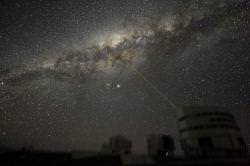
In late January, astronomers celebrated the creation of an artificial star in the nighttime sky. The star was created 90 km up in the atmosphere by a powerful laser projected out of the ESO's fourth 8.2m Unit Telescope of the Very Large Telescope at Cerro Paranal in Chile. This artificial star allows the telescope's adaptive optics system to compensate against the fluctuations of the Earth's atmosphere, and produce images as crisp and clear as if they were taken from space.
Continue reading

Spiral Galaxy Messier 100

By Fraser Cain - February 24, 2006 04:15 AM UTC | Extragalactic
If our Milky Way looked in the mirror, this is what it would probably see. This is a photograph of galaxy Messier 100, located about 60 million light-years away. It presents an intricate structure with a bright core, two large arms, and a pair of fainter spiral arms. Japanese amateur astronomer Shoji Suzuki and Italian astronomer Marco Migliardi recently discovered a Type-Ia supernova in M100 on February 4, 2006.
Continue reading

Solar Flares Altered Mars' Atmosphere

By Fraser Cain - February 24, 2006 03:55 AM UTC | Solar Astronomy
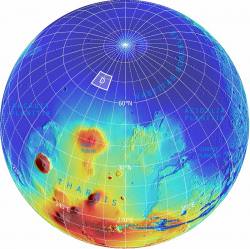
Boston University astronomers announced today that they've found evidence that solar flares change the upper Martian atmosphere. The researchers found that when X-ray bursts from the Sun reach Mars, they cause the planet's ionosphere to produce additional ions and electrons - exactly the same situation was recorded simultaneously by satellites here on Earth. The measurements were made by NASA's Mars Global Surveyor as it transmitted data back to Earth.
Continue reading

Van Allen Safe Zone Migrates

By Fraser Cain - February 23, 2006 12:49 PM UTC | Solar Astronomy
The Earth's magnetic field concentrates solar radiation into a series of regions called the Van Allen belts. Any spacecraft or astronauts passing through these regions must take precautions or be showered with radiation. But NASA scientists have learned that a "safe zone" between the belts actually moves around depending on the amount of solar activity reaching the Earth. The measurements were made using several meteorological satellites which periodically dipped into the Van Allen belts and through these safe zones.
Continue reading

The High Cost of Boots on the Moon

By Fraser Cain - February 23, 2006 07:51 AM UTC | Space Policy
When President Bush announced his new Vision for Space Exploration in January 2004, he set NASA on a new course to return to the Moon, and maybe even set boots on the surface of Mars in the next few decades. Instead of a quick course change, NASA would work within a modestly increased budget to develop the new Crew Exploration Vehicle, while completing the International Space Station and retiring the Space Shuttle. Science, such as the Hubble Space Telescope, Mars rovers, and climate research wouldn't be affected.
Continue reading

Pluto Was Born With Its Moons

By Fraser Cain - February 23, 2006 03:54 AM UTC | Planetary Science
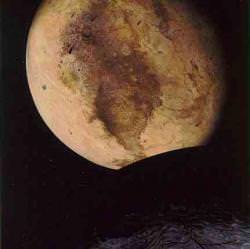
Pluto and its three moons were likely formed together when two large objects collided millions of years ago. Charon has been observed for decades, but the two new smaller moons, discovered last year, also orbit in the same plane as Charon and have a similar orbital resonance. It's even possible that Pluto has a ring system. Astronomers now believe that many Kuiper Belt Objects have multiple moons, and even higher order systems will probably be discovered in the years to come.
Continue reading

Dark Lava Floor of Crater Billy

By Fraser Cain - February 23, 2006 01:55 AM UTC | Planetary Science
This image of the lunar crater Billy was captured by the Advanced Moon Imaging Experiment (AMIE) on board ESA's SMART-1 spacecraft. With a diameter of 46 kilometres (29 miles), crater Billy is located on the southern fringes of the Oceanus Procellarum. The floor of Billy has been filled by basaltic lava with a very low albedo, leaving a dark surface. This image was taken on the 14th Jan. 2006, from a distance of about 1260 kilometres.
Continue reading

Nearby Exoplanet is Scorching Hot

By Fraser Cain - February 23, 2006 01:43 AM UTC | Exoplanets
NASA's Spitzer Space Telescope has uncovered a hot extrasolar planet orbiting a nearby star. Planet HD 189733b orbits its parent star only 63 light-years from Earth, making it the closest extrasolar planet ever detected directly. It moves in an extremely tight orbit - less than 3% of the distance from the Earth to the Sun - completing a tour around its star in just over 2 days. And it's scorching hot, reaching temperatures of 844 Celsius (about 1,551 Fahrenheit) on its surface.
Continue reading

New Type of Star Discovered

By Fraser Cain - February 23, 2006 01:27 AM UTC | Stars
UK astronomers have used the Jodrell Bank Observatory to discover an entirely new class of objects. These new kinds of stars are similar to pulsars, as they produce brief radio flashes which only last for a few milliseconds. Unlike pulsars, however, they stay silent for much longer periods of time, ranging from 4 minutes to 3 hours. Astronomers think these objects build up energy over hundreds of rotations, and then release it in a single burst - and then build back up again.
Continue reading

Southern Enceladus Covered in Fresh Snow

By Fraser Cain - February 23, 2006 01:08 AM UTC | Planetary Science
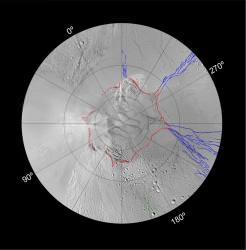
This false colour image of Saturn's moon Enceladus shows incredible features across its surface, invisible in natural colour. The bluish southern regions are deposits of large grains of poure ice, which show that the moon's southern hemisphere is relatively young compared to the meteor pounded northern hemisphere. Cassini took this photo on January 17, 2006 when it was 153,000 kilometers (95,000 miles) from Enceladus.
Continue reading

Gemini Counts Up the Dark Matter in NGC 3379

By Fraser Cain - February 22, 2006 12:40 PM UTC | Extragalactic
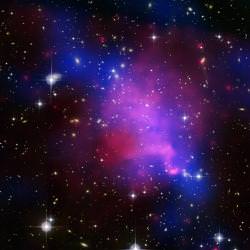
Australian astronomers have used the powerful Gemini observatory to measure the amount of dark matter in the heart of galaxy NGC 3379. They made their estimate by observing 22 globular clusters near the galaxy's central halo, and then measured their distance from the galactic centre. They were then able to calculate how much dark matter in the galaxy's dark halo was nearby to keep them in this orbit.
Continue reading

NASA Builds a Stardust Factory

By Fraser Cain - February 22, 2006 12:12 PM UTC | Missions
When stars near the end of their lives, they expel their outer layers into space. This gas expands and cools, and some of it condenses into grains of dust; eventually this dust comes together to form stars and planets. NASA scientists have built a stardust factory at the Goddard Space Flight Center to model what kinds of conditions are required to generate this dust. It turns out that stars can make this dust at much higher temperatures than previously believed.
Continue reading

So, Is Pluto a Planet or Not?

By Fraser Cain - February 22, 2006 08:44 AM UTC | Planetary Science
In ancient times, skywatchers knew of 5 planets: Mercury, Venus, Mars, Jupiter and Saturn. The fact that Earth was another planet didn't occur to anyone for a few more years. Uranus was discovered in 1781, Neptune in 1846, and tiny Pluto was finally located in 1930. That brought the total number of planets to 9. We were all raised to believe that there are 9 planets. That's it, case closed. Right? Wrong... maybe.
Continue reading

Book Review: Getting Off the Planet

By Mark Mortimer - February 22, 2006 06:13 AM UTC | Space Exploration
The first astronauts wanted to be more than passengers in their spaceships. However, undertaking an active role meant that systems, interfaces and controls need be suited for human use even though the environment was completely unknown. Mary Jane Chambers and Dr. Randall Chambers in their book Getting Off the Planet provide a first hand account of some of the challenges that were mastered in resolving this issue and in meshing human to machine. As they note, with judicious testing and training, there was much greater confidence in the success of all the space missions.
Continue reading

Great Mercury Viewing This Week

By Fraser Cain - February 21, 2006 11:38 AM UTC | Observing
Since it's often hidden by the glare of the Sun, you don't get many chances to see Mercury. Well, now's your chance. From now until March 1, Mercury will be clearly visible in the west as twilight turns to night. Friday, February 24th will be the best night to look for Mercury, and a thin crescent moon will be close to the planet on March 1st. NASA's Messenger spacecraft is on its way to Mercury, and is expected to arrive in 2008. Until then, make sure you get outside, look west, and enjoy a view of this tiny planet.
Continue reading

Earth's Iron Building Blocks

By Fraser Cain - February 21, 2006 11:26 AM UTC | Planetary Science
The iron meteorites whizzing around the Solar System are probably remnants of objects that helped form the Earth and the other rocky planets. When they fall down to Earth, scientists get an opportunity to study some of the primordial building blocks of our planet. Although many of the Solar System's asteroids are found in the asteroid belt, they probably emerged out of the same disk of planetary debris that formed the Earth, and then drifted out to their current location.
Continue reading

Stardust's Samples Under Analysis

By Fraser Cain - February 21, 2006 11:13 AM UTC | Planetary Science
Scientists at the University of Chicago have received their first samples of cometary dust from NASA's Stardust mission, which returned back to Earth in mid-January. The samples consist of several thin slices of a single dust grain, as well as a larger piece which can be sliced up even finer. Mission scientists believe that the spacecraft collected a total of 2,300 particles larger than 15 micrometres across (1/3rd the width of a human hair).
Continue reading

The Milky Way Shines in X-Rays Too

By Fraser Cain - February 21, 2006 10:54 AM UTC | Milky Way
Astronomers now know that the haze of the Milky Way is actually the combined light of millions of stars. The Milky Way has a similar haze in the X-ray spectrum, and that also seems to be coming from a multitude of point sources. Astronomers pooled together 10 years of observations from the Rossi XTE orbital observatory, and they were able to determine that the emissions are coming from a million white dwarf stars, and hundreds of millions of stars with active coronas.
Continue reading

Saturn's Feathery Northern Clouds

By Fraser Cain - February 21, 2006 02:03 AM UTC | Planetary Science
In orbit for more than a year and a half now, NASA's Cassini spacecraft is only just now getting around to imaging Saturn's northern hemisphere. It's winter in northern Saturn right now, and scientists want to know if the two hemispheres experience different weather patterns depending on the seasons. Cassini took this image on January 6, 2006 when it was 2.9 million kilometers (1.8 million miles) from Saturn.
Continue reading

The Sky is Full of Black Holes

By Fraser Cain - February 21, 2006 01:42 AM UTC | Black Holes
Astronomers have been puzzling over a mystery for a few years now, and they think they might have an answer. Everywhere you look, there's a diffuse glow of background X-ray radiation - but where's it coming from? Astronomers pointed the Chandra X-Ray Observatory at a patch of sky for a total of 23 days over a 2-year period, and resolved 600 separate point sources. This isn't a background glow at all, but the X-ray radiation from hundreds of millions of supermassive black holes, like the one at the heart of the Milky Way.
Continue reading

The Shadow of Phobos

By Fraser Cain - February 18, 2006 04:00 AM UTC | Planetary Science
Mars' moon Phobos casts its shadow across the surface of the Red Planet in this photograph captured by ESA's Mars Express. Phobos is only 27 kilometres by 22 kilometres in size (17 x 14 miles), and it orbits Mars once every 7.5 hours. To an observer on the ground, this eclipse would look similar to one on Earth; however, Phobos would only cover about 20% of the Sun's surface. And it would be over quickly - the shadow moves at 7200 km/h (4400 mph).
Continue reading

Tethys and Titan

By Fraser Cain - February 18, 2006 03:49 AM UTC | Planetary Science
Cassini captured two of Saturn's moons in this image: Titan and Tethys. Titan is in the upper left, and is shrouded by a thick atmosphere that protects it from most impacts. Tethys, on the other hand, has no atmosphere, and has suffered numerious impacts, including the enormous impact that dug out the crater Odysseus. This image was taken on January 6, 2006, when Cassini was 2.7 million km (1.7 million miles) from Tethys, and almost double that distance from Titan.
Continue reading

Mars Express Finds Auroras on Mars

By Fraser Cain - February 18, 2006 03:36 AM UTC | Planetary Science
ESA's Mars Express spacecraft has spotted evidence of auroras over the night time side of Mars. These auroras make v-shaped structures of accelerated electrons and ions, similar to what we see here on Earth. Mars doesn't have a planetary magnetic field, so the discovery of auroras came as a surprise; however, it does have magnetic regions - the remnants of an old planetary magnetic field. Since Mars is always lit from our vantage point here on Earth, it required a spacecraft to find the auroras, which are only detectable at night on Mars.
Continue reading

Venus Express Tests its Engine

By Fraser Cain - February 18, 2006 03:23 AM UTC | Missions
After 100 days of travel, ESA's Venus Express tested its main engine for the first time. The burn only lasted 3 seconds, and changed the spacecraft's velocity about 3 metres/second (10 feet/s). The engine test worked perfectly, and Venus Express was able to reorient itself after the burn, and correctly point its high-gain antenna back at Earth. The engine will be used again on April 11, when it will fire for 51 minutes, putting it into orbit around Venus.
Continue reading

Greenland Ice Loss Doubled in the Past Decade

By Fraser Cain - February 18, 2006 03:00 AM UTC | Planetary Science
According to new research published by NASA scientists, Greenland's glaciers are losing ice at an accelerating rate. In the period from 1996 to 2005, the island's glaciers doubled the amount of ice they're shedding annually into the world's oceans. This acceleration is due to a global rise in temperature. Once Greenland's glaciers are all gone, scientists estimate world sea levels will have risen approximately 7 metres (23 feet).
Continue reading

Book Review: Europa, the Ocean Moon

By Mark Mortimer - February 17, 2006 04:56 AM UTC | Planetary Science
Our five senses are all we have to allow our brains to interact with the world outside our bodies. Space exploration relies almost entirely on one, the sense of sight. Space probes send us images of planets, moons and other objects which we then have to decipher as best we can. Richard Greenberg in his book Europa, The Ocean Moon uses recent images of Europa, together with our understanding of celestial mechanics and plate tectonics, to unravel this little moon's mysteries. For Europa's biggest mystery is whether it harbours life who may be looking right back at us from their own little world.
Continue reading

Three Moons in a Row

By Fraser Cain - February 17, 2006 03:01 AM UTC | Planetary Science
In this beautiful Cassini photograph perfectly lined up along Saturn's ringplane, it's possible to see three of the planet's moons: Dione is at the left, Prometheus is in the centre, and Epimetheus is on the right. This image was taken on January 2, 2006, when Cassini was 2.8 million kilometers (1.7 million miles) from Saturn.
Continue reading

Japan's New Satellite Sends Back its First Image

By Fraser Cain - February 17, 2006 02:49 AM UTC | Missions
Japan's recently launched Advanced Land Observing Satellite (ALOS) has sent back its first pictures of Earth - Mt Fuji and its surrounding towns. The satellite was launched on January 24, 2006, and it contains three onboard instruments for Earth observation. One instrument is called the Panchromatic Remote-sensing Instrument for Stereo Mapping (PRISM). It's capable of taking many 3-D images quickly and accurately.
Continue reading