Universe Today

Reflect Orbital moves ahead with the company’s first Eärendil launch, ahead of concerns from the astronomical community.
Move over, Starlink. A new constellation of bright reflector satellites could soon compete with the night sky.
The United States Federal Communications Commission (FCC) recently approved the first demonstration launch of Reflect Orbital’s Eärendil-1 satellite. Sporting an 18 by 18 meter-wide reflector once unfurled, the satellite will test the ability to reflect sunlight back to Earth, on demand. The company envisions more than 50,000 reflectors girding the Earth in low Earth orbit by 2035, while many in the astronomical community have raised concerns on the project's impact.
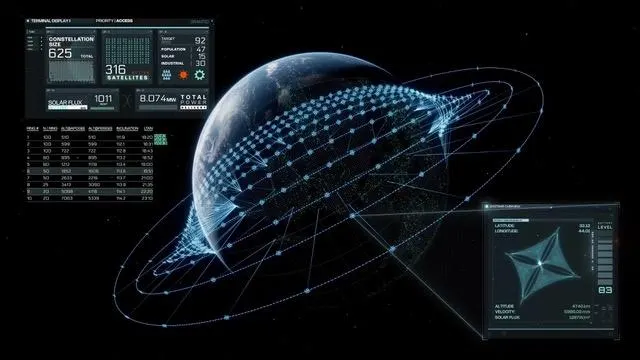 A future fleet of orbital mirrors. Credit: Reflect Orbital.
The first launch could occur as early as late this year. The FCC’s role in approval was related to the allocation of the radio frequency spectrum the satellite will use, versus the reflector’s overall impact. Reflect Orbital plans to launch three unfoldable test reflectors three months apart, starting with this year’s first approved launch of Eärendil-1. Reflect Orbital CEO Ben Nowack states that these first three will also be used as revenue generating vehicles for the company. The FCC approval notes a near-polar, 88 degree inclination orbit 625 kilometers from the surface of the Earth for the first launch, suggesting a Vandenberg launch, probably with SpaceX.
“Our approach is incremental and test-and-learn,” a Reflect Orbital spokesperson told Universe Today. “Our first milestone is this single demonstration satellite. What we learn from this test mission will shape everything that comes next, including the design of future satellites, the markets we serve, how we engage communities and the operational practices we put in place.”
Putting reflectors in space is actually a very old idea, going back to the Vietnam war and the early space age. Russia fielded a 20-meter space mirror known as Znamya-2 in 1992. Deployed from the late Mir space station, Znamya 2 created a 5 kilometer light patch as bright as a Full Moon that traversed Europe early on the morning of February 4th, 1993.
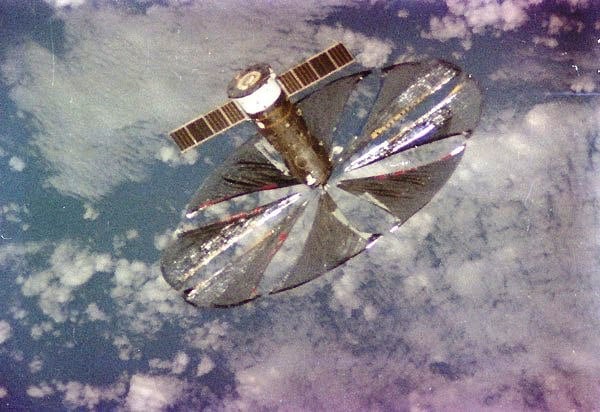 The Znamya-2 reflector, shortly after release from Mir. Credit: RSC Energia.
The mission name comes from a character from Lord of the Rings who carried the light of the morning star on his brow. For context, the Echo-1 communications satellite fielded by NASA in 1960 featured a balloon 30-meters in diameter, just under twice the span of Eärendil-1.
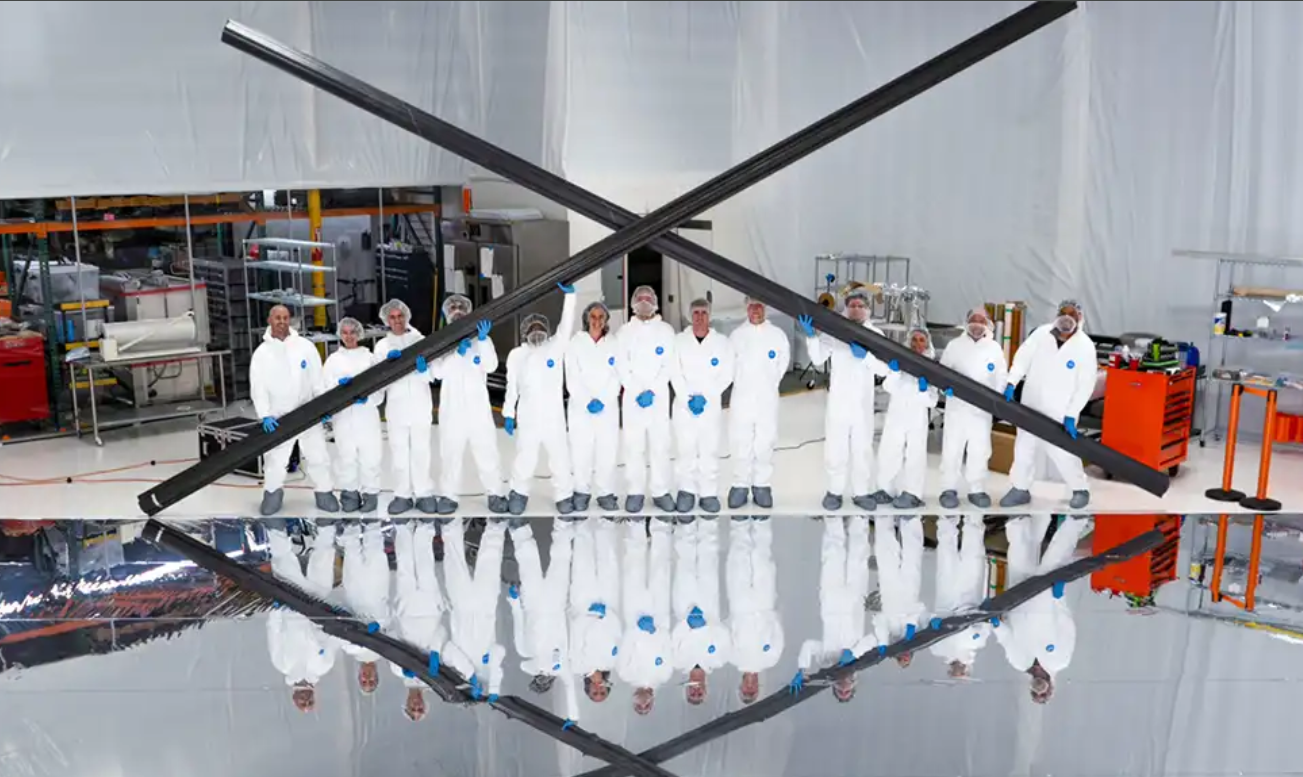 Reflect Orbital engineers. Credit: Reflect Orbital.
Reflect Orbital’s plan is to use on-demand solar for everything from extending working hours to disaster relief and agriculture. Read between the lines, and the U.S. Department of Defense could also potentially be a prime consumer of this technology. Certainly, the ability to generate and sell solar power at peak times has a lucrative appeal to the company.
Of course, the push back on the plan extends beyond the astronomical community. Reflect Orbital states that the plan for Eärendil-1 is to show the ability to project the brightness of a Full Moon at magnitude -12.6 magnitude over a 3-mile wide area. But all that brightness would be concentrated in a pinpoint source, rather than a half and degree-wide Moon. Also, the goal of generating solar power from such a source suggests that Reflect Orbital has a much brighter goal in mind.
The night sky has been under siege over the past decade, as SpaceX’s Starlink, China’s rival Qianfan ‘Thousand Sails’ mega constellation and AST Space Mobile’s Bluewalker and Bluebird satellites have all taken to the night skies. These were all incidental reflectors, photo-bombing the twilight sky view. What Reflect Orbital envisions seems more like it’s in direct conflict with the nighttime sky.
The company is aware of concerns, and has stated their wish to work with astronomical community to provide pinpoint service while announcing when and where the sunlight beams will be deployed. What would be key if this constellation of mirrors comes to pass would be the creation of exclusion zones for dark sky preserves and major observatories.
Unfortunately, this might also mean that the truly dark natural skies on your doorstep might soon become a thing of the past. We already see a marked difference at nightfall now. The next ‘star’ you wish upon may very well be an artificial one. All-sky surveys like the Vera C. Rubin observatory took decades to go from planning to seeing first light. They’re an investment on a national scale, threatened by obsolescence shortly after the observatory shutter opens. Plus, if this venture proves lucrative, perhaps the next startup in the field won’t be as interested in preserving the night sky.
Beyond the impact on astronomy, there’s safety concerns surrounding the project in terms of the public and aviation, as well as the impact on nocturnal wildlife, plus the potential for bright flashing objects in the sky to confuse satellite based star-trackers and more.
The American Astronomical Society has voiced the astronomical community’s concerns, and “stressed the importance of advance modeling of the full effects of atmospheric scattering as an input to understanding the severity of these risks” in a statement.
The company’s plan to mitigate light pollution includes ideas to quickly pivot reflectors into a passive configuration when not in use. The company is counting on the specular (non-diffuse) nature of its mirrors to focus and pinpoint light only where needed. This first mission could test that capability, though it’s tough to envision scaling this up, once thousands of reflectors are in space.
“We’re an industry member of the International Astronomical Union’s Centre for the Protection of the Dark and Quiet Sky,” a Reflect Orbital spokesperson told Universe Today. “We’ve engaged in substantive discussions with astronomers, whose feedback has already materially informed the design of our spacecraft and operational plans. We’re committed to ongoing dialogue with the astronomy community, as well as scientists, environmental researchers and other groups with a legitimate interest in how this technology develops. We’re actively commissioning third-party research on the impacts of our technology through both independent researchers and federal partners. This includes working to develop a coordination agreement with the National Science Foundation.”
Our science fiction future is indeed here, and with it, we’ll need to give some thought as to how it will look draped across our night sky.