 Universe Today
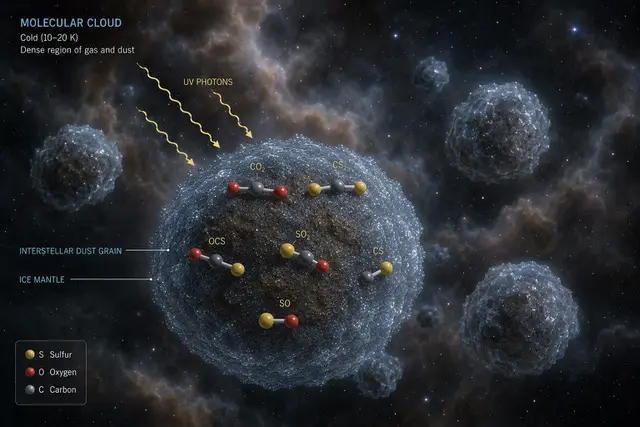
Sulfur is one of the most abundant elements in the universe. If you peer into a diffuse interstellar cloud, you find loads of it - about the amount expected based on fusion patterns of the stars it was born in. However, if you look at a dense, cold, molecular cloud - the kind where those stars actually form - it seems like 99% of the sulfur that is expected to be there is missing. Scientists have puzzled over this “missing sulfur problem” for decades, though a leading theory is that the element hides on icy dust grains making it hard to detect. A new paper published in Astronomy & Astrophysics from the Max Planck Institute for Extraterrestrial Physics and the Centro de Astrobiologia describes a new computer simulation model that they aimed to support the interpretation of laboratory results and test our current understanding of sulfur evolution in interstellar ices.
The simulation was written in pyRate - a Python based application that calculates how chemicals interact, especially between ices and gas phases. The paper marks the first successful model of the chemistry of a multicomponent interstellar ice analog with a rate-equation simulation. Scientists love “firsts”, but what does that actually mean in practice in this case?
The authors focused on simulating the results of one particular lab experiment focusing on sulfur that was performed in 2024. During this experiment, a mixture of carbon dioxide (CO2) and carbon disulfide (CS2) was cooled down to 10K and then blasted with vacuum-ultraviolet (VUV) photons. During the physical experiment, this processing broke the molecules apart and created a mix-mash of new sulfur-bearing chemicals such as sulfur dioxide, carbonyl sulfide, and even pure sulfur chains known as allotropes. Critically, a significant amount of the sulfur “disappeared” from the experiment - likely locked up in long sulfur chains that were invisible to the instrumentation hooked up to monitor them.
Fraser and Pamela talk about how life's molecules can form in space.Mimicking this experiment in simulation was the goal of the current paper, and it held some interesting new breakthroughs. First was how the molecules actually move. Most astrochemists simply assume that molecules move via thermal diffusion - they wander around a surface until bumping into another molecule. But when the team ran the simulation with only standard diffusion occurring, the reaction that produced such a plethora of sulfur-containing compounds completely ground to a halt. Enabling “non-diffusive chemistry” - where atoms can interact with their neighbors immediately upon breaking off from their host molecule - was the key to getting the reaction to complete - likely because 10K doesn’t really provide a lot of thermal impetus.
Another breakthrough came in an understanding of how thick of ice a VUV photon can penetrate. Turns out the answer is about 100 “monolayers” - or single sheets of ice molecules. This can be added as a feature to future iterations of these astrochemical codes, as there had been some debate about the VUV photon’s ability to penetrate deep into icy formations.
However, there were some discrepancies between the simulation and the actual experimental data from the 2024 experiment. Experimentally, the main compound found when all was said and done was sulfur dioxide, as well as high levels of sulfur allotropes. However, the simulation predicted low amounts of both molecules. Additionally, the simulation predicted high concentrations of carbonyl sulfide, sulfur monoxide, and carbon monosulfide, and while initially these were not reported, further analysis of the infrared spectra revealed that the experimental data are actually compatible with the presence of some carbon monosulfide and sulfur monoxide molecules, as their chemical signatures were likely hindered by overlapping with the dominant sulfur dioxide features.
Fraser discusses the clouds at the heart of the Milky Way, which are notably missing a lot of sulfur.The authors actually took these discrepancies as a clue, showing that our current understanding of interstellar chemical interactions is lacking at best. But they also showed that the original experiment might have missed something - the chemical signatures for carbon monosulfide and sulfur monoxide heavily overlapped with the dominant sulfur dioxide signal, so some of those concentrations might have been misinterpreted.
Either way, this is a step forward in understanding how chemistry in the galaxy at large works. Such work will allow the authors to update pyRate to more accurately match the laboratory experiment, and even inform future observational campaigns for the likes of the James Webb Space Telescope. Slowly but surely, scientists are working to get to the bottom of the missing sulfur mystery, no matter how many monolayers of ice they have to dig through.
Learn More:
Max Planck Institute for Extraterrestrial Physics - Recreating the Cosmos: Modeling Sulfur Chemistry in Interstellar Ice Analogues
O. Sipilä et al - Modeling the UV-photon irradiation of CS2-bearing ices in the laboratory with the pyRate gas-grain astrochemical code
UT - For the First Time, Scientists Detect Molecule Critical to Life in Interstellar Space

