Universe Today
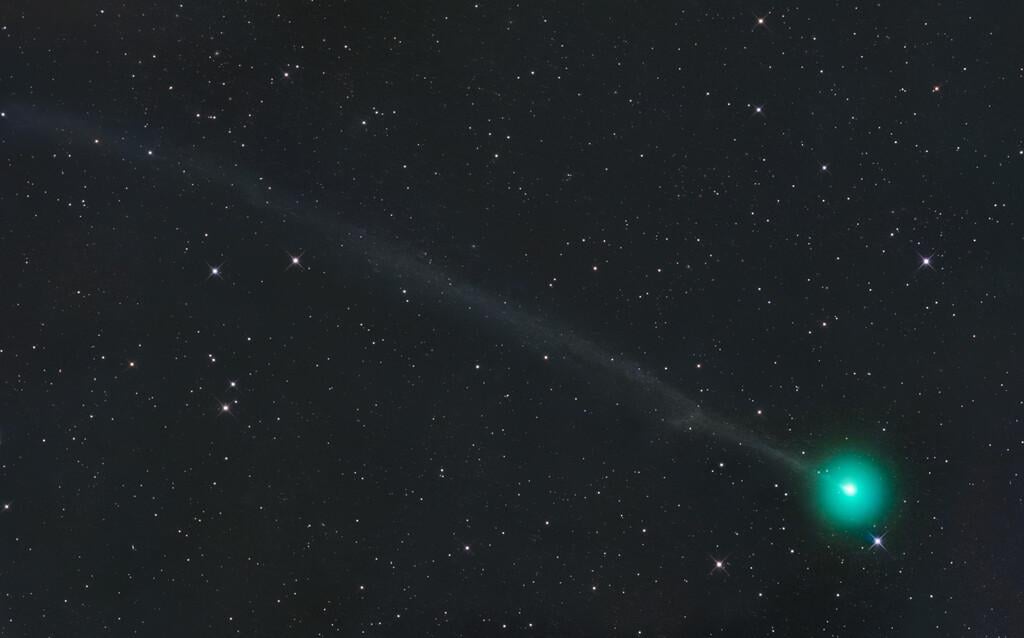
Comet 220P McNaught bursts into telescopic view, low in the dawn sky.
We had a surprise outburst late last week, from a lesser known periodic comet. Posts flashed across message boards late last week, alerting comet watchers to a dramatic change in brightness for periodic comet 220P McNaught. Though it wasn’t on our list for bright comets to watch for in 2026, Comet 220P is now in range of binoculars or a small telescope, low to the east at dawn as it heads towards perihelion this coming weekend.
The comet is the first of 18 comets discovered by prolific Australian observer Robert McNaught. McNaught found the comet as a +17th magnitude smudge on images captured by Siding Spring Observatory on the night of May 20th, 2004.
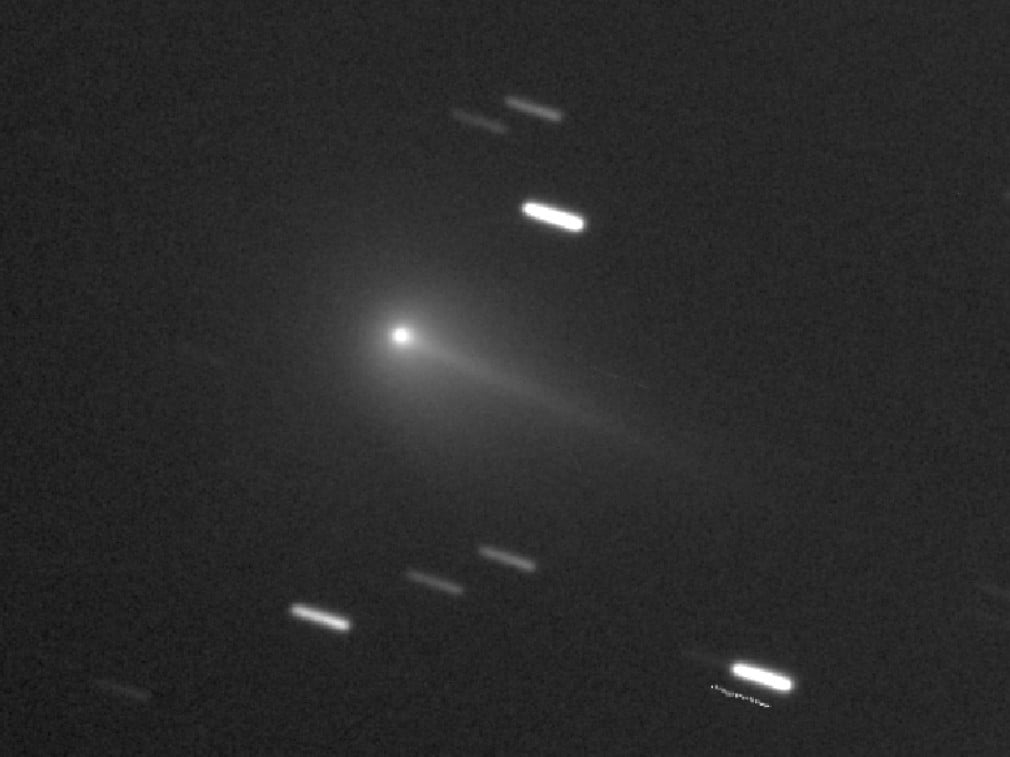 Comet 220P/McNaught from June 5th. Credit: Filipp Romanov/captured remotely using iTelescope.Net.
The outburst was first noted by observer Mike Kelley, looking at images from the Zwicky Transient Facility. The comet brightened by a respectable 7 magnitudes on June 1st. That’s a 600-fold increase in brightness. Later backup observations suggested the comet topped out at +8th magnitude, representing an amazing 8,000 times increase in brightness. Clearly, something interesting is going on with comet 220P.
The European Space Agency’s Rosetta mission gave us a closeup look at what a cometary outburst looks like, when Comet 67P/Churyumov-Gerasimenko blew its top:
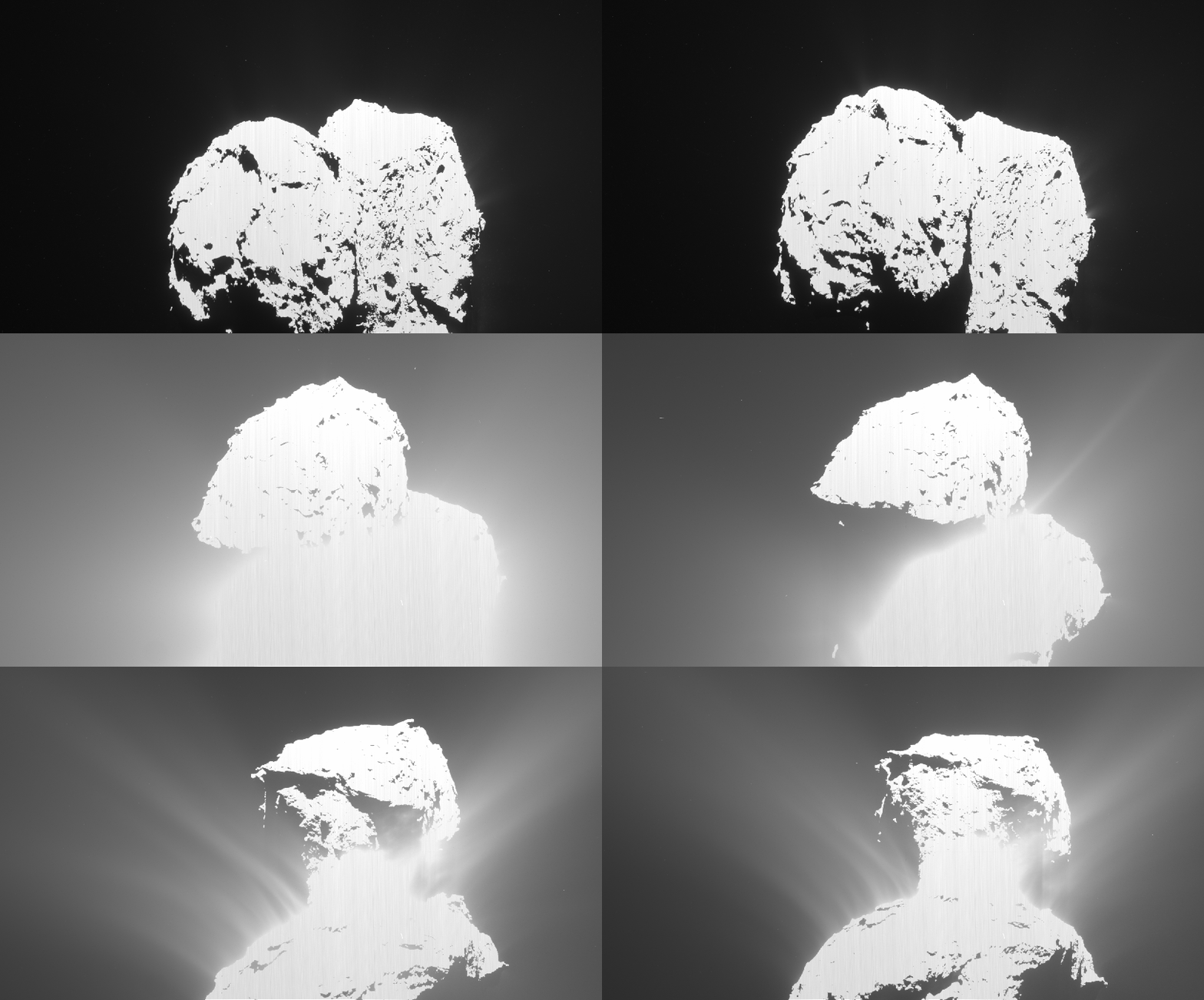 Comet 67P in outburst, as seen from ESA's Rosetta's mission. Credit: ESA.
Astronomers recently got time to observe Comet 220P McNaught using the TRAPPIST-North telescope located in Morocco. "Production (dust) rates have dropped significantly between the two nights (June 4th/5th)," astronomers note in recent Astronomer's Telegram post. "The comet appears enriched in C2 (diatomic carbon) with respect to CN (cyanogen). It also displays a narrow and intense dust tail, visible in all filters and in particular in the dust continuum filters, which could indicate a fragmentation event."
The comet reaches perihelion on June 14th, 2026 at 1.6 Astronomical Units (AU) from the Sun, just outside of the orbit of Mars. On a 5.5 year orbit, the comet was likely captured by Jupiter in its present day passage, as it just lags behind sharing a 2:1 resonance with the gas giant planet.
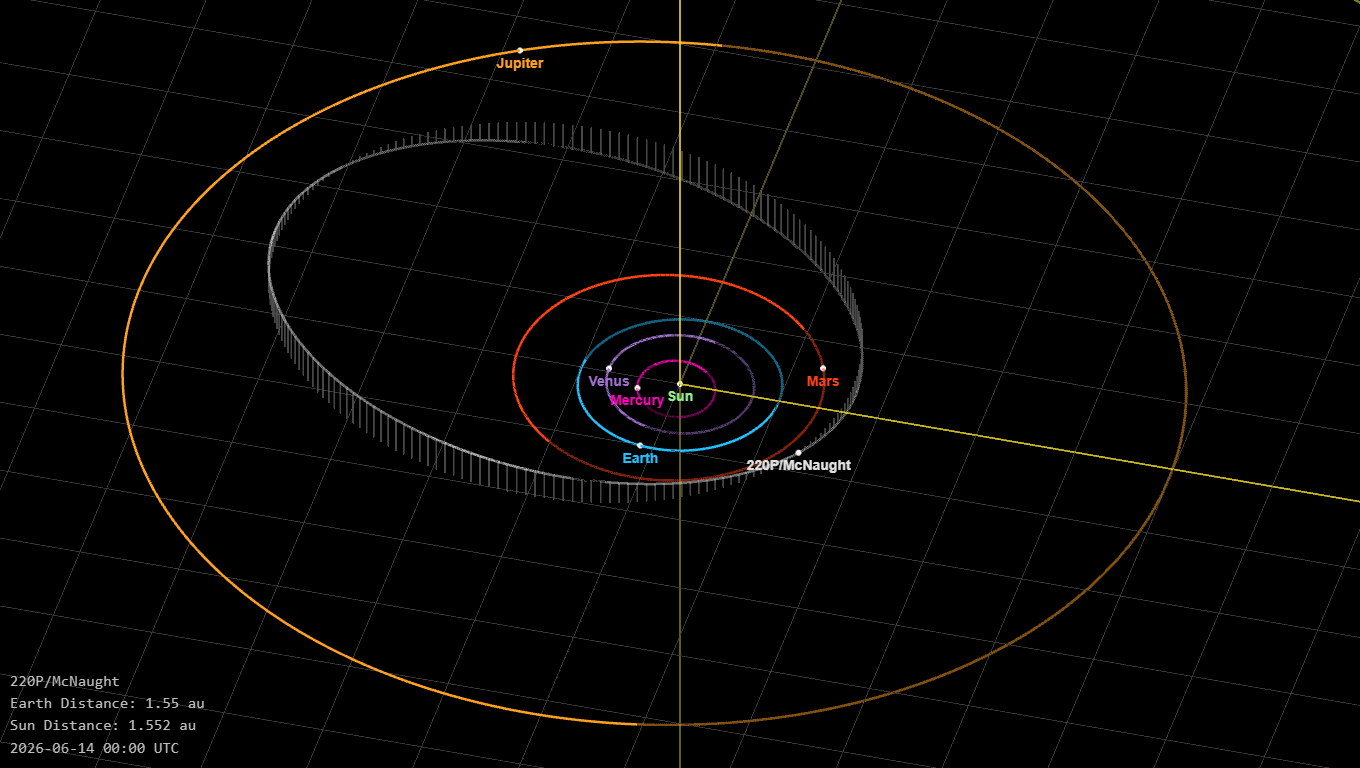 Comet 220P/McNaught at perihelion. Credit: NASA/JPL.
Finding the Comet
First, the good news: the comet is well-placed for northern hemisphere observers, around 65 degrees from the Sun in June. The bad news is, it’s an early morning object. For folks up north nearing the June solstice, this means walking the thin line time-wise between when the comet breaks 10 degrees above the eastern horizon, and the approach of dawn. For example, from here in southern Virginia near latitude 37 degrees north, this meant a 4AM wake up to grab the comet.
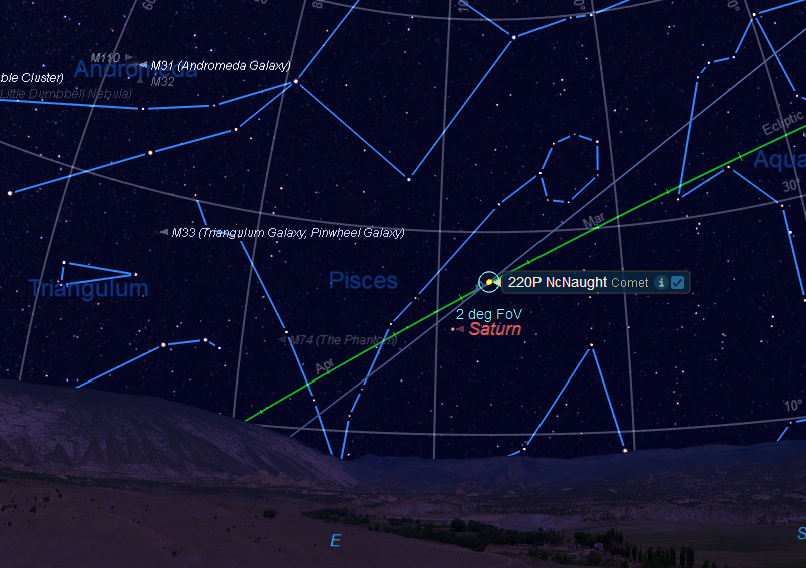 The location of Comet 220P, looking east two hours prior to local sunrise in early June. Credit: Dave Dickinson/Starry Night.
It was a cinch to grab with a DwarfMini smartscope, which listed it in the database under ‘220P’:
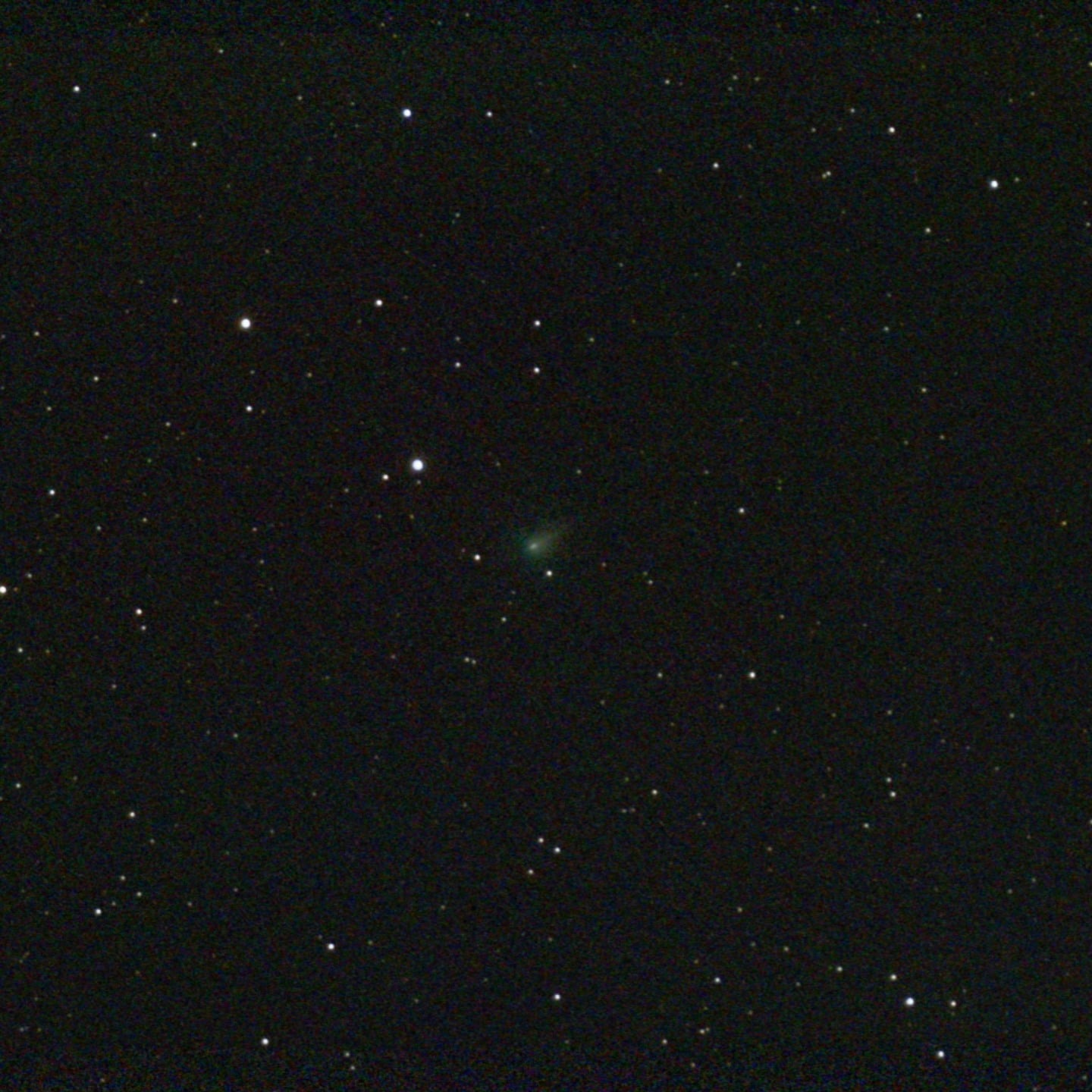 Comet P/220 McNaught from the morning of June 4th. Credit: Dave Dickinson/taken using a Dwarf Mini smartscope.
Comet 220P is currently hanging out in the dawn sky in the constellation Pisces, very near the planet Saturn. The comet crosses the ecliptic southward on June 9th, and passes less than 2 degrees from Saturn on June 16th. The -32% illuminated, waning crescent Moon passes just over a degree north of the pair on the morning of June 10th.
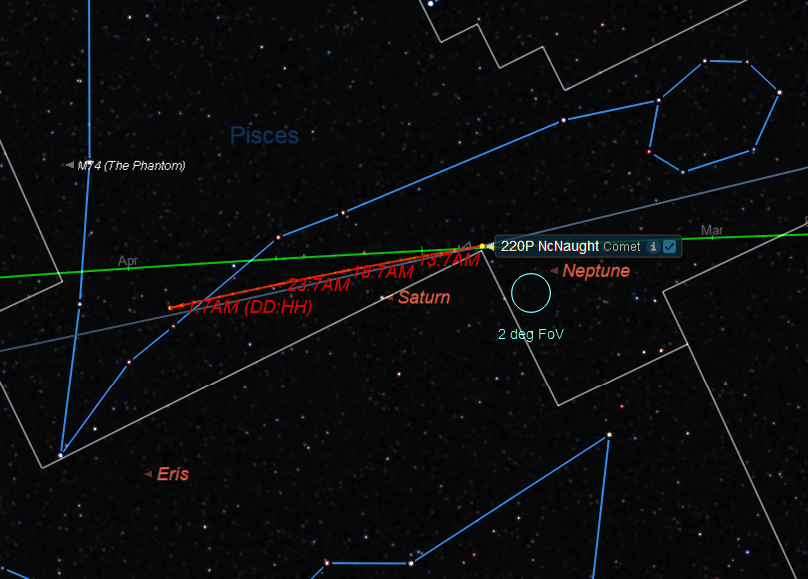 The celestial path of Comet C/220P through July 1st. Credit: Dave Dickinson/Starry Night.
We can hope this outburst holds, and that more could well be in store. The 9-plus change in magnitude in total edges out the 2013 outburst from Comet 289P/Blanpain as the biggest and most abrupt outburst since Comet 17P Holmes in 2007. That eruption put Comet 17P into naked eye range around +3rd magnitude in Perseus, that very night.
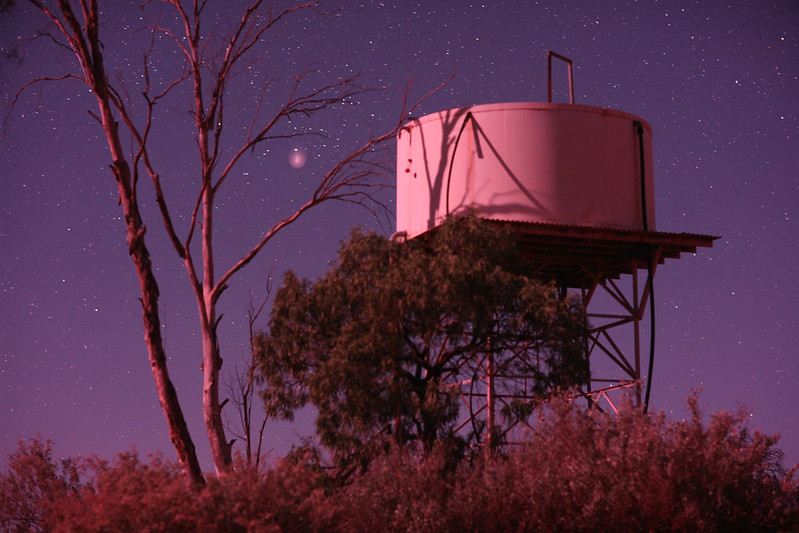 Comet 17P/Holmes in outburst from 2007. Image Credit: Joseph Brimacombe.
Comets give us an element of unpredictability, in an otherwise clockwork Universe. Be sure to follow Comet 220P McNaught through perihelion and beyond this weekend… it might just steal the celestial show this summer.