Universe Today
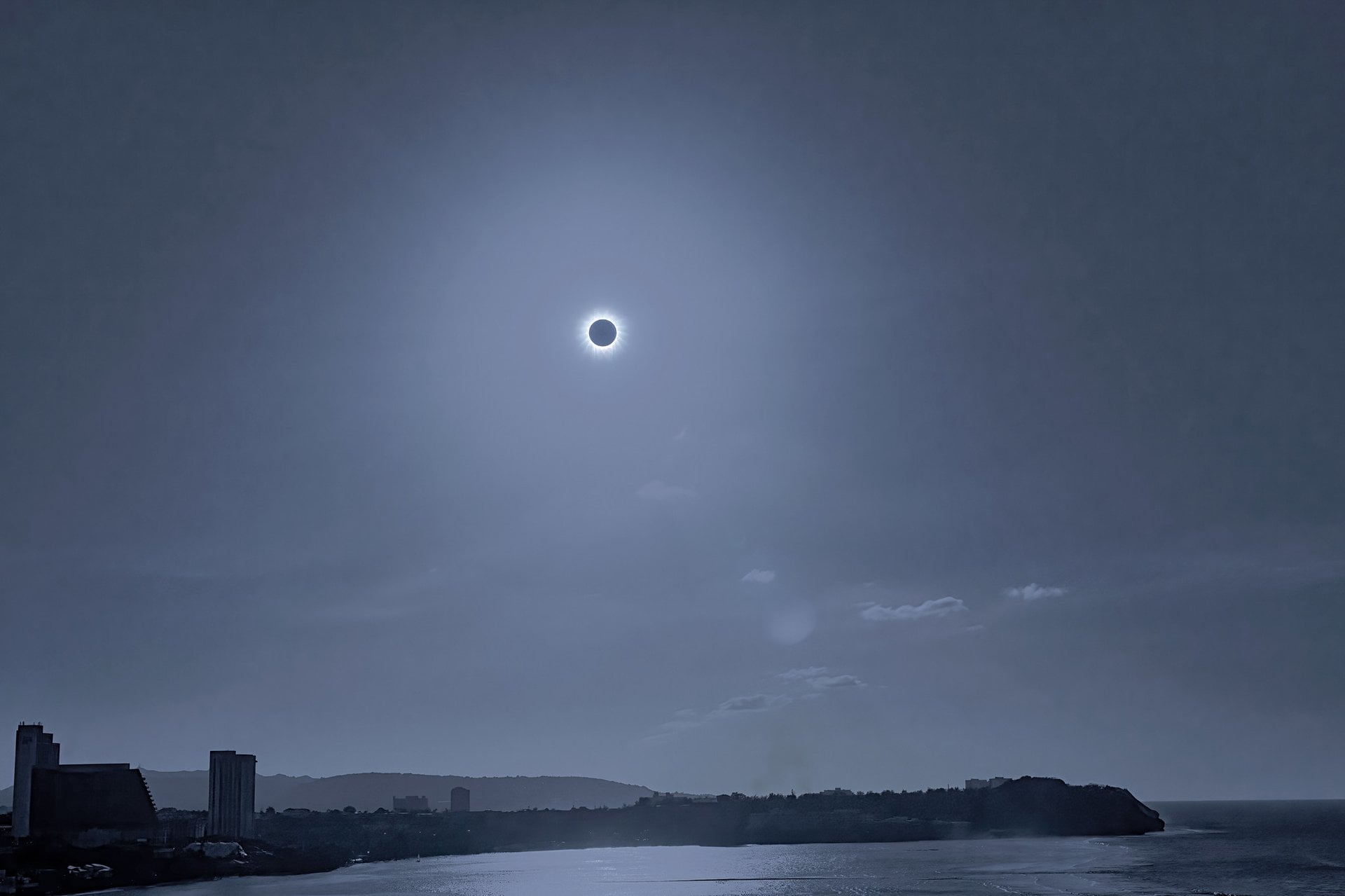
The coming year offers eclipses, occultations and much more.
Ready for another amazing year of skywatching? 2025 was a wild year with a steady parade of comets knocking on naked eye visibility, and one extra special interstellar comet, 3I/ATLAS.
The sky just keeps on turning into 2026. Watch for mutual eclipse season for the major moons of Jupiter, as the moons pass one if front of the other. The ongoing solar cycle is also still expected to be active into 2026 producing sunspots, space weather and more. And (finally!) we’ll see the return of total solar eclipses on August 12th, as umbral shadow of the Moon crosses Greenland, Iceland and northern Spain.
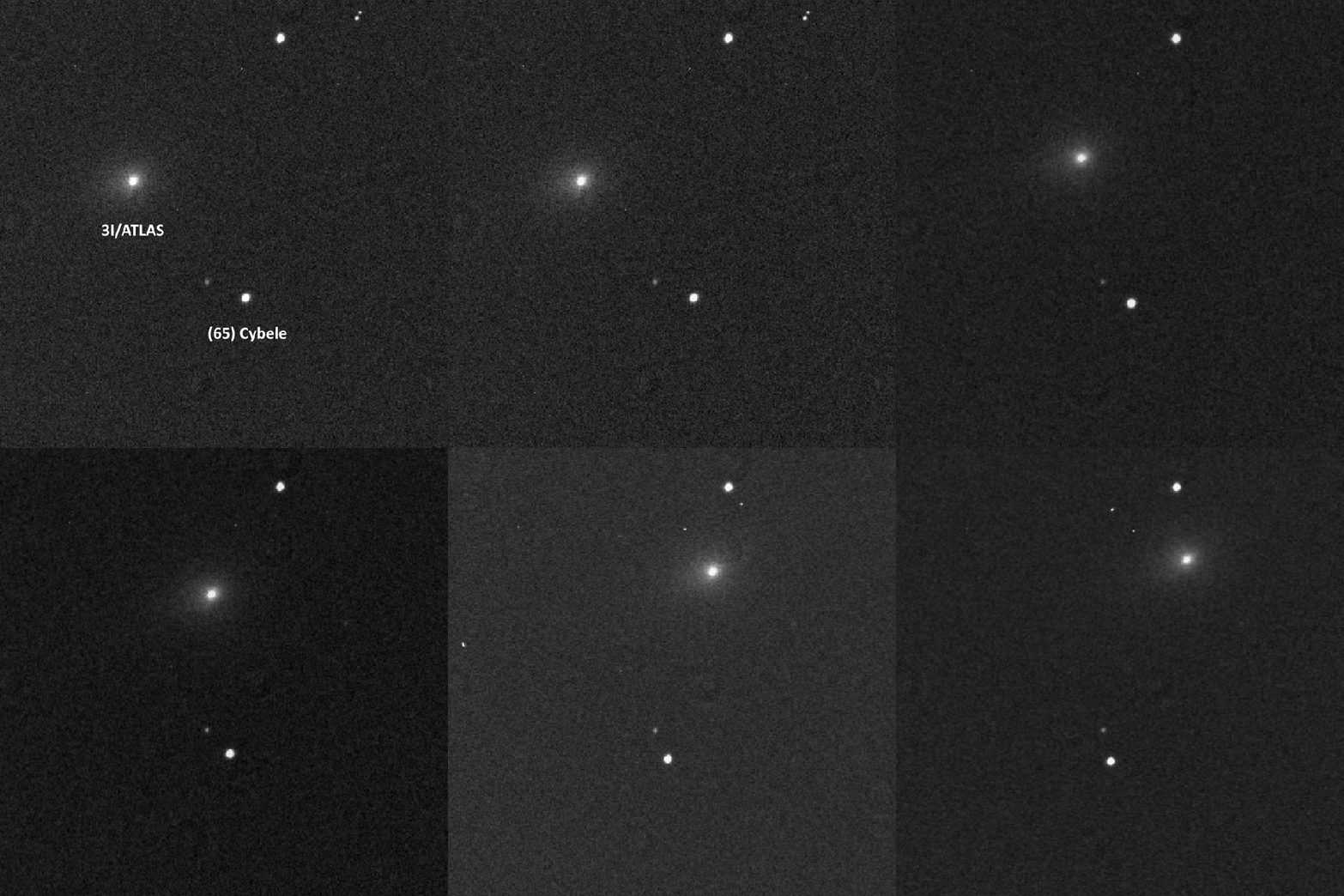 Comet 3I/ATLAS crosses paths with asteroid 65 Cybele. Credit: Filipp Romanov.
Here's a quick run down of the best of the best events to watch for in 2026:
-A total solar eclipse spanning the North Atlantic into Spain on August 12th.
-A return of totality with a total lunar eclipse for North America and the Pacific Region on March 3rd.
-Mutual eclipse-transit season resumes for the moons of Jupiter.
-Two fine dusk occultations of Venus by the Moon on June 17th and September 14th.
-The Moon occults Jupiter for eastern North America on October 6th.
-The Perseid and Geminid meteor showers both put on fine shows, with the Moon near New.
-The Moon occults Antares, Regulus and the Pleiades (Messier 45) worldwide.
-Saturn meets Mercury in the dusk sky on April 20th.
-Several fine lunar/planetary/stellar groupings occur in November, as the Moon slides by several planets and notable bright stars.
-A good binocular comet C/2025 R3 PanSTARRS makes a brief Spring 2026 apparition.
The Sun in 2026
We’re still coming off of the intense Solar Cycle 25 maximum in 2026, as we head towards the transition dip of solar minimum around 2030 into solar cycle 26.
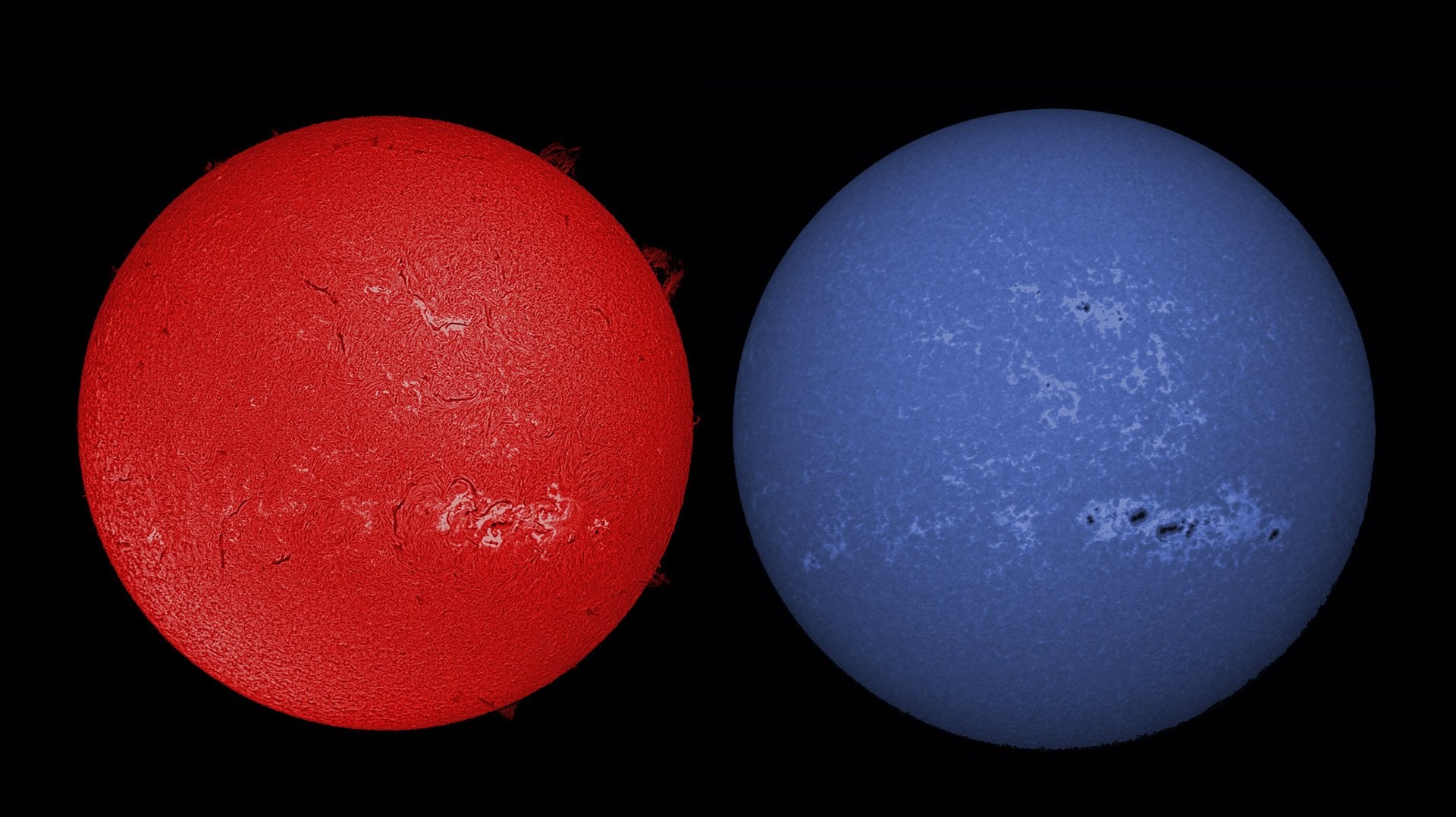 A massive sunspot graces Sol in 2025, as seen in hydrogen-alpha and calcium-k. Credit: Eliot Herman.
Sunspot activity is always a big unknown, as massive sunspots come and go. Here are the definite known phenomena for the Earth and Sun in 2026:
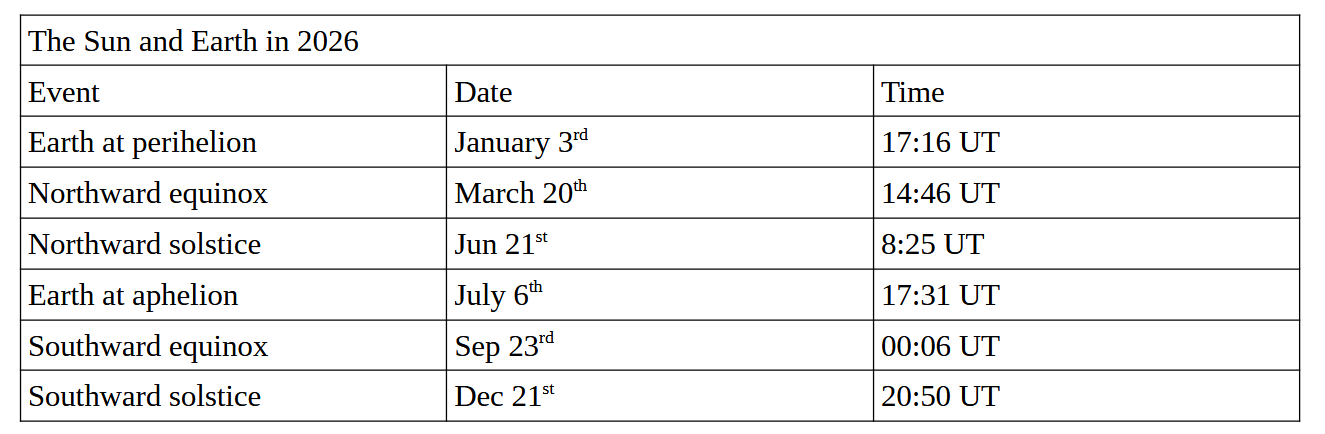 Sun-Earth phenomena for 2026.
The Moon in 2026
The path of the Moon is still transitioning in 2026, from steep versus the ecliptic plane in 2025 fresh off major lunar standstill. We're now headed back towards shallow and Minor Lunar Standstill in May 2034. This is due to the 5 degree tilt of the Moon’s orbit versus the ecliptic, assuring a cycle transitioning from hilly to shallow to hilly again. This 18.6 year cycle is what’s known as lunar nodal precession. The Moon is still swinging wide in 2026, and headed from wide north-to-south near the solstices.
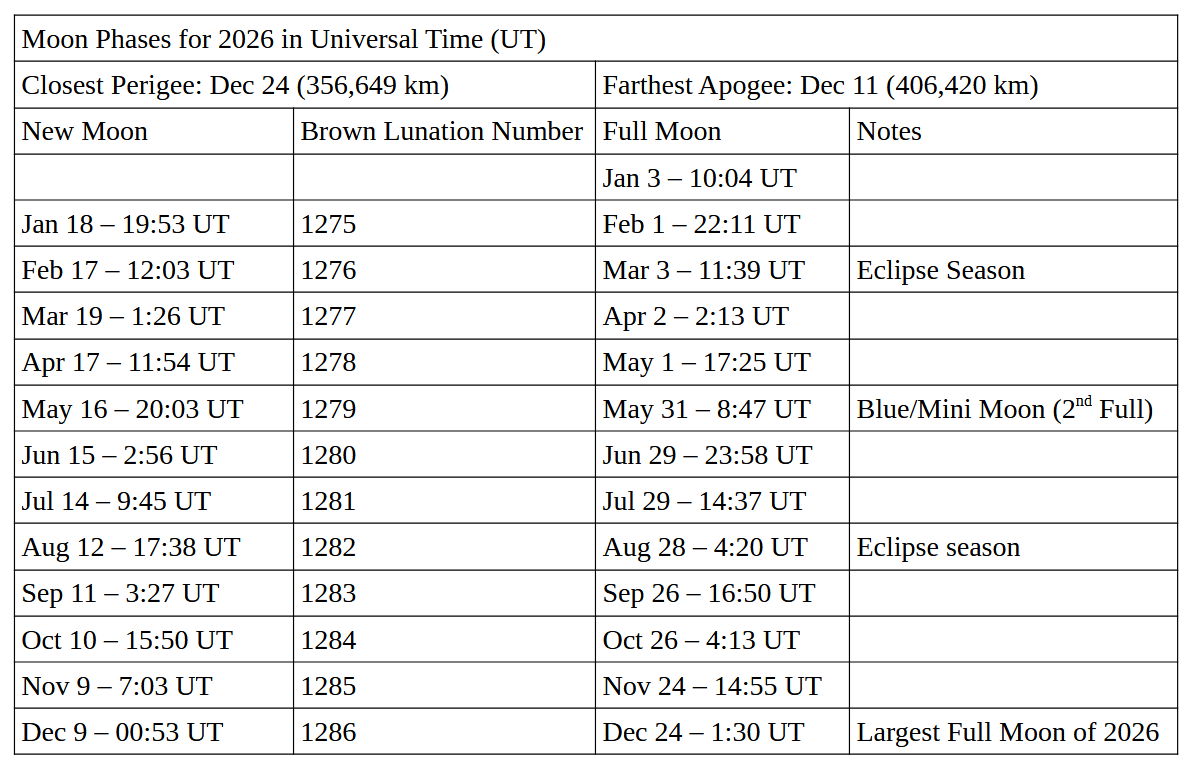 Moon phases for 2026.
Eclipses in 2026
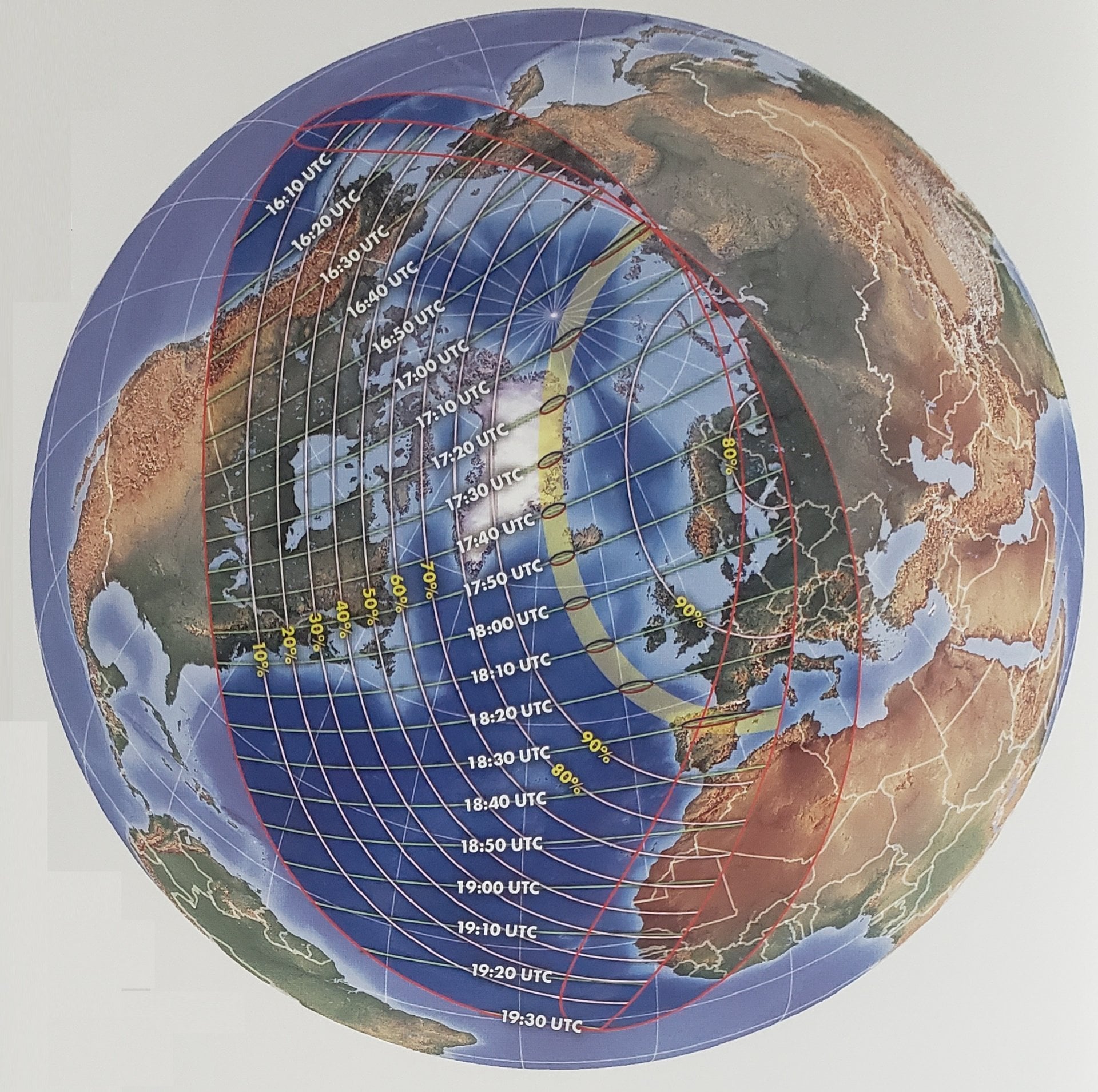 The eclipse path for the August 12th Total Solar Eclipse. From The Atlas of Total Solar Eclipses 2020 to 2045 by Michael Zeiler/Michael E. Bakich
2026 sees four eclipses (2 lunar and 2 solar) the normal minimum that can occur:
February 17th - An annular solar eclipse for the Antarctic.
March 3rd - A total lunar eclipse for the Americas, the Pacific, Australia and the Far East. Totality for this one is just over 56 minutes in duration.
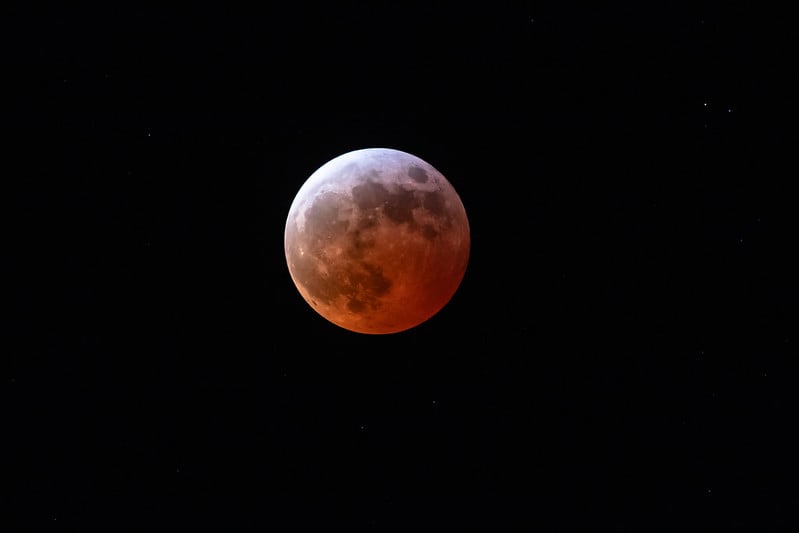 The March 2025 total lunar eclipse. Credit: Robert Sparks.
August 12th - A Total solar eclipse for Iceland, the North Atlantic and northern Spain.
August 28th - A deep (93% obscured) partial lunar eclipse for Africa, Europe, the Atlantic and the Americas.
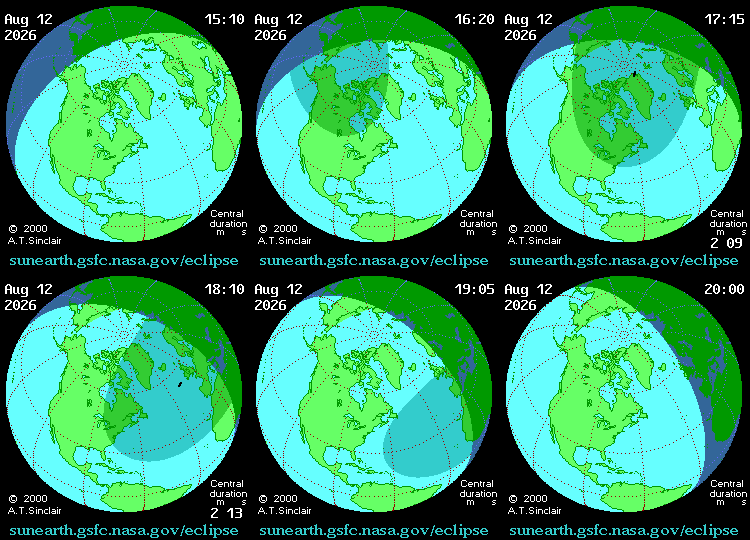 An animation of the August 2026 eclipse. Credit: NASA/GSFC/A.T. Sinclair
Lunar Occultations of Planets in 2026
The Moon occults 4 planets a total of 11 times in 2026: Mercury (1), Venus (3), Mars (3), Jupiter (4). Saturn is the only naked eye planet that eludes the Moon in 2026.
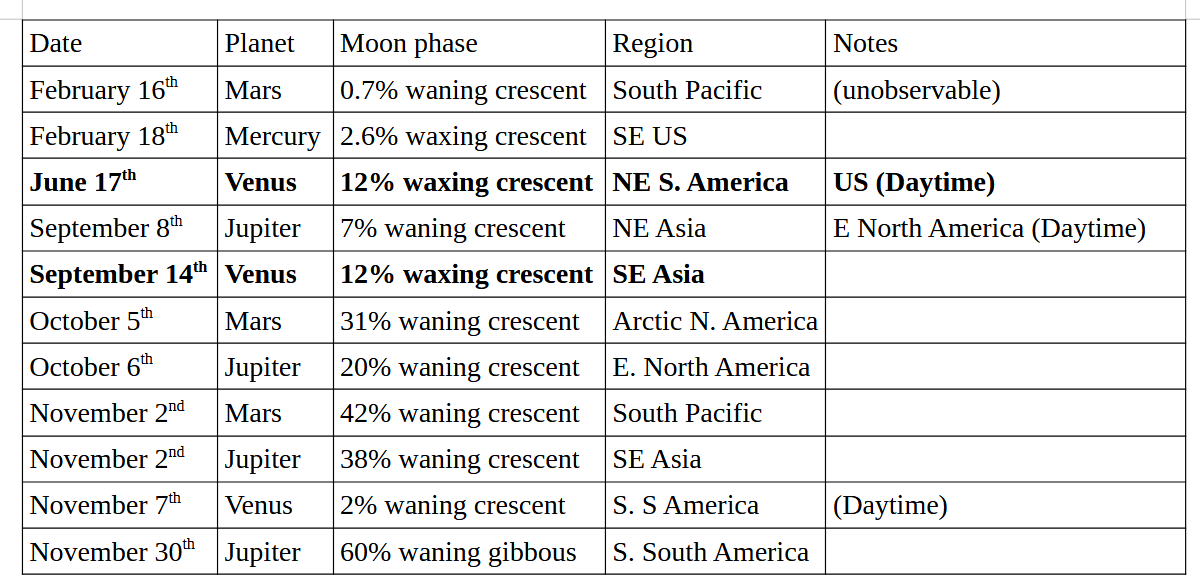 Lunar v. planet occultations for 2026.
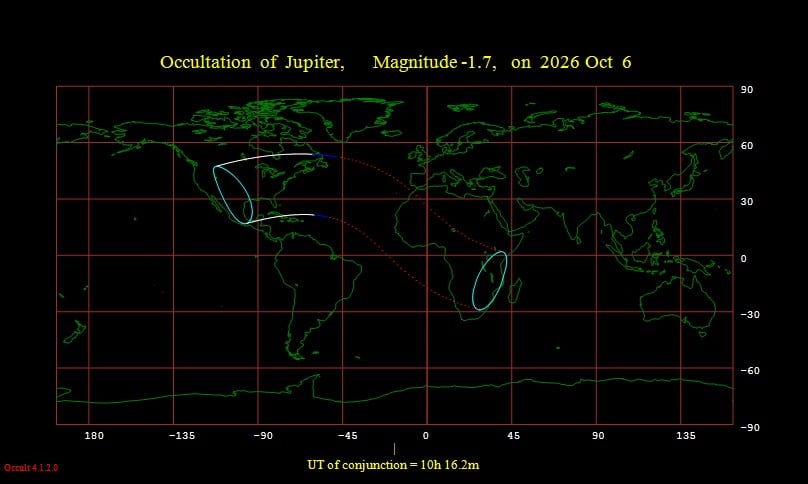 The October 6th occultation of Jupiter by the Moon. Credit: Occult 4.2.
Lunar Occultations of Bright Stars by the Moon
Two of the four +1st magnitude stars that the Moon can occult (Regulus and Antares) are visited by the Moon in 2026… Aldebaran and Spica sit this one out.
First, the Moon occults Regulus:
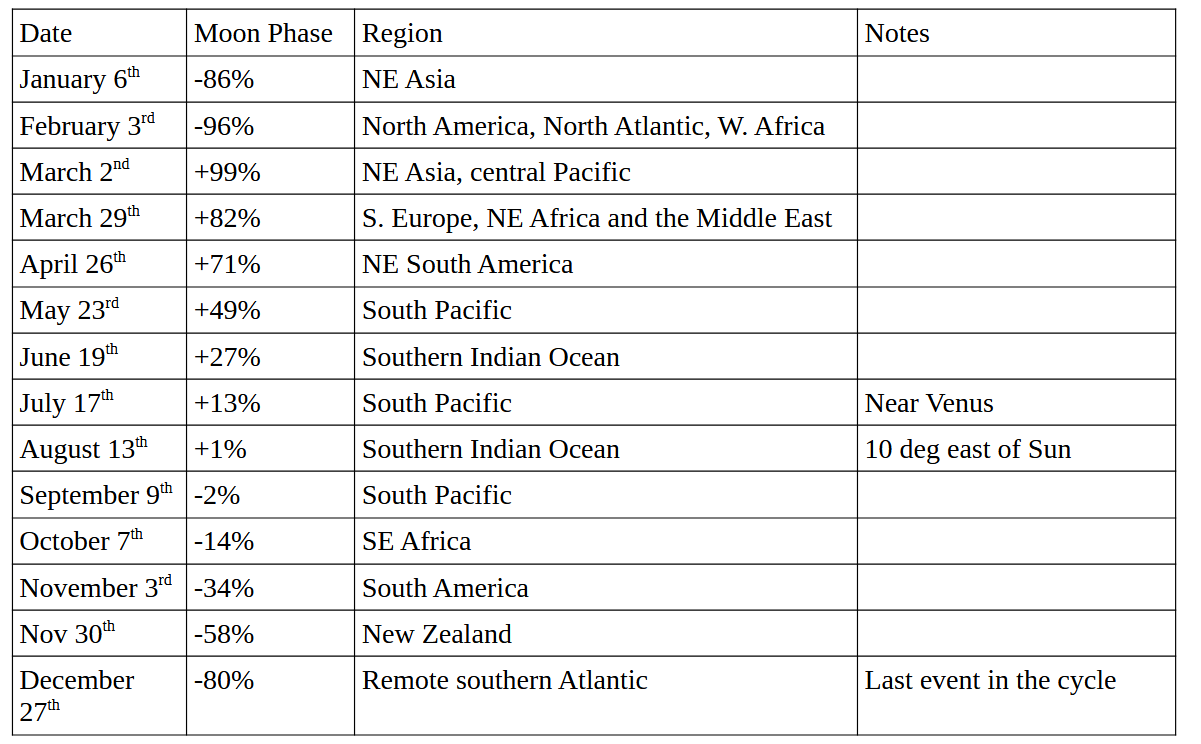 Lunar occultations of Regulus for 2026.
The Moon also visits Antares in 2026:
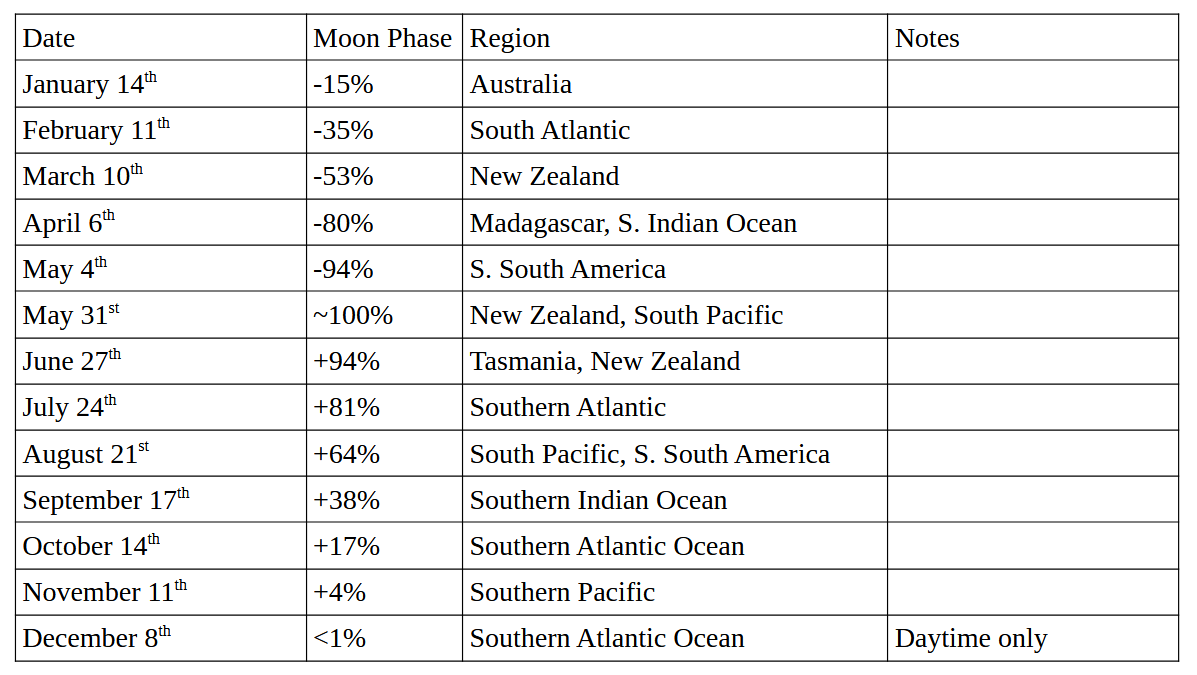 Lunar occultations of Antares for 2026.
The Moon also continues visiting the open cluster Messier 44 (Praesepe) and Messier 45 (The Pleiades), once per lunation in 2026.
Planets in 2026
Planets wander the ecliptic (hence the Greek name planetai, meaning ‘wanderer’) transitioning from the dawn to dusk sky and back again. Sometimes, they slide past each other as seen from Earth. Here’s the best planet-versus-planet conjunctions to look forward to in 2026:
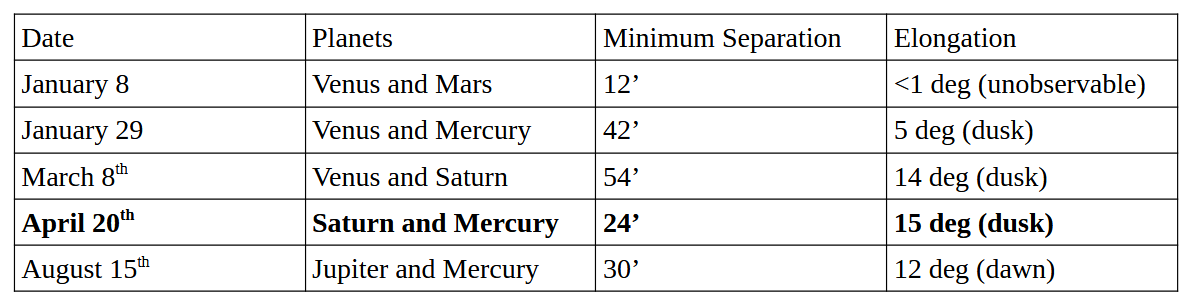 Planetary conjunctions for 2026.
The Inner Planets in 2026
Mercury reaches greatest elongation six times in 2026, three each in the dawn and dusk. Meanwhile, Venus passes solar conjunction on January 6th, and spends the rest of the year dominating the dusk sky before reaching solar conjunction on October 24th and reemerging once again in the dawn.
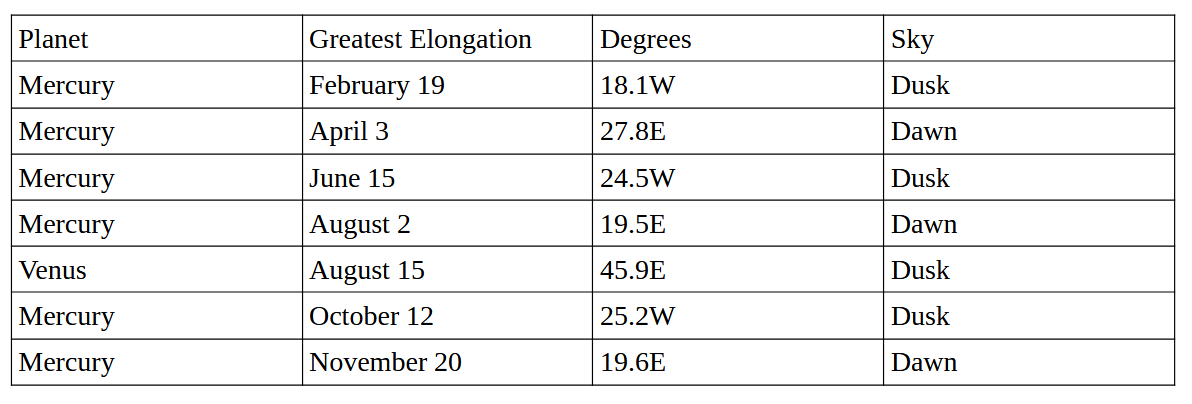 The inner planets for 2026.
Outer Planets in 2026
Planets beyond Earth’s orbit can reach opposition, rising ‘opposite’ in the east versus the setting Sun in the west. This also represents the best time to observe a given planet, as it passes closest to the Earth and remains above the horizon from sunset until sunrise.
Mars does not reach opposition until February 19th, 2027. Meanwhile, the average plane of Jupiter’s moons reaches its bidecadal edge-on point once again starting in late 2026, meaning the four moons will pass one in front of the other, eclipsing and occulting each other in a complex series of events. Finally, Saturn’s rings are gradually widening from edge-on in 2025, averaging 10 degrees open in 2026 and headed towards their widest tilt 27 degrees in 2031.
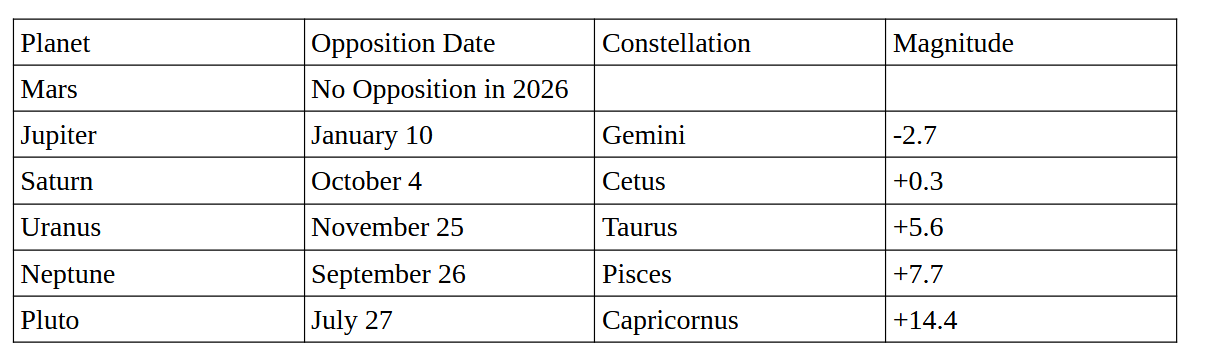 Oppositions for 2026.
Here are several key planetary groupings to watch for in 2026:
-June 16th: Mercury, Venus, Jupiter and the waxing crescent Moon at dusk.
-Nov 2-3rd: The waning, just past Last Quarter Moon passes Mars, Jupiter and Regulus, all in a row in the pre-dusk sky.
-Nov 7th: The waning crescent Moon groups with Venus and the bright star Spica at dawn.
-Nov 30th: The waning gibbous Moon groups with Mars, Jupiter and Regulus high in the pre-dawn sky.
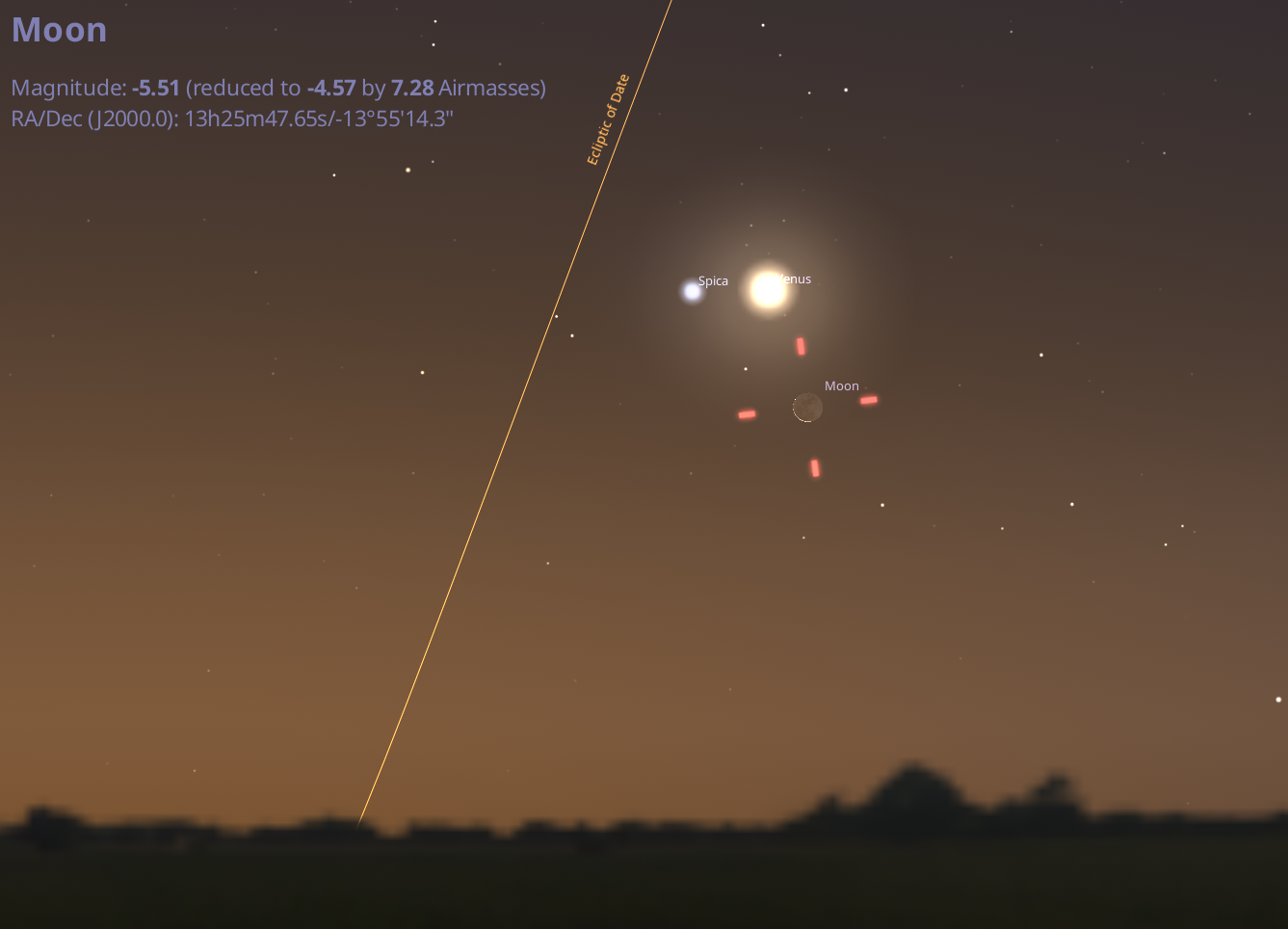 The Moon meets Venus and Spica on November 7th. Credit: Stellarium.
Three planets also transit the Messier 44 cluster in 2026:
-M44/Jupiter August 4th (but just 4 degrees west of the Sun)
-M44/Mercury August 14th (just 13 degrees west of the Sun)
-M44/Mars October 11th (70 west of Sun the Sun)
The Best Meteor Showers in 2026
About a dozen dependable meteor showers of the 110 known showers peak annually, as the Earth plows through streams laid down by their respective parent comets:
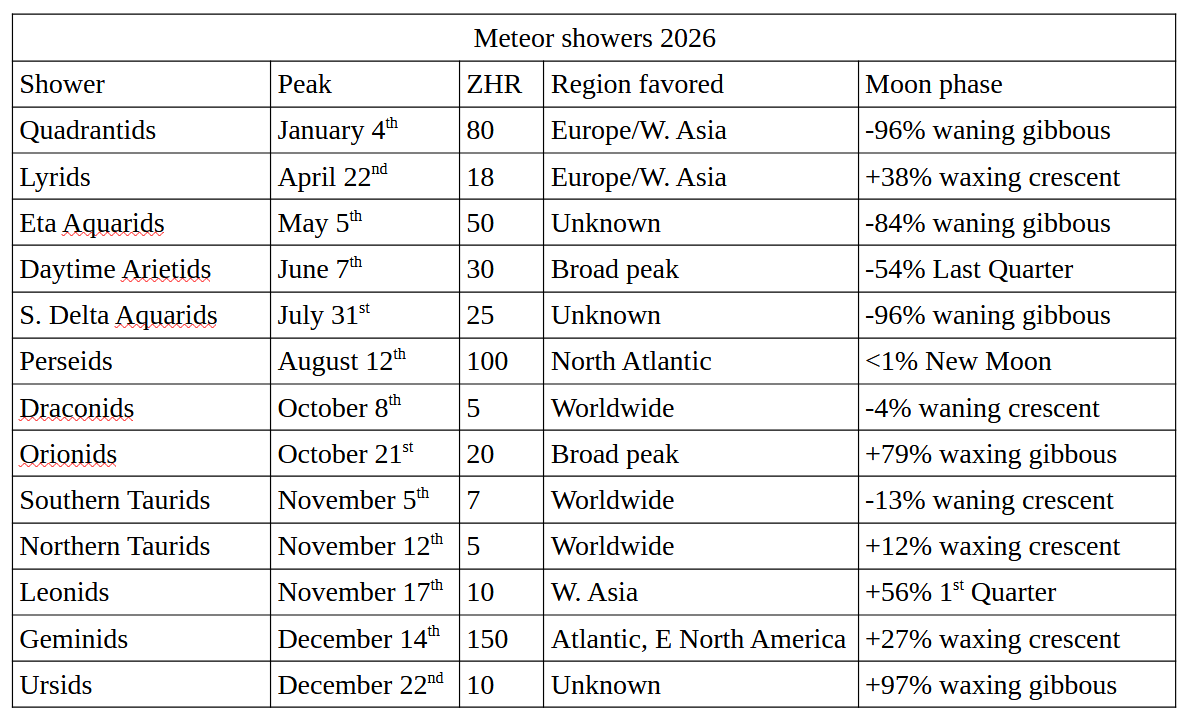 Top meteor showers for 2026.
Bright Comets in 2026
Bright comets for the coming year are always the big wildcard. As of writing this, there are only a half-dozen odd comets set to break +10th magnitude in 2026. Keep in mind, that could change very quickly if a bright new comet on a long period orbit makes itself known.
 Comet C/2025 A6 Lemmon as seen from Sa Calobra, Mallorca Spain. Credit: David Maimó.
C/2025 R3 PanSTARRS passes thru SOHO’s view from April 22-26.
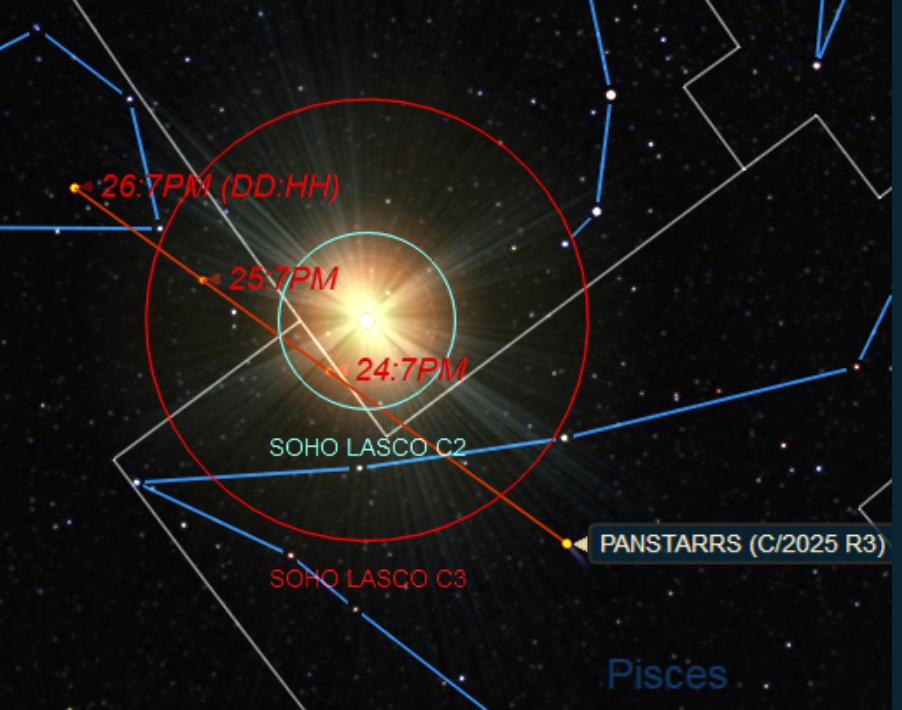 The path of Comet R3 PanSTARRS through SOHO's field of view. Credit: Starry Night.
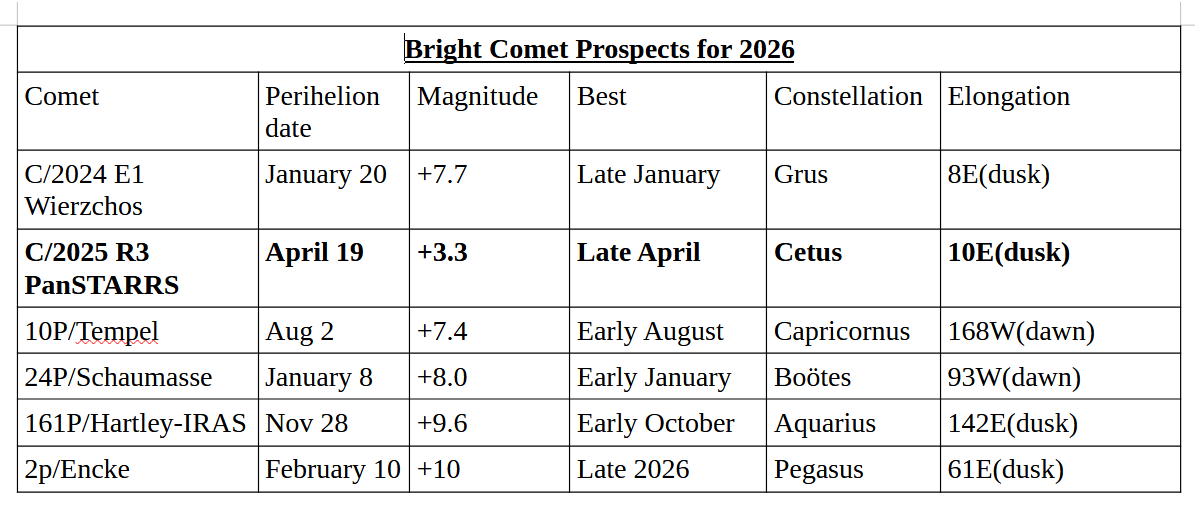 Best Predicted Comets in 2026.
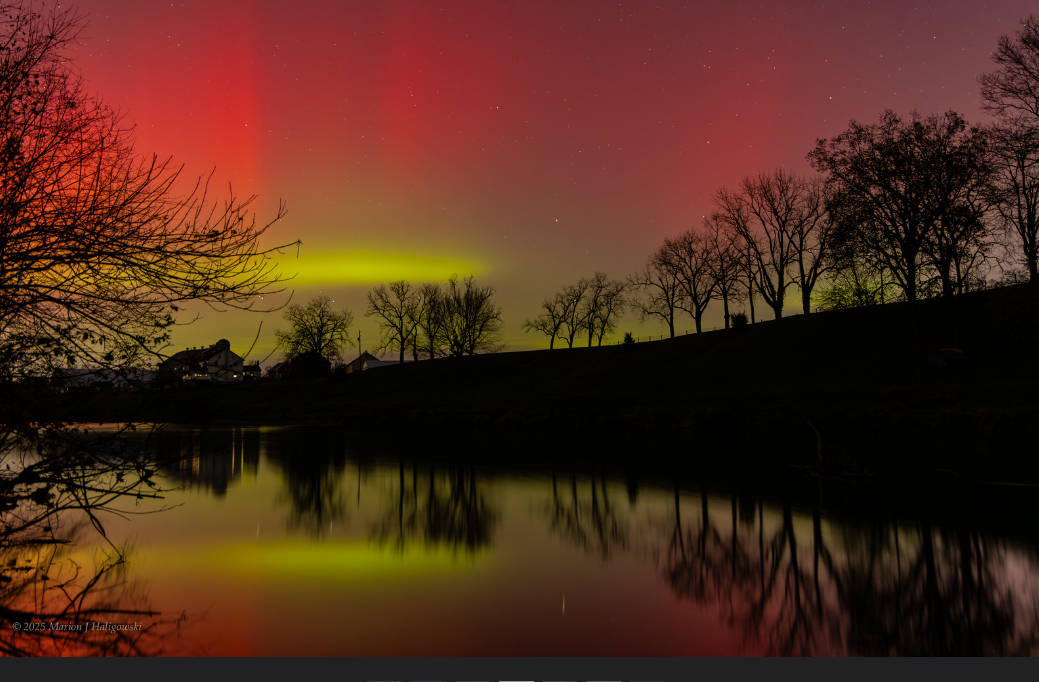 Aurora over Conestoga River from 2025. Will 2026 provide an encore? Credit: Marion Haligowski/Radical Retinoscopy.
And that’s just a brief look ahead, at what promises to be another fine year of skywatching in 2026.