 Universe Today
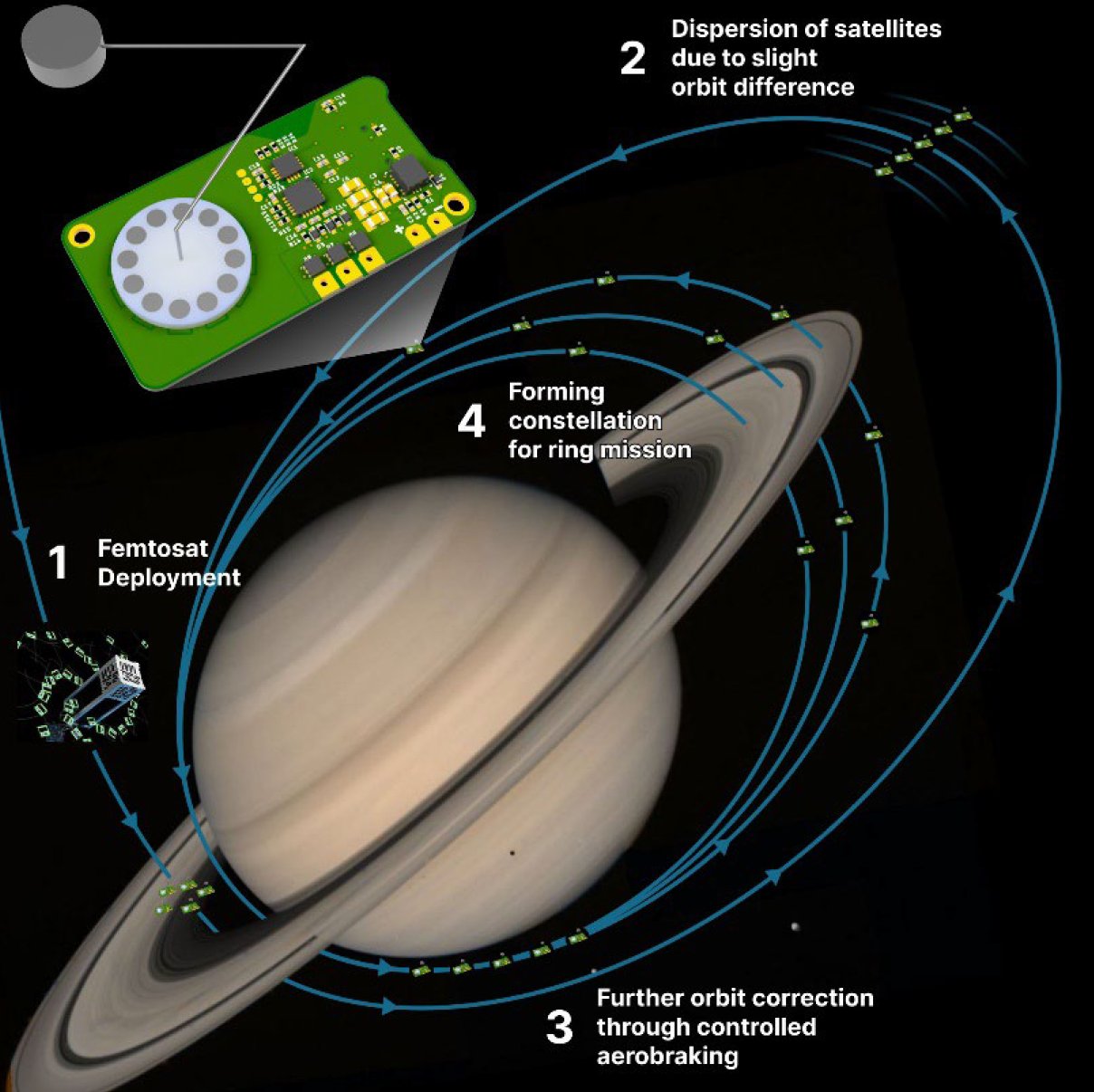
Cassini, NASA’s last major mission to Saturn, famously plunged to its fiery death in the gas giant’s atmosphere at the end of its mission. It had captured more accurate in-situ data of the Saturnian system than any mission before or since. But there’s one particular part that it couldn’t directly approach - Saturn’s rings. But NASA very obviously wants to take a nice up-close look at them, as they have recently funded a NASA Innovative Advanced Concepts (NIAC) Phase I grant to send a swarm of 10,000 highly expendable “femtosatellites” to get up close and personal with the most spectacular rings in our solar system.
The rings of Saturn are largely composed of water ice mixed with rocky material, with particles ranging from microscopic grains to chunks the size of houses. Despite the success of the Cassini mission, scientists still lack definitive answers regarding the exact age of the rings or the mechanics of how these ice particles collide and merge.
So what makes the ring so hard to visit in the first place? Let’s use Cassini as an example again. It actually flew in between the rings and the planet on its last few orbits, but if it had gone into the rings itself, it very well could have impacted a stray chunk of ice, destroying a multi-billion dollar satellite in the matter of a few seconds. No sane mission planner would take such a risk, and so Cassini never got up close and personal with the rings, even as it was about to plunge to its death.
Fraser talks about where Saturn’s rings came fromOn the other hand, if you had 10,000 identical satellites, even the most risk-averse mission planners would begin to think losing a few of them is OK. Honestly, even losing a few thousand of them is OK at that scale, since there would still be thousands more capable of continuing on with the mission. That is the basic premise behind the NIAC proposal titled “Actively Steerable Femtosat Constellations for In-Situ Exploration of Saturn’s Rings, Atmosphere, and Magnetosphere”.
Dr. Michael Rubenstein, the PI behind the project, is a world-known expert in swarm robotics. His most famous project is likely the Kilobot project - a swarm of over 1,000 tiny robots that can autonomously communicate and form complex shapes. Applying that knowledge of small, coordinated robotics to space lands him square in the realm of the femtosat. In July 2026, NASA announced this project as one of 18 early-stage concept awards, totaling $3.2 million in funding. Each Phase I award provides up to $175,000 for an initial nine-month investigation into these breakthrough technologies.
A femtosat is, simply put, a very small satellite. They leverage the extreme miniaturization of electronics that has been ongoing as part of the smartphone industry. While they haven’t yet been formalized in the way CubeSat sizes have been, a typical femtosat (which are also commonly called chipsats or “Sprites”) weighs only a few grams and is only a few centimeters across.
Fraser talks about Cassini’s Grand FinaleThey aren’t just science fiction either. In 2019, the KickSat-2 mission deployed 105 Sprites into Low Earth Orbit, where they proved they can actively communicate with ground controllers. However, for that mission the femtosats didn’t have any propulsion, and were left to the whims of the Earth’s atmosphere for the trajectory.
In Rubenstein’s proposal, it's very clear the 10,000 femtosatellites will have some form of active steering - indeed that requirement is right in the name. As of now, it’s unclear what exactly that steering mechanism would be. It could be anything from microthrusters to electromagnetic tethers feeding off of Saturn’s chaotic magnetic fields. But that active propulsion gives the whole mission capabilities that are unmatched by any single craft mission.
Thousands of femtosats could dive inside the rings, providing the first-ever in-situ look at their kinetic behavior and answering lingering questions about when they formed. At the same time, thousands more could dive into different parts of Saturn’s upper atmosphere—covering different locations across its surface all at the same time, allowing for more accurate weather forecasting on our ringed neighbor. And that magnetic field that is so chaotic? At the same time, thousands more femtosats could be monitoring it from different orbits and different altitudes.
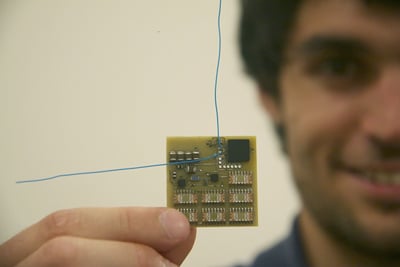 Example of a femtosat used in the KickSat project. Credit - Rebecca Manchester / Cornell University
But the rings seem to be NASA’s main focus for this mission concept. In fact, they are so focused on them they even funded another NIAC grant with a similar end goal but using a very different concept. A project by the Jet Propulsion Laboratory’s Macro Quadrelli proposes a mothership that hovers above the ring system and extends an AI-guided boom to “touch and go” the ring system like a sport fisherman would. The mission, known as the Planetary Rings Autonomous EXploration with In-Situ Sampling (PRAXIS) shows how interested NASA is in taking a close-up look at these planetary marvels.
To be clear, it’s going to be awhile before we see either mission visit Saturn. NIAC Phase I proposals are meant to fund early stage concepts, and typically last about a year, with the expectation that there would be a multi-year Phase II project to follow. Even then, any such concept would need years more funding to reach its actual launch date, and then years more to reach the planet itself. So at the earliest, such a mission would probably be looking at the 2040s to start science operations. But that is exactly the point of NIAC in the first place - take long-shot bets that will pay off decades hence. And in the meantime, if they fund some awesome work on robotic swarms, the better off we all are for it.
Learn More:
NASA / Michael Rubenstein - Actively Steerable Femtosat Constellations for In-situ Exploration of Saturn’s Rings, Atmosphere, and Magnetosphere
UT - Saturn's Rings Might Be Really Old After All
UT - Using Saturn's Rings to Figure out What's Inside the Planet

