Universe Today
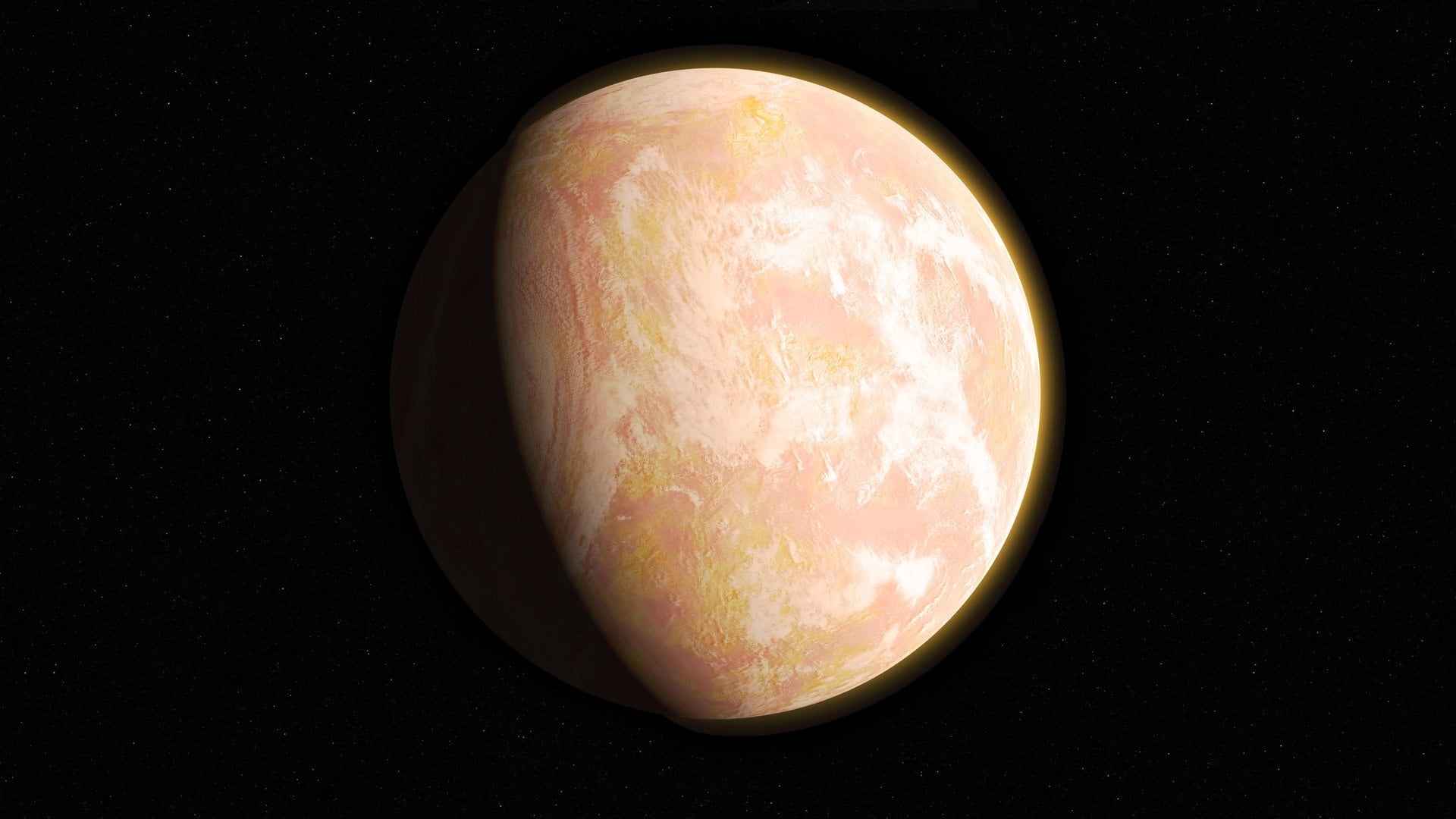
Push back the tape of Earth's history, and both geologists and astrobiologists remain roundly perplexed as to the environmental conditions of our earliest Earth. That's because conventional pathways for understanding Earth's history have been lost in time due to our planet’s own active geology and atmospheric weathering.
But in an ingenious new move, Jared Landry, an astrobiology PhD student at the Earth Life Science Institute in Tokyo (ELSI), has begun to marshal an analysis of nearside Apollo lunar surface samples to counterintuitively use as a mirror onto early Earth.
Previous studies have suggested gases from Earth’s upper atmosphere have been deposited and recorded on our Moon’s surface for billions of years, Landry noted in a paper given at the recent Origins 2026 conference in Paris.
That’s because these chemical species are subsequently ionized (or become electrically charged) before being picked up by our Sun’s magnetized solar wind. And although this has been an eons-long process --- which is still ongoing, Landry is focused on an epoch some 3.5 billion years ago. That is, during the Archean Eon, a period spanning 2.5 to 4.0 billion years ago.
The Archean is one of the biggest unknowns, especially in atmospheric chemistry, Landry told me in Paris.
Why is this important?
Understanding Earth’s atmosphere is key to constraining the environment in which life emerged and evolved, Landry noted in his paper. That’s because surface processes, molecular concentrations, and climate are all heavily influenced and controlled by atmospheric composition, he noted.
The mechanism by which these chemical species escape Earth’s atmosphere rests in a unique outflowing channel through which our Moon passes during a portion of its orbit.
The Moon is only in that outflow channel for a fraction of its orbit, so Landry had to account for that to determine how much material was leaving Earth's atmosphere and striking the moon’s lunar surface during this Archean epoch.
The Takeaway?
The main takeaway from my research is that lunar samples support the hypothesis that the Archean atmosphere was more sulfur rich than today, Landry told me at the conference. This allowed many relevant prebiotic and biotic pathways to emerge in an aqueous environment, he says.
As a result, the Archean ocean was likely supplied with significant levels of sulfur, favorable for the synthesis of complex organics. The big difference is that Landry’s model points to the Archaean atmosphere as having roughly a hundred times the amount of carbon dioxide than today.
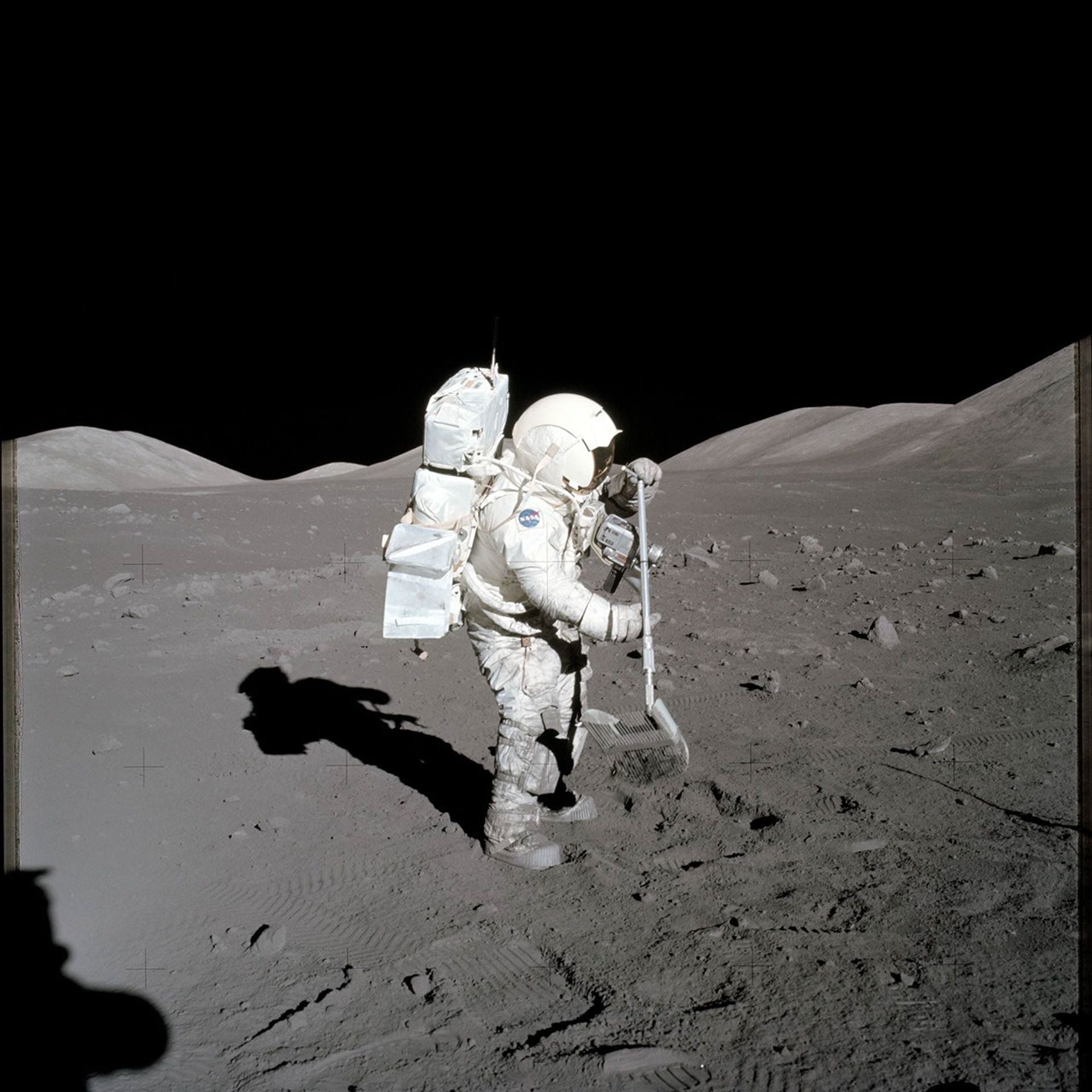 Scientist-astronaut Harrison H. Schmitt, lunar module pilot, collects lunar rake samples at Station 1 during the first Apollo 17 EVA (extravehicular activity). Credit: NASA
Overcoming The Faint Sun Paradox
Because our Sun was much less luminous 3.5 billion years ago, previous studies have estimated that to overcome the effects of a faint young Sun and for Earth to have had a liquid ocean, our planet would have needed about a tenth of an atmosphere of the greenhouse gas carbon dioxide, Landry noted in his conference presentation. And Landry’s model predicts that Earth had just under that amount during this epoch during the Archean.
Landry also had to factor in the flow of the ancient solar wind, as well as the amount of granular meteoritic material making its way to the lunar surface.
Landry’s model calculates for a single Apollo lunar surface sample from all these different sources, and it says the extra source must be from the Earth, and it must be this much.
The samples suggest a high carbon dioxide and methane abundance, strong enough to overcome the faint young Sun and sustain a liquid ocean, says Landry.
It's difficult to sustain all that sulfur, so there must have been some process happening that isn't happening today to not have sulfur dissolve into the oceans, says Landry. You either need to have low hydrological activity or a cool environment, and we don't have that today, he says.
All the lunar samples from the Apollo missions came from the near side, which would have received flux from Earth, says Landry. So long as the sample has an age associated with it, you really don't care from where on the nearside it came, he says.
What’s Next?
To determine exactly how warm the Archean must have been, and exactly what the ocean would have looked like, says Landry.
The bottom line is to determine which chemical species would be present and to what sort of prebiotic chemistry this would lead. This sort of analysis is possible for any terrestrial body system and may be applied to Mars and moon of Phobos, and potentially to the icy moons of the outer solar system, Landry notes in his paper.
As For Earth?
Could our planet’s prebiotic chemistry been further along than expected 3.5 billion years ago?
Maybe not further along, but different, says Landry. Sulfur is probably underappreciated and lots of people are working to figure out the role it played in the onset and development of life here on Earth, he says.