Universe Today
 *UF laser origami research could shape future moon construction. Credit: UF*](/article_images/laser-wide-resized_20260610_220417.jpg)
Between NASA's Artemis Program, the Russo-China plans for an International Lunar Research Station (ILRS), and the ESA's long-term goal of establishing a Moon Village, the message is clear: We're going back to the Moon, and this time, to stay! For NASA especially, things are ramping up after the successful flight of the Artemis II mission and NASA Administrator Jared Isaacman's recent announcement that NASA will build a Moon Base by the 2030s.
The challenges of building on the lunar surface are well known, and this has led to some creative solutions. A popular approach is sintering, a form of 3-D printing in which lasers fuse feedstock (in this case, lunar regolith) into building materials. At the University of Florida, researchers are exploring how lasers could help astronauts turn the local soil into glass and ceramic, which would then be used to build a lunar base. Their approach has earned the nickname "origami" because of how it folds materials without needing additional machinery.
The work is led by Victoria M. Miller, Ph.D., an associate professor in the Herbert Wertheim College of Engineering and researcher with the UF Astraeus Space Institute. Her team consists of Nathan Fripp, Tianchen Wei, and Benjamin A. Begley, researchers from the UF Department of Materials Science and Engineering. Their research paper, "Controlling the Pre-bending Delay During Laser Sheet Metal Forming Under Different Atmospheres," appeared in late April in the journal Springer Nature Link.
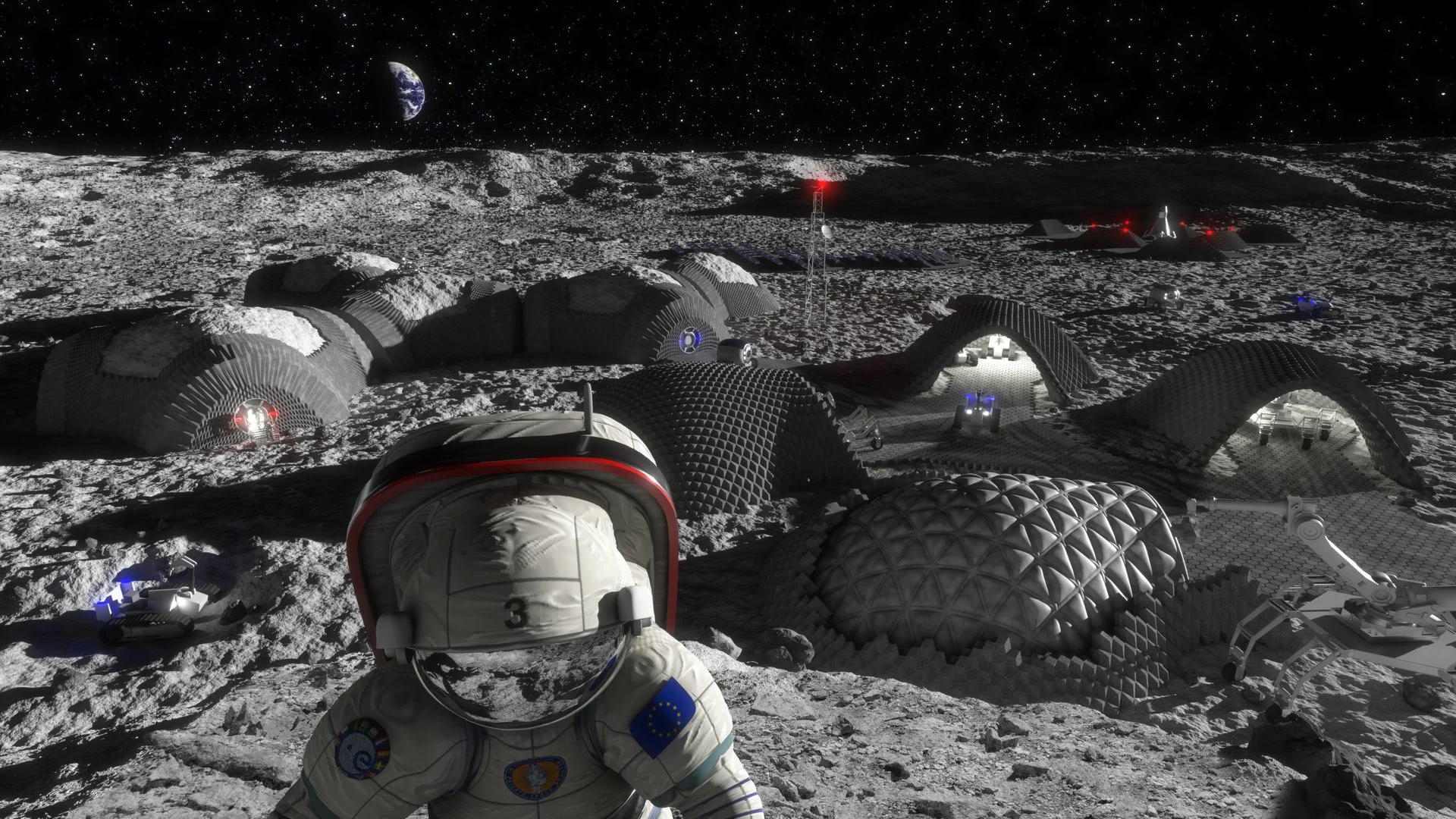 A vision of a future Moon base that could be produced and maintained using 3D printing. Credit: ESA/RegoLight/Liquifer Systems Group
The team recently completed a DARPA-funded research phase focused on a manufacturing process known as laser forming. This process uses lasers to bend materials without physical contact, and the team investigated how atmospheric conditions would affect its performance. This is a vital question, given that the technology is part of a larger effort to establish space manufacturing in orbit and on other celestial bodies with very tenuous atmospheres (such as the Moon).
Laser forming offers many opportunities for building in space because it is lightweight and flexible, thereby reducing the cost of launching components. In short, the process uses concentrated infrared lasers (heat) to bend materials into new shapes without molds, heavy machinery, or direct physical force. During the research phase, the team tested the technology on lunar regolith and rock simulant, which proved highly successful in bending lunar glass.
As Miller stated in a UF News release, this helps overcome the limitations of conventional construction, which are far more significant in space:
So when we build things on Earth, we have machinery. And just massive amounts of machinery and weight and volume are not really constraints when we’re doing conventional manufacturing on Earth. If we have to take tools, tools are heavy, and they are big, and it costs a ton of money and a ton of resources just to get stuff into space. One of the experiments that we did, was having a collaborator make a piece of glass out of lunar soil simulant. And then we used our laser bending technology to bend the lunar glass.
This technology is very much in line with the philosophy of In-Situ Resource Utilization (ISRU), where local resources are leveraged to reduce reliance on heavy payloads and resupply missions. With laser forming and other 3-D printing methods, astronauts would be able to fabricate building materials on-site rather than sending heavy prefabricated structures from Earth. The team is also exploring how laser forming could expand manufacturing possibilities beyond traditional materials.
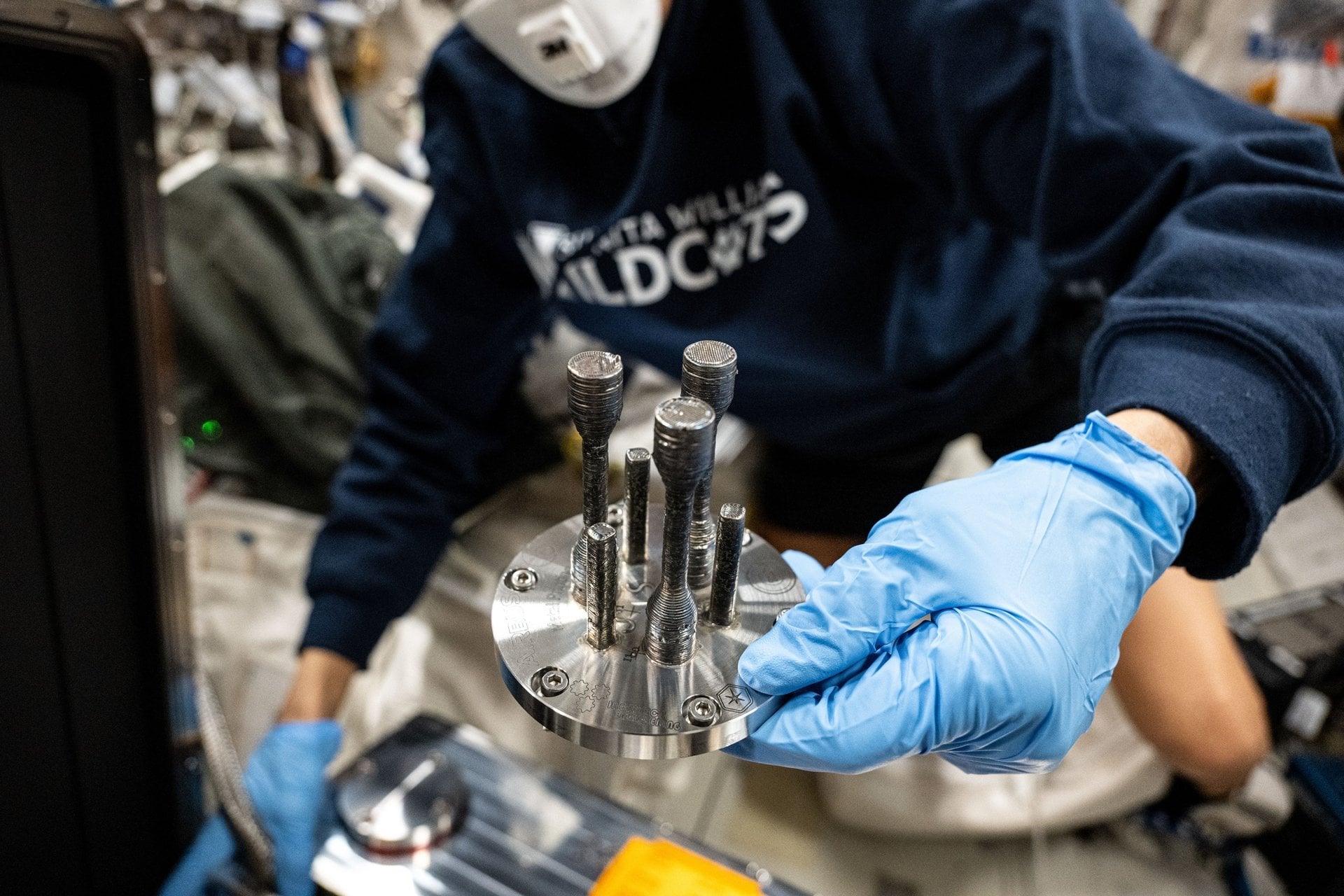 In 2024, the ESA's Metal 3D Printer aboard ISS produced the first metal part ever created in space. Credit: ESA
Such capabilities could present new opportunities for in-space manufacturing, where traditional tools are impractical. According to Miller, the project reflects the University's expanding role in space research and a broader, collaborative, future-oriented vision:
The thing that I’m most excited about is that we can bend basically anything. I haven’t found a material that we can’t bend yet, even glass. I think that this research reflects the direction of space research at UF because it is collaborative and future-looking. Looking at how we can build things on the moon, build things on Mars, and how we can actually make sure that astronauts stay safe and healthy.
Laser forming could also allow astronauts to manufacture tools and replacement parts in orbit or on the Moon, eliminating the need for transporting large amounts of both from Earth. As astronauts who have lived and worked aboard the International Space Station (ISS) will attest, if something breaks down in space, it is burdensome to carry multiple spares for every part. The same applies to tools, which are required for regular maintenance and are sorely missed when they break and run out.
In keeping with the philosophy that "Solving for space solves for Earth," the technology also has applications beyond space exploration, potentially supporting flexible manufacturing on Earth. As Miller indicated, the UF team is also focused on flexible manufacturing for defense applications, but that is only one of many possible uses for the technology. Quite literally, any form of manufacturing could benefit from this technology, including housing construction.
Amid continued population growth and the specter of Climate Change, lightweight, flexible forms of fabrication that are also more efficient than traditional methods would be a boon for all concerned.
Related:
- Laser-Based 3D Printing Could Build Future Bases on the Moon
- Metal is 3D Printed on the Space Station,
- 3-D Printing on the Moon. From Regolith to Paste to Useful Objects and Structures
- NASA Tests Prototype 3D Printed Titanium Spring in Space
Further Reading: UF News