Universe Today
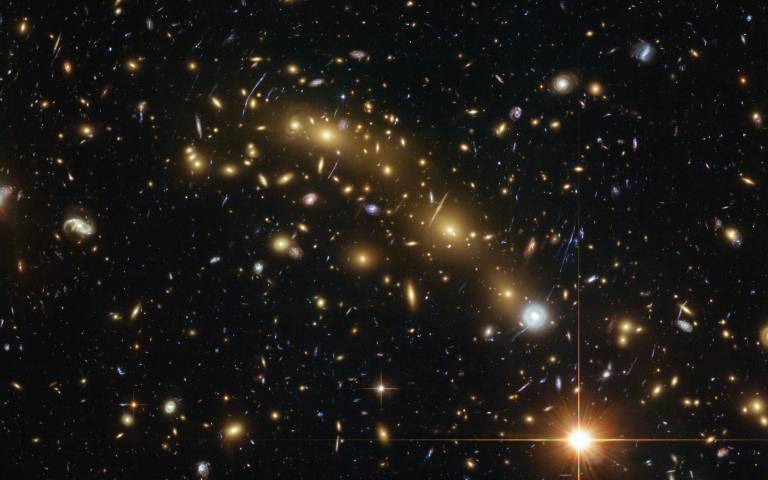
After only four short years, NASA’s James Webb Space Telescope (JWST) and observational cosmologists like Richard Ellis at University College London (UCL) have pushed the cosmic lookback time to an era when the universe’s very first stars and galaxies are within observational reach.
A recent multi-spectral JWST survey of thousands of objects using 150 separate narrow sight lines over 0.6 square degrees of sky shows a steep drop in galaxy formation at only 150 to 200 million years after the big bang.
That’s an observational area only about three times that of a full moon.
But the study of galaxies out to the earliest times affords a unique window into the initial conditions that set the stage for the formation and evolution of the chemical abundances, supermassive black holes (SMBHs), and large-scale structures we see today, as the authors of a 2026 paper appearing in the journal Monthly Notices of the Royal Astronomical Society note.
Inspired by the ability to look back in time, Ellis himself began his research of the distant universe as an undergraduate some 58 years ago. In 1968, high redshift meant luminous quasars --- now known to be active galactic nuclei (AGN).
We didn't have big telescopes, and we were still using the photographic plate, Ellis, a professor of astrophysics at UCL, told me in his office.
A redshift of 3, which was where quasars were being found, corresponds to the universe expanding by a factor of four.
That really is taking you back before the solar system was formed to a period when the universe was about a third of its present age, says Ellis.
But in 1995, Ellis was the only European-based member of the Hubble Space Telescope and Beyond Committee, which made the scientific case for what became the 6.5-meter infrared JWST.
We've pushed the frontiers back to when the universe was only 200 million years old and learned so much about how the universe evolves, says Ellis. We're beginning to see the glimpse of what we call cosmic dawn, the moment when the very first galaxies emerge from darkness, he says.
How Do These Galaxies Form?
As the universe expanded and cooled, then the hydrogen atom eventually formed, but the universe was dark, the gas clouds were there, but they weren't shining, says Ellis.
But these gas clouds soon collapsed around the early cosmos’ plethora of dark matter.
Eventually those gas clouds got hot and ignited nuclear burning, says Ellis.
These early galaxies are tiny; some thirty times smaller than our grand spiral Milky Way galaxy and only 60 to 70 light years across. That’s more on the scale of a stellar globular cluster, rather than a full-blown galaxy.
Although they are physically very small, they're producing stars 20 times faster than the Milky Way, says Ellis. So, they're being seen at a remarkably youthful and energetic period in their activity, he says.
Connecting the dots between these early objects and majestic spirals like the Milky Way Galaxy and the nearby Andromeda Galaxy is one quest of understanding all galaxy evolution. But the holy grail is to find short lived so-called Population III stars don't have heavy elements, only hydrogen and helium.
The massive ones only live maybe 5 million years before they explode, and of course, once they explode, they pollute the gas with heavy elements, so they're no longer chemically pristine, says Ellis.
It’s still going to be a scientific slog to confirm that any given galaxy or galaxies is the first to have formed. There are essentially three current methods for pinpointing cosmic dawn.
The discovery of a population of chemically pristine galaxies un-polluted by supernova explosions.
This is very challenging as you must unequivocally demonstrate the absence of oxygen emissions, says Ellis.
Trace the declining abundance of star-forming galaxies with increasing redshift and at a certain point locate a steeper decline.
Trace the declining chemical abundance (e.g. the ratio of oxygen to hydrogen) with increasing redshift.
This requires a lot more spectra than we currently have but perhaps is the most promising route, says Ellis.
There’s also another route to finding cosmic dawn which doesn’t involve conventional space-based or ground-based telescopes. That is, looking for the Lyman alpha signature of hydrogen gas at cosmological distances. The forthcoming Square Kilometer Array (SKA) in West Australia has a chance to make this detection in the radio spectrum.
When galaxies first lit up the universe with starlight, gas clouds are heated and emit the strongest spectral line of hydrogen which is the so-called Lyman alpha line.
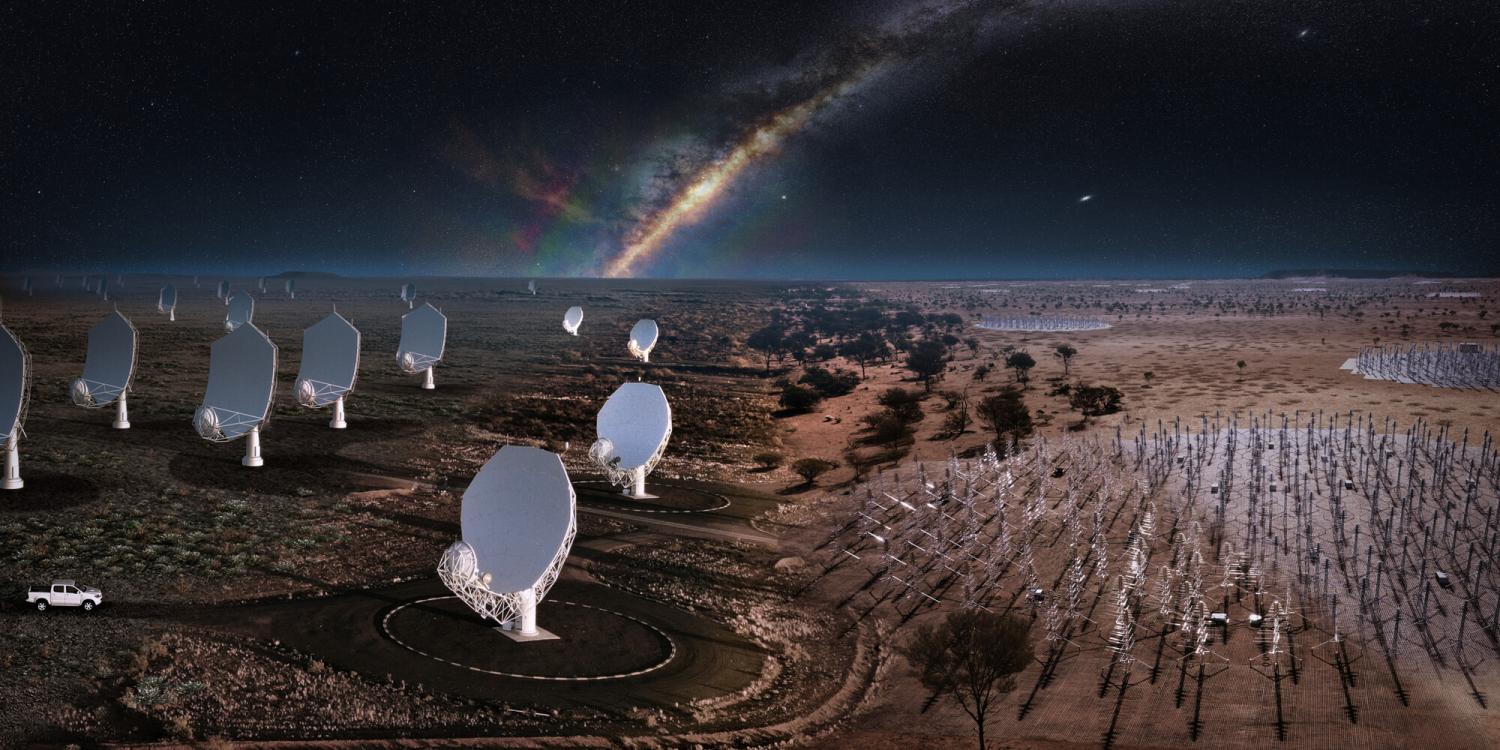 A composite image of the future SKA telescopes, blending what already exists on site with artist's impressions. Credit: SKA Observatory.
A Cosmic Correlation
There’s an interesting resonance between this Lyman alpha line of hydrogen and the 21cm radio ground-state line of hydrogen when this most fundamental of all elements is at its most stable, lowest possible energy level.
As a result, Ellis and colleagues expect to see this 21cm line of hydrogen redshifted in spectral lines of absorption as it’s observed against the further distant Cosmic Microwave Background (CMB).
As for those who argue that the study of these early times isn’t relevant to our daily lives?
We are made of the material that is synthesized in stars; the chemistry that ultimately led to us began at cosmic dawn, says Ellis. So, in some sense, it's almost as important as the big bang, he says.
But without understanding the first galaxies and the first stars, we can't really get a full grip on astrobiology. Because as these stars explode, they produce clouds of gas and dust that circle around the next generation of stars, which in turn may produce planets with conditions suitable for life.
And as those elementary single cellular life forms formed, eventually somewhere in the mix of all this, there's you and me, says Ellis.