NASA has announced that its Ames Research Center will manage the agency's new Robotic Lunar Exploration Program. Before humans set foot on the Moon again, a fleet of robots will map the lunar surface in tremendous detail. NASA Ames has already sent robots to the Moon; most recently the Lunar Prospector, which was launched on January 6, 1998. The spacecraft orbited the Moon, and found evidence of water ice at its poles.
Continue reading
Star-forming region NGC 1333 is located 1,000 light-years away in the constellation Perseus, and is normally enshrouded by thick dust. NASA's Spitzer Space Telescope used its infrared capabilities to pierce this dust layer to reveal the young stars hidden inside. Astronomers are hoping to use Spitzer to spot any nascent planetary structures around these young stars. Now that they're getting going, the young stars are firing out jets of radiation that are steadily clearing the surrounding region of additional dust.
Continue reading
Greetings, fellow SkyWatchers! With plenty of Moon and Mars to go around this week, let's see what else we can find as we begin by honoring the Southern Hemisphere and 47 Tucanae. We'll explore in Cassiopeia, watch for the Leonid meteor shower, capture double stars and look at both northern - and southern - spiral galaxies. So keep your eye on the sky...
Because here's what's up!
Continue reading
Continue reading
Continue reading
One of the most iconic images taken by the Hubble Space Telescope is of the Eagle Nebula, aka the "Pillars of Creation". NASA's Spitzer Space Telescope has taken a similar photograph of a region in the Cassiopeia constellation called W5. This region is dominated by a single massive star blowing powerful solar winds. The surrounding dust and material has been cleared, and compacted into the pillars - these contain clusters of newborn stars.
Continue reading
Venus is our nearest planetary neighbour. Compared to the Earth, it's nearly identical in size and distance from the Sun. But that's where the similarities end. While we enjoy our comfortable temperature, pressure and atmosphere, Venus' environment is downright hostile to life. The European Space Agency's Venus Express blasted off for our "evil twin" planet today, and will hope to help answer the question: what went wrong? My guest today is Larry Esposito from the Laboratory for Atmospheric and Space Physics at the University of Colorado. He's a member of the Venus Express science team.
Continue reading
One of the many hassles of returning humans to the Moon will be the lunar dust. This tiny, gritty, static-loving dust will get into everything, jamming seals, wearing down equipment, and generally causing astronauts endless headaches. Larry Taylor from the University of Tennessee is proposing that astronauts use a heated "lawn mower" to melt the surface of the Moon around their base camp to fuse the dust into larger pieces which won't be so destructive. Lunar dust will melt down with surprisingly little energy because it contains microscopic beads of pure iron which can fuse the grains together.
Continue reading
In this amazing image taken by NASA's Cassini spacecraft, you can see three of Saturn's moons. Dione is on the left, and it's possible to see a large impact crater on the bottom right. Tethys is in the middle, and tiny Pandora is visible against the rings. Cassini took this image on September 22, 2005 when it was 1.2 million kilometers (800,000 miles) from Saturn.
Continue reading
An international team of researchers have developed a new computer model that simulated Jupiter's incredible weather systems. Jupiter's weather is much different from the Earth's, as the strong winds continuously circle the planet, changing very little over time. The massive East-West winds in Jupiter's equatorial region can reach speeds of 550 kph (340 mph). The simulation predicts that the planet's hot interior powers these winds, and explains why they can stay so stable for centuries.
Continue reading
This Hubble Space Telescope photograph shows NGC 346, a star forming region in the Small Magellanic Cloud (SMC). The radiation pouring out of the young hot star at the heart of the nebula is pushing out the surrounding gas and dust creating the beautiful shapes in the image. The small dark globules of material point back at the star like windsocks. NGC 346 can be resolved into at least three different sub-clusters of material each of which contains several more hot, blue, high-mass stars.
Continue reading
Continue reading
"Aruba, Jamaica oh I want to take you, Bermuda, Bahamas, come on pretty mamma, that's where you want to go to get away from it all", or do you? What about the edge of space, low earth orbit or Mare Tranquillitatis? They don't rhyme as well, but the company Space Adventures can take you there or get you as close as any private company can make possible. To show their stuff, Eric Anderson, the president of Space Adventures, together with Joshua Piven, have written,
The Space Tourist's Handbook. In it, they help you decide which space vacation to choose and how to make the best of your special time. So really get away from it all, skip the run-of-the-mill, and read about trying some truly out-of-this-world stuff.
ESA's Venus Express lifted off today atop a Russian Soyuz-Fregat rocket, beginning its journey to Venus. ESA's Space Operations Centre (ESOC) at Darmstadt, Germany made contact with the spacecraft two hours after liftoff, and reported that it has oriented itself correctly and deployed its solar arrays. Its onboard systems are working properly, and its low gain antenna is communicating back to Earth - the high-gain antenna will be deployed in three days. If all goes well, Venus Express will arrive at our closest planetary neighbour in April 2006 and begin orbiting maneuvers.
Continue reading
Scientists have found that hardy bacteria can survive a trip into space, and now the list of natural astronauts includes lichen. During a recent experiment by ESA, lichen astronauts were placed on board the Foton-M2 rocket and launched into space where they were exposed to vacuum, extreme temperatures and ultraviolet radiation for 14.6 days. Upon analysis, it appears that the lichens handled their spaceflight just fine, in fact, they're so hardy, it's possible they could survive on the surface of Mars.
Continue reading
Astronomers have discovered a massive star moving extremely quickly through the outer halo of the Milky Way, and into intergalactic space. The star, named HE 0437-5439, was discovered as part of the Hamburg/ESO sky survey, and was clocked traveling at 723 km/s, or 2.6 million kilometres per hour (1.6 million miles an hour). It's possible that the star was accelerated when it came too close to a supermassive black hole in the centre of the Large Magellanic Cloud.
Continue reading
This Cassini photograph shows Saturn's moon Dione, passing just underneath the planet's wispy F ring. If you look carefully, you can actually see several strands of the ring. This picture was taken on September 20, 2005, when Cassini was approximately 2 million km (1.2 million miles) from Dione.
Continue reading
After yesterday's launch delay, a Zenit-3SL rocket blasted off from Sea Launch's Odyssey Launch Platform carrying the Inmarsat-4 satellite into orbit. Inmarsat-4, one of the heaviest communications satellites ever launched, will provide high-speed mobile communications to customers in the Americas. Early data indicates that the satellite is in excellent condition.
Continue reading
Expedition 12 Flight Engineer Valery Tokarev and Commander Bill McArthur spent over 5 hours outside the International Space Station, performing their first spacewalk. During their time in space, the two men installed a new video camera on the P1 truss structure and jettisoned a probe attached to the exterior of the station. The mission started an hour later than planned because of a misaligned valve in the Quest airlock that needed troubleshooting.
Continue reading
Cassini snapped this picture of Titan on September 24, 2005, before its recent flyby. If you look carefully, you can see a thin haze hanging just above the surface of Titan's surface. This is part of Titan's atmosphere, visible at an altitude of 500 km (310 miles) above the surface of the moon. The particles in this part of the atmosphere are the exact size that scatters the ultraviolet light that reaches Cassini's cameras, which is why we can see it.
Continue reading
Greetings, fellow SkyWatchers! "It is a most beautiful and delightful sight to behold the body of the Moon." Take Galileo's words to heart and be sure to let Venus and Mars capture the eye this week. Come, now. Let's explore and observe some of the finest moments in astronomy history as we ask for the Moon...
But keep reaching for the stars.
Continue reading
The history of our universe encompasses all. Our existence and the existence of every other atom can be traced back to an earlier time. One strong postulation envisions a moment when time and space all came together at which moment there was a Big Bang. Since then, actions and relationships have dictated development until we arrive at where we see ourselves on Earth today. Joseph Silk in his book
On the Shores of the Unknown manages to include physical explanations for many of the astronomical highlights of this process. In so doing, he's made a very readable history of our universe.
After 5 years afloat, the gigantic B-15A iceberg has broken up off the coast of Antarctica's Cape Adare. This image of the iceberg was taken using ESA's Envisat satellite Advanced Synthetic Aperture Radar (ASAR). The bottle-shaped iceberg had run aground, and probably flexed and strained until it broke up into 9 pieces along fault lines on October 27. The largest pieces have been named B-15M, B-15N and B-15P.
Continue reading
Cassini's latest flyby of Titan on October 28, 2005 took it directly over Huygen's landing site, allowing scientists to match up images from the two spacecraft. This mosaic was created from 10 images taken by Cassini as it swept past Titan. The view gives a resolution of 1 km (0.6 miles) per pixel, and has been labeled with names that imaging scientists have been devising.
Continue reading
The launch of Inmarsat-4 F2 from the floating Sea Launch platform has been pushed back a day because a software glitch halted its countdown. Flight controllers say they've resolved the problem, and the countdown should progress smoothly now. Once launched, the Inmarsat-4 F2 will be one of the largest and most powerful communications satellites ever deployed, providing coverage for most of the Americas and into the Pacific and Atlantic Oceans.
Continue reading
The European Southern Observatory has released a beautiful high resolution image of Robert's Quartet; a group of 4 very different galaxies located about 160 million light-years from Earth. Its member galaxies are NGC 87, NGC 88, NGC 89 and NGC 92. Robert's Quartet is one of the best examples of a compact group of galaxies, which can contain anywhere from 4 to 8 galaxies, and interact with each other from time to time. One galaxy in the group, NGC 87, has large regions of furious star formation because of its interactions with its neighbours.
Continue reading
The European Space Agency's upcoming Venus Express mission to our planet's "evil twin" should reveal a planet of extremes, and more than a few surprises. One question revolves around the identity of a mysterious "unknown ultraviolet absorber", which seems to limit the amount of sunlight that reaches the planet's surface. Scientists are also hoping to find out if the planet still has active volcanoes. Venus Express is due to lift off from the Baikonur Cosmodrome on November 9th and arrive at Venus in April 2006.
Continue reading
After gathering data on Greenland for more than a decade, ESA scientists have reported that the island's ice sheet is actually growing at its interior. Data collection began in 1991 with the radar altimeter instrument on board ESA's ERS-1, followed by ERS-2, and most recently Envisat, which has 10 instruments to measure various properties of the Earth from orbit. Greenland's ice sheet seems to be thickening at a rate of 6.4 cm (2.6 inches) a year above altitudes of 1,500 metres (5000 feet). Below that altitude, the ice sheets are decreasing in thickness.
Continue reading
Cassini snapped this photograph of Saturn's moons Tethys and Dione separated by Saturn's rings seen nearly edgewise. Even though they're roughly the same size, it's easy to see they have much different surfaces, indicating different evolutionary histories. Cassini took this image on September 12, 2005 when it was 2.4 million kilometers (1.5 million miles) from Saturn.
Continue reading
The Hubble Space Telescope snapped this high resolution image of Mars on October 28, 2005; one day before the Red Planet made its closest approach to Earth. Clearly visible near the middle of the planet is a large dust storm that has been growing and evolving over the last few weeks. This dust storm measures about 1,500 km (930 miles) across, and is actually visible in many amateur telescopes. Some of the smallest craters visible in this image are approximately 20 km (12 miles) across.
Continue reading
Have you seen some really bright meteors in the sky? You might have been lucky enough to see a fireball from the Taurid meteor shower. Every year in late October, early November, the Earth slams into the dust trail left behind Comet Encke. The tiny grains strike our atmosphere traveling at 105,000 kph (65,000 mph) and explode, leaving a bright trail that we see in the sky. 2005 could be a very special year for the Taurid meteor shower, which is due to peak between November 5th and November 12th.
Continue reading
We only see material in the Universe when it's hot enough to glow, like stars, hot clouds of gas or galaxies. The material which isn't glowing is practically invisible. But astronomers from the Harvard Smithsonian Center for Astrophysics have developed a method to detect the reflected starlight bouncing off of normally dark clouds of material. This "cloudshine" allows astronomers to see the shape of a cloud forming nebula in tremendous detail.
Continue reading
Astronomers have used the National Science Foundation's continent-wide Very Long Baseline Array (VLBA), to peer deeper into the heart of the Milky Way than ever before. This image brings astronomers tantalizingly close the supermassive black hole believed to lurk there called Sagittarius A*. The strong pull of this black hole should create a distinctive shadow on the surrounding material, which should be visible if astronomers can double the sensitivity of this instrument.
Continue reading
NASA's Spitzer Space Telescope might have captured images of the first stars in the Universe, glimpsing an era more than 13 billion years ago; a time when the glow of the Big Bang faded. A 10-hour observation by Spitzer's infrared camera array in the constellation Draco captured a diffuse glow of infrared light. It's believed this glow is coming from the first stars, more than a hundred times more massive than our Sun, which survived for only a few million years before exploding as the first supernovae.
Continue reading
Researchers have discovered methane-producing microbes in some of the most inhospitable deserts here in Earth, bolstering the theory that methane detected in the Martian atmosphere was caused by life. The scientists collected soil samples near the Mars Desert Research Station in the Utah desert. They added a growth medium to the soil, and detected methane gas being released. This isn't conclusive evidence of life on Mars, but it helps make the case that microbial life can and might exist on the Martian surface.
Continue reading
Astronomers were expecting that a massive star in the Westerlund 1 star cluster should have collapsed into a black hole. Instead, it became a neutron star. Since this star was 40 times the mass of the Sun before it collapsed, it should have been a prime black hole candidate. So why did it end up as a neutron star? It's possible that the star blew off most of its mass at the end of its life, so there just wasn't enough material to form a black hole.
Continue reading
When Mars Express' Planetary Fourier Spectrometer (PFS) malfunctioned a few months ago, mission controllers weren't sure they could get it working again. Well, they were wrong. It turns out that the pendulum motor, which drives various parts of the PFS had failed, and they were able to recover by using a back-up motor. PFS is a very sensitive instrument capable of detecting minute traces of various gasses in the Martian atmosphere, including methane which could indicate current life on the Red Planet.
Continue reading
During Cassini's recent Titan flyby on October 28, 2005, it imaged the area where Huygens landed earlier this year. Of course it couldn't see the probe, but scientists were able to match up Cassini's images to Huygen's images to show exactly where it landed. The colour image is was actually taken in infrared (red areas are brighter and blue is darker, and the the black-and-white image was produced by Cassini's synthetic aperture radar.
Continue reading
Eta Carinae is one of the most massive and unusual stars in the Milky Way, and now NASA's Far Ultraviolet Spectroscopic Explorer satellite has detected a hot companion. This mysterious star, which scientists think is in the final stages of life, is located 7,500 light-years from Earth in the constellation Carina. Its companion star completes an orbit every 5.5 years, and FUSE was able to detect when it passed behind Eta Carinae, briefly dimming the amount of high-end ultraviolet radiation coming from the pair.
Continue reading
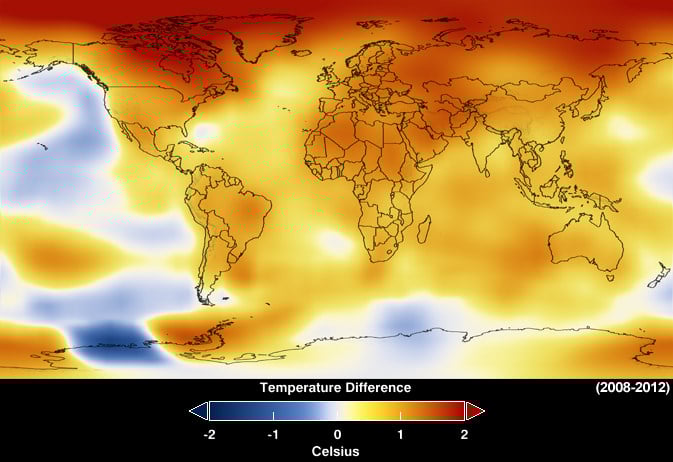
Scientists at the Lawrence Livermore National Laboratory have developed a detailed model of the Earth's climate over the next few centuries to answer the question... what if we burned all the fossil fuels by the year 2300. The answer, of course, isn't a pretty picture. In their model, global temperatures will rise 8-degrees Celsius (14.5 F), and melting polar caps will raise the oceans 7 metres (23 feet). The damage would be even worse in the polar regions, which could grow by 20-degrees C (68 F).
Continue reading
This photograph of Saturn's moon Dione was taken by Cassini on Sept. 20, 2005 from a distance of 2.1 million kilometers (1.3 million miles). The image shows the many canyons that crisscross the surface of the 1,126-kilometer (700-mile) moon, as well as its bright southern pole.
Continue reading
Time to revise your idea of Pluto. New images gathered by the Hubble Space Telescope have revealed that this distant planet could two additional moons. If this is true, Pluto will be the first Kuiper Belt Object found to have multiple moons. The candidate moons have been provisionally named S/2005 P1 and S/2005 P2, and are approximately 44,000 km (27,000 miles) away from Pluto.
Continue reading
Is science fiction an arena where fantasies run wild or an experimental lab where new technologies, cultures and even physics can be assessed? Afficionados of this genre more likely think the latter. But not long ago, science fiction stories and even rocketry were considered little more than a fool's occupation. One person bucked this trend. He is Jack Parsons and he is also the central figure in George Pendle's biography entitled
Strange Angel. From this we read how Parsons made believers of many people who ridiculed science and space travel.
Greetings, fellow SkyWatchers! We begin the week on the eve of All Hallows as we learn the significance the Pleiades. Come... Join in the fun as we as the night steals our souls and gives us X-ray eyes. We'll search for glowing bones, watch fireballs, look into the eyes of a "Demon", brave a supernovae and stare down the "God of War". Go outside under the stars, if you dare. Because...
Here's what's up!
Continue reading
Things haven't gone well for the student-built SSETI Express, launched last week from the Plesetsk Cosmodrome on board a Russian Kosmos 3M launcher. Ground controllers haven't been able to make contact with the satellite since Friday, and a preliminary analysis points towards a failure of the satellite's electrical system. Controllers have a plan that might be able to restore power to the satellite, but it will take a few more days to know if it's going to work.
Continue reading
When you're exploring new territories, all kinds of things can go wrong. When you're exploring millions of kilometres away from Earth in an environment totally hostile to human life, these risks get deadly. NASA's Mars Exploration Program Analysis Group has put together a list of top risks for human Mars explorers, including the dust and potential biohazards. But one of the biggest risks is the lack of water - it's absolutely essential for a long-duration visit to the Red Planet.
Continue reading
NASA's Spitzer Space Telescope took this chilling image of the Black Widow Nebula for Halloween. In this image, there are two gigantic bubbles of gas being formed in opposite directions by the powerful outflows of newborn massive stars. These baby stars can be seen as yellow specs where the bubbles overlap.
Continue reading
Workers at the University of Arizona Steward Observatory Mirror Lab have cast the first mirror for the Giant Magellan Telescope. By the time they're complete, the lab will cast a total of 7 of these enormous 8.4-metre (27-foot) mirrors, giving the enormous observatory the equivalent of a 22-metre aperture. The Giant Magellan Telescope will be constructed in Northern Chile by 2016.
Continue reading
Look east this weekend and you'll see a bright red star blazing in the night sky. That's not a star, it's Mars, and on the night of October 29, it'll reach its closest approach. And you don't need dark skies, a telescope, or any special knowledge. Just look East... you can't miss it. Don't worry if you're too busy this weekend, Mars will stay bold and bright for the next few weeks.
Continue reading
One of the hazards of human spaceflight is the radiation damage of solar storms and cosmic rays. But it turns out the different parts of the human body are more susceptible to radiation than others. Although the best protection would be to get under cover, like in a spacecraft, future spacesuits could have extra radiation protection for specific areas of the body, like the hips (to prevent bone marrow damage).
Continue reading
 Universe Today